Run one solo work block
- Step 1Name the result
- Step 2Choose a starting move and stop
- Step 3Write an honest closing note
When nobody else is waiting to see your work, accountability has to come from a small arrangement you make before you begin: one result you could show someone, the first action that starts it, a point where you stop, and a plain note afterwards about what happened. You do not need a boss, a co-working desk or a perfect schedule. You need the next session to be easy to start and easy to report on honestly.
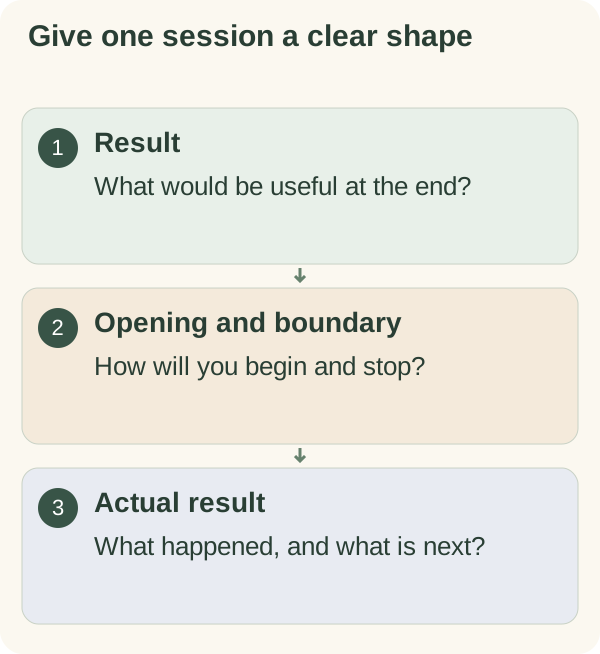
Most advice on this question suggests a fixed timetable, a project app or a shared workspace. Those can help, but they skip the moment that usually goes wrong: sitting down with an intention like "work on the website" and no way to tell, two hours later, whether the session counted. This guide stays with that single session.
You can use this exercise with a notebook, the free daily planner or a conversation in Telegram. You do not need to organize your entire working life first.
What disappears when there is no team around you
In a shared workplace, three things happen without anyone planning them. Someone expects a result by a certain time. Other people starting work makes it obvious when the day begins. And colleagues leaving, or a meeting starting, gives the work an end.
On your own, all three vanish. The task can stay the size of the whole project, the start can slide from nine to eleven without anyone noticing, and the session has no edge, so it either sprawls or never begins. The card in this guide replaces each missing piece with something you write down: a result, an opening move, a boundary and a report.
Pick a result you can see
Imagine an application you have been avoiding. An illustrative first session might be: open the form, find the supporting documents and note what is missing. That is a different task from finishing and submitting the application.
A useful test is whether you could describe the result to another person in one sentence, and whether they could tell at a glance if you had done it.
| Vague intention | A result one session can show |
|---|---|
| Work on the website | Rough text for the About page, saved in the site folder |
| Sort out the application | Form opened, documents gathered, missing items listed |
| Do some research | Three useful sources found, one line noted from each |
| Catch up on email | Replies sent to the four messages that need a decision |
Choose the result before choosing how long to work. A short session is useful only if the task can fit inside it. If you need someone else's answer first, make the next action drafting the question you need to send.
A small work-session card
- The result:
write one thing you would like to have at the end.
- The opening move:
choose the first physical or digital action.
- The boundary:
decide when you need to stop or reassess.
- The review:
record what moved forward and what needs another session.
Give the session a boundary
You can use a timer you already have. There is no required session length here. A five-minute opening and a longer focused session are different choices; pick the one that fits the work and your available time.
A boundary does not have to be a clock time. It can be an event ("until I leave for the school run"), a finished piece ("until the headings are drafted") or whichever comes first. Writing "whichever comes first" helps on days when the task turns out bigger than it looked.
The NHS guide to tackling a to-do list suggests trying a short period on an avoided activity. That is an option to experiment with, not a promise about what you will finish.
Decide who the report goes to
Accountability means someone or something receives your report. Solo workers often skip this step and then wonder why a plan written in the morning has no pull by lunchtime. Pick the lightest option that works for you.
| If your usual problem is... | A report arrangement to try |
|---|---|
| Not starting at all | A card on the desk with a stated start time, ticked when you open the file |
| Starting, then drifting | A check-in you set for the boundary time that asks what happened |
| Moving your own deadlines | Telling one person the result and when you will report back |
| Disliking being watched | Reporting only the outcome afterwards, with no live company |
If another person is involved, agree the details first. The guide on planning a focus session with an accountability partner covers formats and privacy for shared sessions.
Ask for accountability without handing over control
Try: "Help me choose one task for this session. Ask what I want to finish and when I need to stop." Review the suggestion. If a reminder would help, use the scheduled check-in guide to arrange an available follow-up deliberately.
A conversation starter does not automatically create a reminder or save a task. Follow the bot's actual confirmations. A focus plan records an intention; it does not prove that a work session happened.
Example: Alex's drifting mornings
An illustrative example (the person is made up): Alex translates documents from a desk in the spare room. Most mornings began with email and news, and real work started around eleven. Alex felt busy all day but could rarely say what a morning had produced.
Alex tried writing a card the evening before:
- Result: a first draft of pages one to three.
- Opening move: open the source file and the glossary side by side.
- Boundary: 11:00, or page three drafted, whichever came first.
- Report: one line in a notebook kept next to the keyboard.
Over the first week, three of four mornings produced the draft. On the fourth, the source file had not arrived, and Alex spent forty minutes waiting before giving up. Two things changed after that. Alex added a line to the card, "What could block this?", and moved the check for incoming files to the evening, when there was still time to choose a different result. Alex also stopped writing "failed" in the notebook and used the four plain outcomes below instead.
Close the loop yourself
At the end, write a plain result: finished, partly done, changed direction or did not start. If you got stuck waiting for information, record that obstacle instead of marking the work complete.
Date: ________
Result I aimed for: ______________________
What happened: finished / partly done / changed direction / did not start
What got in the way, if anything: ______________________
Next: another session / a question to ________ / a smaller action / a break
Choose what comes next: another session, a question to someone, a smaller action or a break. If this task is no longer the right priority, you can change it.
This is how Armored Kitten approaches planning in general: one honest, manageable session is a real step, even when the project is far from done. More guides built on that idea sit in the planning and reflection hub.
Try the daily planner, review focus-plan controls, or start with the illustrated exercise.
When nobody is waiting for the work at all
Some solo work has no client, manager or deadline: a portfolio, a course, a book draft, a side project. These are the hardest sessions to start, because skipping one costs nothing today.
- If the project has no deadline, give the session one instead: a date when you will show the result to someone or review it yourself.
- If you keep choosing the easiest piece, write the result before you open the task list, so the list cannot pick for you.
- If you have skipped three planned sessions in a row, make the result smaller rather than adding more sessions. The guide on shrinking a task when your energy is lower than expected shows how.
- If the hard part is feeling alone rather than unfocused, company may help more than a better card. Asking someone you trust is covered in how to ask a friend to be an accountability partner.
Leave a return note when the session changes
Before switching away, write the current state, the next opening action and any missing information. For an illustrative application, that might be: "The form is open at supporting documents. Find the proof-of-address requirement before adding files."
That note helps describe where to resume. It does not mean the application is ready, that the evidence has been checked or that the work has been completed. Keep private client, account or identity details in the appropriate secure system rather than copying them into a general planning conversation.
If another person's answer is needed, change the next action into a clear question. A session can end with useful preparation or a recognised dependency, even when the whole task remains unfinished.
Use the first card in the One-session work kit for your result, opening move, boundary and closing report.
Questions people often ask
How long should a solo work session be? There is no correct length. If you struggle to begin, a short opening helps. If you often stop just as the work gets going, try a longer block with a firm end.
Is a to-do list enough accountability? A list stores tasks. It does not say what counts as done for this session, when you will stop or who hears how it went. The card adds those three things.
What if I want someone to actually check on me? Ask a person directly, or request a check-in at a time you choose. Either way, you decide what is shared and you can change the arrangement.
Do I need to record every session? Only if you use the record. One line per session is enough to spot patterns, such as mornings that always start late.