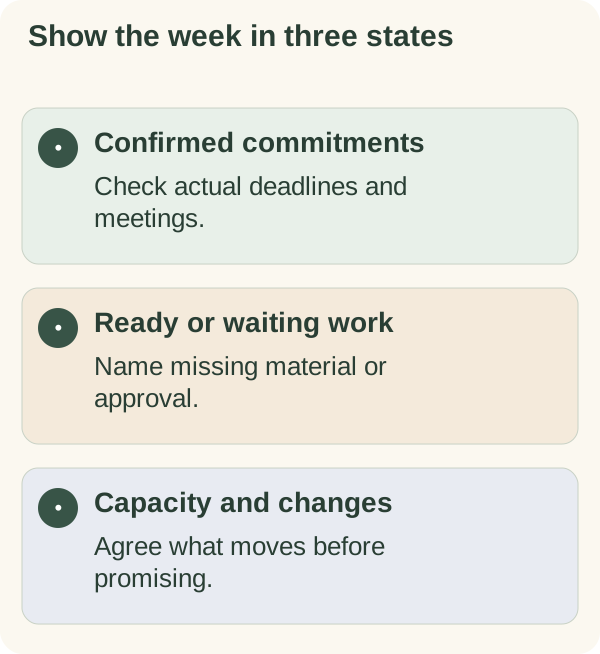
Build your freelance week around what is actually agreed, what is waiting on someone else and what time is genuinely free. Put those in three separate lanes, give admin its own slot, and keep one short review slot for client changes. When a request changes, check which other commitment it would push before you reply. Flexibility is useful only when you know how much of it is left.
Most freelance routine articles describe one person's ideal week: deep work in the morning, email after lunch, a firm stop at six. That is fine until a client moves a deadline on Tuesday. This page is about the part those schedules leave out: keeping the week workable when the plan changes after you made it.
Mark commitments and waiting work differently
Record confirmed deadlines, meetings and work needed to prepare for them. For each deliverable, check whether you have the brief, materials and approval needed to proceed. Work waiting on a client answer may need a question or follow-up instead of a production block.
Keep confidential client material in the systems appropriate to your agreements. A personal weekly outline can refer to a project without reproducing private briefs or access details.
Map the freelance week
- Commitments:
list agreed deadlines and meetings.
- Dependencies:
identify missing information or approval.
- Work blocks:
choose realistic openings for ready tasks.
- Admin:
give invoicing and other necessary operations their own place.
- Change:
choose a review point for new requests and revised priorities.
A three-lane week board to copy
Write this out on Monday morning, or on Friday afternoon for the week ahead. It fits on one page.
WEEK OF ________

COMMITTED (an agreed date, meeting or delivery)
- ________ for ________ due ________   Have brief? Y/N  Materials? Y/N  Approval? Y/N
- ________ for ________ due ________   Have brief? Y/N  Materials? Y/N  Approval? Y/N

WAITING ON SOMEONE
- ________ waiting for ________ from ________ since ________
  Follow up on: ________

READY BUT NOT YET PROMISED
- ________

ADMIN SLOT: ________ (day and time)
CHANGE REVIEW SLOT: ________ (day and time)
FLEXIBLE TIME STILL UNCLAIMED: about ________
The last line matters most. Every time you agree to something new, cross out the old number and write the new one. When it reaches zero, the next request needs something else to move.
Do not spend the same flexible block twice
An unallocated afternoon cannot simultaneously be the guaranteed backup for every client project. Decide how much you are prepared to commit before accepting more work. If a change conflicts with another agreement, communicate and renegotiate where needed.
An illustrative weekly note might say: "Draft the agreed section after the source material arrives; use the current opening to send the missing question and finish the ready admin task." That keeps progress tied to the actual state of the work.
Give new requests a decision path
Check scope, deadline, dependencies and your capacity before promising a delivery time. This article does not interpret contracts or determine prices. Use the terms and professional advice appropriate to your business.
Different changes need different checks:
| The change | Check first | A fair first reply |
|---|---|---|
| Deadline brought forward | Which committed item would lose its slot | Offer the new date with what moves, or a partial delivery |
| Deadline pushed back | Whether the freed time is truly free, or waiting on them | Confirm the new date; move a ready task into the gap |
| Extra work added | Whether it is inside what you agreed | Ask whether it replaces something or is additional |
| Feedback arrives late | Whether your next slot for that project has passed | Give the next realistic slot, not the earliest possible one |
| New client wants to start now | The unclaimed-time number on your board | Give a start date based on that number |
When you reply, name the trade so the client can choose. Two scripts you can adapt:
"Happy to do that. To fit it in this week, the ________ draft would move
from ________ to ________. Does that work, or would you prefer to keep
________ and have this next week?"

"Thanks for sending this. My week is already committed, so the earliest
I can start is ________. If it's urgent, tell me which part matters most
and I'll see whether that piece can come sooner."
When a request is accepted, update the plan and inform anyone whose expectation changes. Adding an urgent item without moving anything else may leave the conflict hidden.
Example: Maya's moved deadline
A fictional example, written to show the steps in practice. Maya is a freelance illustrator with three regular clients. Her week board on Monday showed two committed pieces, one job waiting for a client's reference photos and about six unclaimed hours.
On Tuesday, the first client asked for their piece two days early. Maya's old habit was to say yes immediately and work late. This time she checked the board in her change review slot. Bringing that piece forward would push into Thursday, which belonged to the second client. She replied with the first script: she could deliver early if the second client's draft moved to Monday, or keep both dates as agreed. The client chose to keep the original date.
The reference photos for the waiting job never arrived that week. Because that job was in the waiting lane, not the committed lane, Maya had not blocked Wednesday for it. She sent one follow-up and used the morning for the second client's piece instead. What she changed afterwards: the change review slot moved from Friday to Tuesday and Thursday, because Friday was too late to act on anything.
When two clients want the same afternoon
This is the moment most freelance schedules fall apart, and generic articles rarely cover it.
- If both deadlines are real and fixed, tell both clients early, before the clash, with what you can deliver to each and when. Asking late leaves them fewer choices.
- If one client is still waiting on their own approval, their block is not real yet. Hold the time loosely and give it to the ready project if their materials have not arrived by an agreed point.
- If one piece could be delivered in parts, offer a first part on the original date. Many clients prefer something on time to everything late.
- If you are unwell, tell affected clients as soon as you know, with what can move. Rest is not a planning failure, and if the illness is affecting your work for a while, talk to a doctor.
- If the week has no confirmed work at all, still use the board. Put portfolio pieces, outreach and admin in the ready lane, and avoid promising those hours to anyone in advance.
End the week with a state check
Note what is delivered, what is awaiting response and what needs a new agreement. A task is not necessarily accepted or complete merely because you sent a draft.
A short Friday check also catches the admin lane. Sending invoices, filing receipts or replying to enquiries belongs in a slot of its own, not squeezed into evenings. For tax, accounting or contract questions, use official guidance or a qualified adviser; a weekly routine only gives those jobs a time.
Planning one freelance week at a time, and treating each change as one decision rather than a crisis, is the same small-step promise behind Armored Kitten's guides to planning your days.
Use working alone accountability to prepare one clear work session. The weekly review template can hold the broader check before you plan an overwhelming day. If you prefer to fill something in on screen, the free weekly review worksheet works without an account.
Use the working-week card in the One-session work kit for confirmed work, dependencies, capacity conflicts and agreements that need updating.
Questions people often ask
How much of my week should I leave unclaimed? That depends on how often your clients change plans. Look back at the last few weeks: if changes landed most weeks, keep more time unclaimed. The board's last line will show you whether the amount you leave is enough.
Should I block the same days for the same clients every week? It can help if their work arrives predictably. If it does not, plan by what is ready rather than by client name.
What if a client keeps changing things at the last minute? Keep replying with the trade, so each change has a visible cost. If the pattern continues, raise it in a calm conversation about how you work together.
Where should invoicing go? In the admin slot, on the same day each week if you can. The routine only gives it a time; questions about tax or payment terms need official guidance or a qualified adviser.