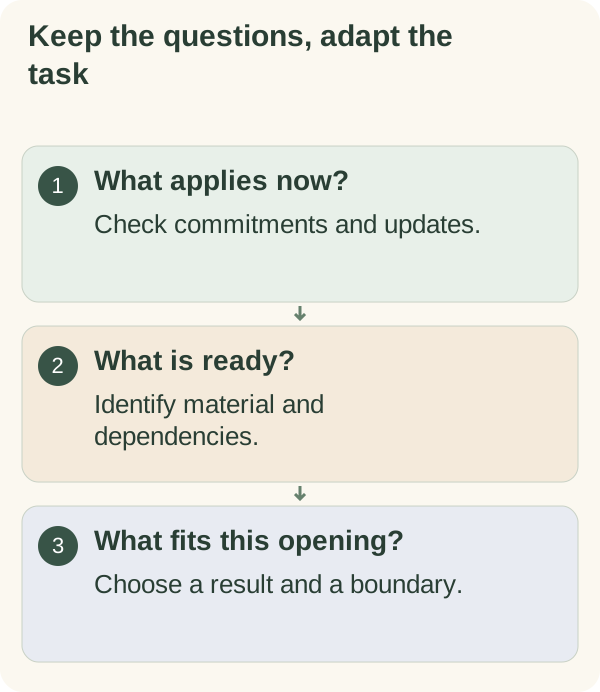
If your workdays never repeat, make the routine a set of questions rather than a set of times. Each time work begins, ask the same things in the same order: what is required now, what is ready, what result fits the time I have, what is the first move and where do I stop. The answers change every day. The habit of asking them is what stays steady.
Advice on routines often assumes the same start time and the same desk every day. If you work across sites, take shifts that change weekly, travel for clients or simply have a calendar that looks different each morning, that advice ends with a routine you break by Wednesday. A question-based routine travels with you.
Why fixed-time routines break on variable days
A routine like "deep work from 8 to 10" depends on 8 to 10 being free. When it is not, the routine does not shrink to fit. It just fails, and a failed routine is easy to abandon altogether.
A routine built on questions has nothing to fail. If the day begins at 7 on site, you ask the questions at 7 on site. If it begins at 1 after a morning of appointments, you ask them at 1. It takes a few minutes, works with whatever tools you have in that setting, and gives every day the same kind of start even when nothing else matches.
Check today's state before yesterday's list
Look at confirmed deadlines, meetings and any updates from people you work with. Work may have changed while you were away. An old next-action note is useful context, but it does not prove that the same action still comes first.
Follow the access, security and availability arrangements that apply to your work. A personal routine should fit those requirements rather than silently replace them.
Open a variable workday
- Commitments:
identify the requirements that apply now.
- State:
check current files, updates and dependencies.
- Result:
choose one useful outcome for the available opening.
- First move:
name the action that begins it.
- Boundary:
decide when to stop, hand over or reassess.
Match the first result to the kind of day
The five questions stay the same. What changes is how big an answer to question three can be.
| Kind of day | What the first result looks like | Where the opening happens |
|---|---|---|
| One long free block | A substantial piece: a full draft, a complete analysis | At the desk, before checking messages if your role allows |
| Broken into short gaps | Pieces that can stop cleanly: one section, one set of replies | In the first gap, using the card on your phone or in a notebook |
| On the move or on site | Preparation and capture: notes, photos, questions to follow up | On arrival, or in the vehicle or waiting area before starting |
| Disrupted from the start | Only what is required today, plus a note of what moved | As soon as the urgent item is handled, not before |
If you cannot tell what kind of day it is yet, treat it as a broken-up day. Small results are easy to extend if a long block appears; big results are hard to cut down halfway.
Make the opening work in more than one setting
You might perform the check before a long work block, between meetings or when a confirmed shift begins. Do not require a particular desk arrangement if your role rarely provides one. Use the approved tools and information available in the actual setting.
For example: "The required source has not arrived. Send the missing question, then use the opening for the ready review task." That is a current-state decision, not a failure to follow the original order.
It helps to keep the questions somewhere you will have them everywhere. A note on your phone works; so does a card in a wallet or bag.
OPENING CARD
1. What is required today, as of now?
2. What is ready, and what is waiting on someone?
3. What one result fits the time I really have?
4. First move: ________
5. I stop or reassess at: ________
Example: Daniel's week across three settings
A fictional example, written to show the steps in practice. Daniel inspects buildings for a small firm. Two days a week he is on site, two he works from home writing reports, and one is mostly calls. He had tried a morning routine of report writing from eight to ten, and it lasted only on home days.
He switched to the opening card. On a site day, he answered it in the car park: required, the inspection at nine; ready, the checklist; result, photos and notes for both floors; stop, when the site closes. On a home day, the result was a finished report. On the call day, it was two report sections between calls.
The first week, the card felt like overkill on home days, when the plan was obvious. What he changed was small: on home days he answered only questions three and five. On the other days he kept all five, because those were the days when yesterday's plan was most often wrong.
When you only find out the plan on arrival
Some roles hand you the day's work when you get there, or change it at midday. Generic routine advice does not cover this at all.
- If the plan arrives when you do, keep your opening to the questions you can answer in advance: what is still open from last time, and what you need to ask about first.
- If the plan changes at midday, run the card again. A second opening is not a sign that the first one failed.
- If your hours themselves keep shifting, the guide on adjusting a routine when your working hours change covers the rest of the day around them.
- If you are often away from a kitchen at lunch, a little preparation the evening before saves one more decision on a busy day. See preparing tomorrow's lunch without a big meal-prep session.
Avoid planning the same gap twice
If several tasks rely on the only unallocated opening, choose which can realistically fit. Negotiate expectations or seek help when required. A routine cannot create additional capacity by relabelling the tasks.
Leave the next session a clear handoff
Record the state, location and next action when stopping. Keep confidential details with the work rather than copying them into a general habit note.
On variable schedules the handoff matters more than usual, because the next session may happen in a different place, with different tools and possibly after several days. Write it for that version of you: where the material is, what you had just done, and what you would check first.
A routine that bends to the day instead of breaking against it is what Armored Kitten means by one manageable step at a time; you can find more of that approach in the planning and reflection guides.
Use focus when working alone to prepare a bounded session. The daily planner can help compare the changing requirements before you choose the first move.
Use the first session card in the One-session work kit after checking the current commitments and work state.
Questions people often ask
Is it still a routine if the times change every day? Yes. The repeated part is the sequence of decisions at the start. That gives you the same predictable beginning a fixed timetable promises, without depending on the timetable.
How long should the opening take? A few minutes is usually enough. If it regularly takes longer, the card is probably asking for too much detail.
What if my employer sets the plan for me? Then the card helps with the parts you control: which assigned task you start with, what you need to ask and where you leave your notes.
Should I plan the whole week on variable schedules? Plan the commitments for the week, but choose each day's first result on the day. That keeps the plan honest when things move.