Make tomorrow's lunch decision while you clear up after dinner, not in the morning rush. Check what the place you will eat has (a fridge, a microwave or nothing), choose a lunch that suits it, and do the one step tonight that saves the most time, such as putting leftovers in a container. Then leave a note on your bag or keys that says what to take from the fridge. That is a full lunch routine, without a Sunday spent cooking.
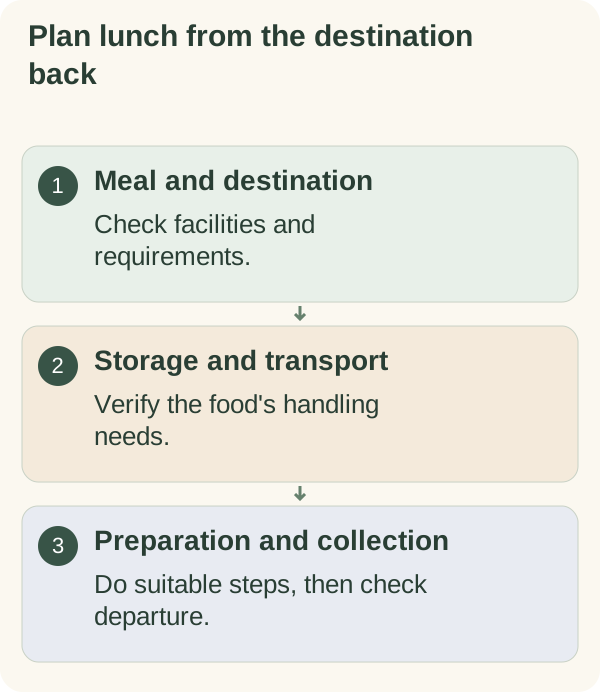
Most lunch-prep advice is either a full Sunday batch-cooking session or a list of lunchbox recipes. Neither helps much if you just want tomorrow sorted tonight. The night-before version is smaller: one decision, one step, one reminder.
Start with where you will eat tomorrow
The right lunch depends less on what you fancy and more on where it will spend the morning. Check tomorrow's facilities first. If you are not sure whether the site, client office or venue has a fridge, assume it does not.
| Tomorrow's setup | Lunches that tend to suit it | What to check |
|---|---|---|
| Fridge and microwave | Leftovers to reheat, soup, dishes that need warming | Reheating guidance for that food; whether the fridge is shared and labelled |
| Fridge, no microwave | Things eaten cold: salads, wraps, sandwiches, cold leftovers that suit it | Space in the fridge; how long the commute is before it goes in |
| No fridge, insulated bag with a cold pack | Foods that need cooling for a few hours, packed straight from the fridge | Storage guidance for how long that food can stay out of a fridge |
| No facilities at all, long day | Food that does not need chilling, plus something to buy as a fallback | Whether there is anywhere to buy food nearby |
| Eating on the move | Food you can eat in one hand without a table | Packaging that will survive a bag |
How long food can safely sit out of the fridge, and how to reheat it, depends on the food. The FoodSafety.gov food-safety guidance and the charts linked from it set those limits. Convenience does not make an unsuitable storage or transport arrangement acceptable.
If you have allergies, a medical diet or are pregnant, your lunch choices should follow advice from your doctor, midwife or a registered dietitian. This guide covers the timing and logistics, not what you should eat.
The ten-minute evening version
The best moment is when the kitchen is already in use: just after dinner, before you wash up.
Sort tomorrow's lunch after dinner
- Check tomorrow.
Where will you be at lunchtime, and what does that place have?
- Choose the lunch.
Leftovers if they suit tomorrow's setup; otherwise something from the lunch shelf.
- Do one step.
Put food in a container, wash fruit or pack the parts that do not need the fridge.
- Store it properly.
Into the fridge straight away if it needs chilling, with the lid on.
- Leave the note.
A note on your bag, keys or the door handle: "lunch, top shelf of the fridge".
If ten minutes is too long tonight, do step five only and choose the lunch in the morning. The note is the step that most often saves the day.
Leftovers: decide while you serve dinner
The simplest lunch is one extra helping of tonight's dinner. Decide before you serve whether there will be leftovers for tomorrow, so that they are set aside rather than eaten as seconds. Put them into a lunch container while you clear up, let them cool as the storage guidance for that food says, and get them into the fridge.
If you plan meals for the week, you can build this in from the start. The free meal planner has an option to use dinner leftovers for the next day's lunch, so the plan and the grocery list account for it.
A small "lunch shelf" in the cupboard helps on evenings without leftovers. Keep a few things there that need no cooking, such as crackers, tins or a pack of wraps, so choosing a lunch takes seconds.
In the morning: collect, do not prepare
The night-before routine only works if the lunch leaves the house. Resist the urge to move the food out of the fridge and next to your bag overnight so you will not forget it. Leave it in the fridge and let the note do the reminding. If you are out of the door before anyone else is up, put the note somewhere you must touch: the keys, the bag strap or the door handle.
Example: Sam on a site with a shared fridge
Illustrative example only; this is not a real person's story. Sam works on a building site some weeks and in an office others. Lunch was usually bought on the way in, partly because the site fridge was shared and often full, and partly because mornings were rushed.
Sam tried a full Sunday prep for a fortnight. The containers did not fit the site fridge, and by Wednesday the food no longer appealed. Sam dropped it and tried the evening version instead.
On site weeks Sam now checks the night before whether there will be room in the fridge. If the answer is "probably not", Sam packs food that does not need chilling and adds a cold pack to an insulated bag for anything that does, following the storage guidance. On office weeks, where there is a microwave, Sam takes dinner leftovers. The change that made it stick was an old luggage tag on the bag strap that reads "lunch in fridge?". Sam forgot lunch twice in the first week and not at all in the third.
A lunch note and lunch shelf you can copy
Print or copy these. The note goes where you will see it on the way out; the shelf list stays in the cupboard.
TOMORROW'S LUNCH
Where I'll eat: ____________
Fridge: yes / no    Microwave: yes / no
Lunch: ____________________
It's in: fridge top shelf / bag / cupboard
Take as well: cold pack / cutlery / container lid
Backup if I forget: buy at ____________
LUNCH SHELF (no cooking needed, check dates monthly)
- ______________
- ______________
- ______________
Refill when one runs out: add to the grocery list
When the evening plan falls through
Lunch routines usually fail in a few predictable ways. Here is what to do in each.
- If you are too tired after dinner, do the note only. In the morning, take something from the lunch shelf. Two minutes is still a plan.
- If you forget the lunch in the fridge, leave it there and buy lunch that day. When you get home, check the food against its storage guidance before deciding whether it can be tomorrow's lunch instead.
- If you find it was left out of the fridge overnight, follow the food-safety guidance for that food rather than guessing. When in doubt, throw it out.
- If you start very early or work nights, shift the routine to the end of your main meal, whenever that is, and put the note where you will see it before your shift.
- If someone else packs lunches for the household, agree who prepares, who stores and who checks the bags in the morning, so an unspoken handoff does not leave a lunch behind.
- If the shared fridge at work is a problem, label your container with your name and the date, and keep any allergy information on the label if others might handle it.
Keep it as small as it needs to be
After a week or two, notice which part of the routine actually helped. For many people it is just the note, or just the habit of setting leftovers aside. Keep that part and drop the rest. If tonight is already full, the smaller-plan guide can help you leave the lunch to tomorrow morning without guilt.
To fold lunch into a short evening routine, wind down for the evening helps you choose the one thing to prepare for tomorrow. Use the food-decision card in the routine worksheet to name what needs checking, then follow the real handling instructions for the food.
Ten minutes on tomorrow's lunch is the kind of small, repeatable step the habits and goals path is built around: a kinder morning for yourself, decided the evening before.
Questions people often ask
Is the night before really better than the morning? For most people, yes, because the kitchen is already in use and the morning is the most rushed part of the day. If your evenings are worse than your mornings, swap it round.
Do I need special containers? No. You need something with a lid that fits tomorrow's fridge or bag. Add an insulated bag and a cold pack only if tomorrow has no fridge.
What if I get bored of leftovers? Keep the lunch shelf varied, and alternate leftover days with shelf days. The routine is the evening decision, not the food.
How do I stop forgetting it in the fridge? Put the reminder on something you must pick up to leave, such as your keys or bag, rather than on the fridge door.