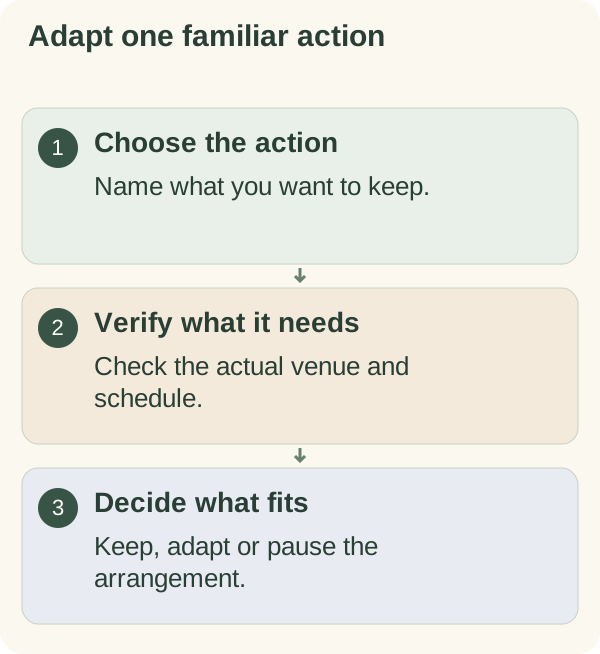
Pick the one routine you most want to keep and plan a travel version of it before you leave. Find out what the hotel, venue and agenda actually allow, decide what the smallest useful version looks like on a long workday, and leave the arrival day unplanned until you know when the work ends. The other routines can pause for the trip on purpose, which is different from dropping them.
Most business-travel advice is a long list: exercise in your room, eat well, sleep more, drink less at the client dinner. On a trip where your hours belong to someone else, a list like that mostly produces guilt. Keeping one familiar thing going is more realistic, and it is often enough to make the return home easier.
Choose one routine to carry and pause the rest
Look at the routines you keep at home and choose the one that would make the trip feel most like your normal life. For some people that is a morning walk; for others it is a phone-free half hour before bed or a proper lunch away from the laptop. Then decide what the others do while you are away. "Paused until I'm home" is a decision; quietly missing them is not.
Each routine has a purpose and a setting. The setting rarely travels, but the purpose often can.
| Home routine | What it does for you | A travel version | Pause it if |
|---|---|---|---|
| Morning walk around the park | Fresh air and a slow start | A walk around the block near the hotel, or the long way to the venue | The first session starts before it is light or the area is unfamiliar after dark |
| Reading before bed | Winding down without a screen | A few pages on the plane or in the room | Evening events run late every night |
| Cooking dinner | Eating something you chose | Choosing one meal a day yourself instead of eating whatever is passed round | Every meal is provided by the event |
| Gym visits | Keeping the habit alive | One visit to the hotel gym, if it has one and the hours fit | The schedule has no gap at all |
| A weekly call home | Staying connected | A shorter call at a time that suits both time zones | You are crossing many time zones in a few days |
Medicines are not an optional routine. If you take regular medication, keep taking it as prescribed, and if you are changing time zones ask your pharmacist or doctor how to adjust the timing.
Check what the trip actually allows before you pack
A routine that depends on a hotel pool, a quiet room or a fridge falls apart if you find out on arrival that none of them exist. Spend ten minutes before the trip finding out.
Plan the travel version before you leave
- Name the anchor.
Write the one routine you want to keep.
- Write its purpose.
One line on what it does for you, such as "a slow start before a long day".
- Check the destination.
Ask the hotel or look at its page for opening hours, facilities and whether there is a fridge in the room.
- Read the agenda.
Note the earliest start, the latest finish, the travel days and any group dinners.
- Find one slot.
Mark the most likely place for the travel version, plus a second choice.
- Pack for it.
Put in the one item the travel version needs, such as walking shoes or a book.
- Set the pause rule.
Decide in advance what makes you skip it, so skipping is part of the plan.
Leave the arrival day open
Delays, a late check-in or a colleague who suggests dinner can change the first evening completely. Do not plan the routine for it. A useful note is: "After I check in, look at tomorrow's start time, then decide whether tonight has room." If it does, good. If not, the first full day is the real start.
The same applies to the travel day home. Assume it has no room, and anything that fits is a bonus.
Example: Sam's three-day conference
A fictional example, written to show the steps in practice. Sam has a short morning walk most days at home and was heading to a three-day conference in another city, with sessions starting early and a team dinner every evening.
On previous trips Sam had planned to keep everything going: walking, reading, choosing every meal and getting early nights. None of it happened, and the week after felt like starting from nothing.
This time Sam picked the walk as the anchor and paused the rest. Before leaving, Sam checked the conference agenda (first session at nine), looked at a map of the area around the hotel and packed walking shoes. The arrival day was left open, and it was just as well: the train was delayed and check-in was late.
On the two full days Sam took the long way from the hotel to the venue, about the same length as the walk at home. On the last morning the venue changed, so Sam skipped it as the pause rule said. Back home, Sam walked on the first ordinary morning and picked the other routines up over the following days. The change Sam kept for next time was checking the agenda's first start time before deciding where the walk could go.
A trip card you can copy
Fill this in the evening before you travel, and keep it on your phone or in your bag.
TRIP: __________  Dates: __________

Anchor routine: ______________________
What it does for me: __________________
Travel version: _______________________

Paused until I'm home: ________________

Earliest start: ______  Latest finish: ______
Group meals or evening events: __________________

Best slot for the travel version: ______________
Second choice: ______________

Item to pack for it: __________________
I skip it when: _______________________

Arrival day: open. Decide after check-in.
First ordinary day home: __________
When the trip is not really yours to plan
Much travel advice assumes you control your own hours. Many work trips do not work like that.
- If someone else sets the agenda, ask for it in advance, or at least the start and finish times. Plan the travel version around those two facts and nothing else.
- If there is a group dinner every night, move your anchor to the morning, or choose a routine that happens on the journey, such as reading on the train.
- If you are sharing a room with a colleague, pick a routine that does not depend on privacy or quiet, or do it outside the room.
- If you travel every week, stop treating each trip as an exception. Give the routine a permanent home version and a permanent road version, and switch between them without replanning.
- If the trip is extended at short notice, keep the anchor and do not try to restart the paused routines on the road. Write a new date for the first ordinary day home.
- If you are crossing time zones, keep the first day after arrival and the first day home free of routine plans, and follow professional advice for anything to do with medication or health conditions.
Food and activity on the road
Hotel breakfasts, conference lunches and late dinners make it tempting to set rules for what to eat or how much to move. Keep food and activity decisions within the guidance that already applies to you. If you follow a medical diet, have allergies or have been given activity advice for a health condition, check what the venue can provide before you go and ask the person who gave you that advice if you are unsure. This guide covers how to fit a familiar routine into a trip. It does not evaluate diets, prescribe exercise or promise a health result from keeping a routine while away.
Coming home without a backlog
The trip did not create a debt. On the first ordinary day home, do the anchor routine in its usual form, then restart one paused routine at a time over the next few days. Write down one lesson from the trip for next time, such as "check the first start time", and let the rest go.
If several days went missing, restart after missing days with the next suitable opportunity rather than doubling up. To choose or reshape the anchor before your next trip, use build a small routine. The action and availability cards in the routine worksheet let you check one travel-day option without carrying your whole home timetable with you.
A trip is a good test of the idea behind the habits and goals path: keep one manageable thing going for yourself when the rest of the week is out of your hands. For the night before you leave, the travel-night checklist covers the packing and the early start.
Questions people often ask
Should I try to keep every routine going while I travel? Usually not. Pick one that matters most and pause the others on purpose. One familiar routine kept is more useful than five attempted and dropped.
What if the hotel has no gym or the area is not good for walking? Choose a different anchor, such as reading, a call home or a short wind-down before bed. The purpose matters more than the activity.
How do I restart when I get home? Do the anchor routine on the first ordinary day, then bring the paused ones back one at a time. There is nothing to make up.
Is it worth planning a routine for a one-night trip? Probably not. For very short trips, a pause from the evening you leave to the morning you are back is a perfectly good plan.