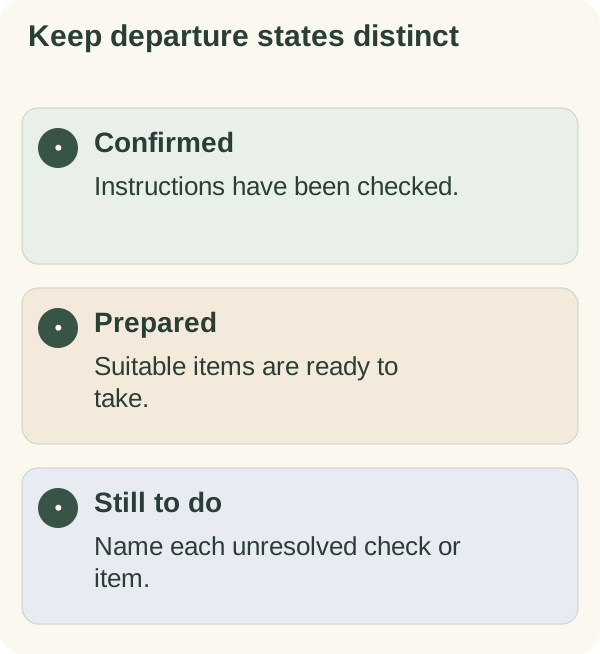
The night before you travel, sort every remaining job into three groups: things you have confirmed at the source, things already packed, and things you will pick up on the way out. Check the booking, the route to the departure point and any document requirements tonight, while there is still time to fix a problem. Then stop packing and leave one clear first move for the morning.
Why the last evening matters more than the packing list
Most travel checklists are long packing lists: chargers, toiletries, adaptors, snacks. They help, but the problems that actually spoil a departure are usually different. A changed departure time. A booking for the wrong date. A passport in a drawer at someone else's house. A taxi that was "probably" booked. These are checking problems, not packing problems, and the night before is the last calm moment to catch them.
So this checklist is mostly about checking. Packing gets one line.
Three columns: confirmed, packed, collect
The core of the evening is one card with three columns. Every item lives in exactly one of them.
| Confirmed (checked at the source tonight) | Packed (in the bag now) | Collect at the door (cannot pack yet) |
|---|---|---|
| Departure time and place on the current booking | Clothes and toiletries | Phone and charger |
| How you reach the departure point, and when | Travel adaptor if needed | Anything kept in the fridge |
| Document and entry requirements for this trip | Printed copies you chose to bring | Medicines kept in their usual storage |
| Baggage allowance on the current booking | Snacks for the journey | Keys, wallet, ID |
The rule is strict on purpose. An item moves to "confirmed" only when you have looked at the source tonight, and it moves to "packed" only when it is in the bag. "I'm sure the train is at 7:40" stays in the first column until you have opened the booking.
What to check, and where
Make a departure-night card
- Journey:
open the current booking and confirm date, time, departure point and any check-in or arrival deadline.
- Documents:
check the requirements for this trip with the relevant official source and the provider, then put the originals where you will collect them.
- Luggage:
compare your bags with the allowance shown on your booking, not a general rule.
- Collect:
list everything that must stay in its usual place until you leave.
- First move:
write the first morning action and the confirmed way you are getting to the departure point.
Check booking details in the provider's own email, app or website. Check passport, visa and entry rules with the official government source for your destination and with your carrier. This page cannot tell you what a particular trip requires, and those rules can change.
If two sources disagree, for example the booking email and the app show different times, treat the item as unconfirmed and contact the provider tonight if you can. A reminder to leave cannot fix a wrong terminal or a missing document.
Copy this travel-night card
TRAVEL NIGHT            trip: ____________

CONFIRMED tonight (source checked)
[ ] Departure: ______ at ______ from ______
[ ] Getting there: ______ leaving at ______
[ ] Documents needed: ______ (checked at ______)
[ ] Bag allowance: ______

PACKED
[ ] ______  [ ] ______  [ ] ______

COLLECT AT THE DOOR
[ ] ______  [ ] ______  [ ] ______

STILL UNRESOLVED (do not tick)
- ______________________

Morning first move: ______________________
The "still unresolved" box is the most useful part. If something cannot be checked tonight, write it there with the time you will check it. A visible open item is safer than a hopeful tick.
Example: Maya's early train to a family wedding
Illustrative example only; this is not a real person's story. Maya was taking an early train to her cousin's wedding, travelling with her brother Sam, who was driving them both to the station. At 9 p.m. she had a packed suitcase and a vague sense that everything was done.
Filling in the card showed three gaps:
- The time: she had remembered 7:40, but the booking said 7:14. She moved the station departure earlier and texted Sam the corrected time.
- The lift: Sam had said "I'll take you", but they had never agreed a pickup time. She asked, and he replied with one.
- The outfit: it was hanging in the wardrobe so it would not crease. It went in the "collect at the door" column, and she hung it on the front door handle.
She put her phone charger on the door list too. After the trip, she changed one thing for next time: she now fills in the "confirmed" column two evenings before travel, so a wrong time has a full day to be fixed.
Sharing the trip with someone else
When two or more people travel, the risky phrase is "I thought you had it". Before bed, agree out loud:
- who carries each person's documents;
- who has the booking on their phone;
- who is responsible for shared items such as chargers or a first-aid kit;
- what happens if one of you is running late.
If someone at home is looking after a pet, plants or a relative while you are away, confirm the arrangement with them directly tonight. A note on the fridge is not an agreement.
If the plan changes after you have gone to bed
Overnight changes do happen, and most lists never mention them. A few if/then rules make them less stressful:
- If your provider sends delay or change messages, decide tonight whether you will check them when you wake or leave alerts on for that one app. The notification review guide explains how to keep one app's alerts while quieting others.
- If your lift falls through, have a backup written on the card: a taxi number, a bus time or a person who could step in.
- If you wake late, go straight to the "collect at the door" column. Everything in "packed" is already done.
- If you are travelling with children or someone who needs extra help, pack their essentials in a bag you can grab first, and agree who looks after them during the morning rush.
Stop when the essentials are ready
Once the confirmed column is filled and the bags are packed, the evening's work is done. Repacking to save a little space or rearrange a wash bag tends to eat the time you wanted for rest, and it can move items whose location you already knew.
If a new worry appears, ask whether it needs action now or can go on the card. Most belong on the card.
Store passports and personal documents securely. Your checklist does not need document numbers or photos of private records; "passport, blue folder" is enough.
Tools for travel night
A trip feels smaller when it is a handful of checked items and one morning move, which is how Armored Kitten approaches any busy day: one manageable step, then the next. The planning and reflection hub collects more guides like this.
Use wind down for the evening to choose a final preparation action. The daily planner can help compare departure arrangements with any other commitments on the travel day.
Use the departure card in the Morning and evening preparation cards for the confirmed journey and final collection action; keep private documents stored securely.
Questions people often ask
What should I do the night before a flight or train? Confirm the booking details at the source, check document and baggage rules, pack, list what you will collect at the door and write your first morning move.
Should I pack everything the night before? Pack what can be packed. Things that need their usual storage, such as chilled food, medicines or a phone on charge, go on the door list instead.
Do I need to print my tickets? It depends on the provider. Check what your booking says and decide whether you want a backup copy.
How do I stop lying awake thinking I forgot something? Write the worry in the "still unresolved" box with a time to check it. Then it has a place to wait.