Close the day
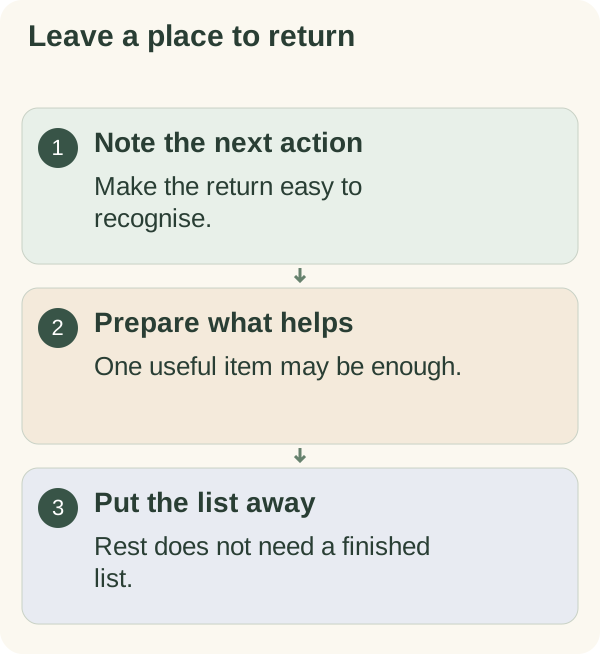
- Step 1Park a loose task
- Step 2Name tomorrow’s first move
- Step 3Set out one useful item
A simple evening wind-down checklist has four lines: park what is unfinished, write the first action for tomorrow, prepare one thing you will need, and decide when the list goes away. That is the whole job. It takes a few minutes, it does not require every task to be done, and on a hard night you can do only the first line or none at all.
This page is about closing your task list for the day. It is a planning habit, not a sleep treatment, and it works the same whether you go to bed at nine or two in the morning.
What the checklist is for, and what it is not
Most wind-down advice is about the hour before bed: dim lights, a book, a warm drink. Those can be pleasant, but they skip the thing that keeps many people busy until late, which is a to-do list that never got a proper ending. You put the laptop away, then remember the form you did not send, then start tidying "while you think of it".
The checklist below closes that loop. It gives every unfinished task a place to wait and gives tomorrow a clear starting point. What you do with the rest of your evening is up to you.
It is also not a test. If you skip it, nothing is broken. A routine that only works when you complete it perfectly tends to be dropped in the first busy week.
An optional closing checklist
- Park it:
write every unfinished task in one notebook, planner or note. One place, not three.
- Pick the opener:
choose the task tomorrow starts with and write its first physical action.
- Prepare one thing:
set out the item, file or bag that first action needs.
- Check the interruptions:
look at any message or reminder settings you want to change tonight.
- Close the list:
decide when it goes away, then put it away.
Write an opener you could start half awake
The most useful line on the card is the first action. Vague tasks are hard to begin because they hide a decision. "Sort out the car insurance" makes you work out where to start before you can start. A good opener has a verb, an object and, where possible, a place.
| Vague task | Opener you can recognise tomorrow |
|---|---|
| Finish the report | Open the outline and add the delivery dates to section two |
| Deal with the bank | Find last month's statement and circle the charge to ask about |
| Plan the birthday | Text Alex to ask which Saturday works |
| Clear the inbox | Reply to the two flagged messages, nothing else |
If the task depends on someone else, the opener is the question you need to ask, not the work you cannot yet do. "Wait for the quote" becomes "Email the plumber asking when the quote will arrive."
Prepare one thing, then stop preparing
Preparation is where an evening checklist tends to grow. Setting out a book becomes clearing the desk, which becomes tidying the room, which becomes planning the week's meals. Each step seems sensible on its own. Together they turn a short close into a second shift.
Ask one question: what does tomorrow's first action need within reach? For a morning study session, that might be the book and a pen on the table. For an early appointment, it might be the confirmation email starred and the papers in the bag. Everything else goes on the parked list or nowhere.
If you notice yourself adding chores to the checklist itself, move them to a separate list and keep the close short.
Copy this evening card
Write it on paper, paste it into a note, or print the first card in the Morning and evening preparation cards.
EVENING CARD            date: ________

Parked (needs another day):
  - ______________________
  - ______________________

Tomorrow starts with:
  ______________________  (first physical action)

Ready for it:
  ______________________  (one item, file or bag)

Can wait (not tomorrow's job):
  ______________________

List goes away at: ______  or after: ______
Leave lines blank if they do not apply. A card with only "Tomorrow starts with" filled in has done its main job.
Example: Sam's quick reset that took an hour
A fictional example, written to show the steps in practice. Sam works morning shifts at a library three days a week and has two children at primary school. Every evening after the children's bedtime, Sam did what was meant to be a quick reset: iron tomorrow's clothes, tidy the kitchen, pack lunches, check the school app, sort the post, plan the rest of the week. It regularly took more than an hour, and Sam often went to bed feeling the day had never ended.
Sam tried the four-line card for two weeks:
- Parked: the post, the week plan and a half-finished form went onto the card instead of being dealt with that night.
- Opener: "Leave at 8:10, library keys in coat pocket" on work days; "Call the dentist at 9" on days off.
- Prepared: one thing only, usually the work bag by the door.
- Closed: the card went on the fridge and the kitchen light went off.
What changed was smaller than Sam expected. Lunches stayed in the evening, because mornings were tighter. Ironing moved to Sunday afternoon. The week plan moved to a short Sunday review instead of being rebuilt every night. On two tired evenings Sam wrote only the opener, and that still counted.
When your evening has no clear end
Most checklists assume a tidy evening that finishes at a fixed time. Plenty of evenings do not. Some concrete options:
- If your evening ends whenever a child finally sleeps, do the close earlier, at a natural pause such as after dinner, and let it cover the day up to then.
- If you share a room or desk, keep the card in a bag or drawer so the close does not depend on a tidy shared space.
- If you work or study late, run the close straight after the last task rather than right before bed. The guide to an evening routine when you work late covers this in more depth.
- If something new lands after you have closed the list, write it on the parked line and leave the rest alone. One added line does not reopen the whole plan.
- If you are too tired to write, say tomorrow's opener out loud or put the item you need on top of your bag.
Three sizes for different nights
| Night | What you do | Roughly |
|---|---|---|
| Ordinary | All four lines on the card | A few minutes |
| Busy or late | Opener and one prepared item | A minute or two |
| Hard or unwell | Nothing, or only the opener | As little as you like |
No size is the "real" one. If the short version becomes your normal, that is a sign the full card was longer than you needed.
Messages and reminders are a separate decision
Closing your list does not change what your phone or apps will send you. If you use the Armored Kitten companion, it has its own message controls and separate calendar reminders. Check their current settings directly rather than assuming that ending the day pauses them.
If you ask the companion for an evening checklist in chat, review what it suggests before saving anything. Reading this page cannot change your preferences or schedule a message.
Rest and sleep
The NHLBI's healthy sleep habits guidance discusses making time for sleep and a quieter period before bed. This checklist is an everyday planning exercise. It does not diagnose a sleep problem or promise better sleep. If you often struggle to sleep, or worry keeps you awake most nights, speak to a doctor or another suitably qualified professional.
Tools that help with the close
Closing the day this way is one of the small, repeatable steps Armored Kitten is built around: you only need to know where tomorrow begins, not have all of it solved. More pages on planning a real week are on the planning and reflection hub.
Write down tomorrow's first step in the printable daily planner and leave the rest blank if you like. Read the daily planning guide for the morning side of the same habit, or try the illustrated evening exercise to see the steps worked through.
Questions people often ask
How long should an evening wind-down checklist take? A few minutes on an ordinary night. If it regularly takes longer, cut the preparation line first.
Should I plan all of tomorrow before bed? No. The opener is enough. Plan the rest when you start, with tomorrow's information in front of you.
What if I keep thinking of tasks after I have closed the list? Keep the card nearby and add a line to the parked section. Leave sorting and planning until the morning.
Can I skip the checklist some nights? Yes. Resting does not depend on completing a routine.