If you work late, build your evening routine backwards from the time you actually get through the door, not the time your shift officially ends. Count the handover and the journey first. Then keep the routine to a few essentials, usually something to eat, one thing ready for your next commitment and a clear end to work, and move everything else to a day with more room.
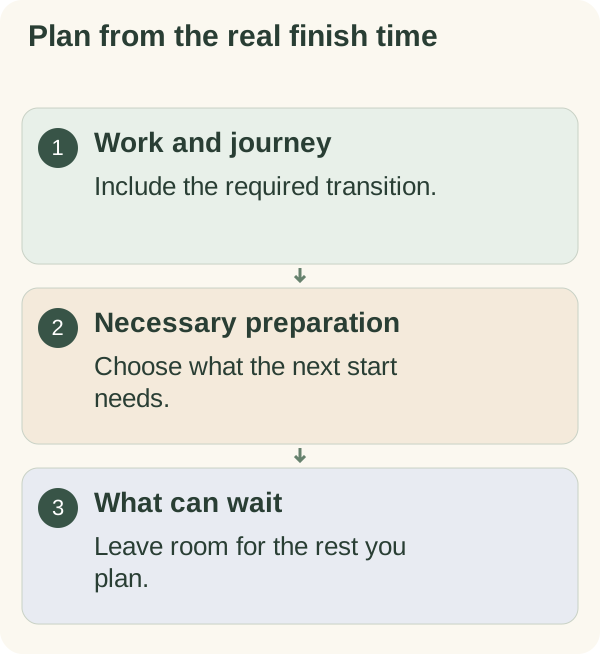
Why standard evening routines break after a late finish
Most evening routine articles assume you are home by six with a whole evening ahead: cook, tidy, exercise, read, prepare for tomorrow, wind down. That routine needs hours. After a shift that ends at 10 p.m. and a long journey home, you may have very little time before you want to rest, and much less energy than the article's imaginary reader.
Copying a daytime routine into that window usually leads to one of two outcomes. Either you skip it entirely and feel you have failed, or you push bedtime later every night to fit it in. A late-finish routine has to be designed for the time you really have.
Find your real arrival time
Your shift's official end is rarely when your evening begins. For one week, note three times: when you stopped working, when you left the building or logged off, and when you got home. Include handovers, closing tasks, waiting for transport and the drive or walk.
LATE-FINISH TIME MAP     week of ______

Day | Shift ends | Actually left | Home at | Gap
Mon | ________   | ___________   | _______ | ____
Tue | ________   | ___________   | _______ | ____
Wed | ________   | ___________   | _______ | ____
Thu | ________   | ___________   | _______ | ____
Fri | ________   | ___________   | _______ | ____

Usual gap: ______   Longest gap: ______
Plan your routine around the usual "home at" time, and keep a shorter version ready for the nights with the longest gap.
Draft a late-finish routine
- Work end:
list the closing or handover tasks your job requires.
- Arrival:
add the journey or, if you work at home, the change from work to home time.
- Necessary:
choose the preparation that truly needs doing before your next commitment.
- Optional:
move or remove tasks that do not fit.
- Rest:
leave room for the rest arrangement that suits you.
Pick essentials, then write the "not tonight" list
After a late finish, the routine should hold only what tomorrow would be noticeably worse without. For many people that is three things or fewer.
| Often essential after a late finish | Often fine to move to a day off or a later start |
|---|---|
| Something to eat, decided before you got home | Cooking a meal from scratch |
| Work items put away and anything for the next shift ready | A full tidy of the kitchen or living room |
| The next commitment checked: time, place, what to bring | Replying to personal messages that are not urgent |
| A clear end to work, with work alerts off if allowed | Exercise you would rather do with more energy |
| Planning the whole week |
The second column matters as much as the first. Writing "not tonight" tasks down means you have decided to move them, which feels very different from failing to do them.
Decide food and kit earlier in the day
The hardest time to make decisions is after a long shift. Moving a few choices to earlier in the day keeps the evening short.
- Food: decide in the morning, or on a day off, what you will eat after work. A portion you cooked earlier, something simple you keep in, or a plan to pick something up on the way home all count. The guide to a simple weekly meal planning routine shows how to plan a week of meals in one sitting. This page does not give nutrition advice; if you have dietary needs, ask a suitably qualified professional.
- Next-shift items: pack the work bag before you leave for work, so only what you used during the shift needs putting back.
- Calls: if a friend or relative usually rings in the evening, agree a different time on late days.
Example: Daniel's 11 p.m. homecoming
The example below is illustrative; the person in it is not real. Daniel works in a restaurant kitchen and does late shifts three days a week, finishing at 10 p.m. He used to get home around 11, cook for himself, wash up, start some laundry and scroll his phone, and often got to bed far later than he meant to.
He kept a time map for a week and saw that the official 10 p.m. finish was really 10:20 once the kitchen was closed down, and he was usually through the door at 11:05. Then he chose three late-night essentials:
- Eat the meal he had decided on that morning.
- Put his apron and work shoes by the bag and check the next shift on the rota.
- Put his phone on charge in the hallway.
Everything else went on a "day off" list on the fridge: laundry, cleaning the oven, calling his brother. After two weeks, the change he kept was the morning food decision, because it removed the evening's longest job. The one he dropped was charging the phone in the hallway, since he used his phone as an alarm; he moved the charger to the far side of the bedroom instead.
When the household is asleep by the time you get in
Late workers often come home to a dark, quiet house. Routine articles rarely plan for that.
- If you share a bedroom, set out what you need for the night in another room before you leave for work, so you are not searching in the dark.
- If someone else usually handles a shared evening job, such as locking up or feeding a pet, agree which nights it is yours and which are theirs. Have that conversation at a calm time, not at 11 p.m.
- If you want to talk about your day, a short message or a note for the morning can stand in until you see each other.
- If you live alone, let someone know your usual late-shift journey if that would make you feel safer.
When late finishes only happen on some days
Rotating rotas make one routine hard to keep. Keep two short routines instead: an ordinary-evening version and a late-finish version. Label them clearly and choose the version from the rota each morning, rather than deciding when you are tired at night. On a week with several late finishes in a row, use the late version every night and save the ordinary one for your days off.
Sleep is a separate question
For general sleep habits, the NHLBI's healthy sleep habits guidance covers setting aside time for sleep and winding down before bed. This planning card does not treat sleep difficulties or set a sleep schedule for shift work. If you regularly struggle to sleep after late shifts, or feel unwell or exhausted on your days off, speak to a doctor or an occupational health service.
Watch for the task that keeps growing
If your short routine slowly becomes long again, find the one task that expanded. Often it is the phone, the kitchen or "just checking" work messages. Give that task a different time or a smaller job ("load the dishwasher" instead of "clean the kitchen") rather than moving the whole routine later each night.
A late shift leaves less room in the evening, which is exactly why it helps to plan it as a few small steps: you do what tomorrow needs and nothing more, the same way Armored Kitten approaches any tight day. More planning guides are on the planning and reflection hub.
Use wind down for the evening to choose one final practical action. Read simple evening wind-down for a way to leave unfinished ordinary tasks without rebuilding tomorrow's whole plan.
Use the first preparation card in the Morning and evening preparation cards to separate what is needed from what can wait after a late finish.
Questions people often ask
How do I fit an evening routine in after a late shift? Keep it to a few essentials, make food and next-day decisions earlier in the day, and move everything else to a day off.
Should I still do my full routine on late nights? Only if it fits. A short late-finish version is a real routine, not a lesser one.
Is it a problem to eat late after work? That is a nutrition and health question. If you are concerned, ask a doctor or a registered dietitian.
What if I cannot switch off after a shift? Try a fixed end-of-work action, such as putting your work things by the bag. If you regularly cannot sleep, speak to a doctor.