A family morning stays flexible when you plan it in versions instead of one perfect timetable. Write down the full version for an ordinary day, a tight version for when everyone is running late, and a one-adult-down version for when a helper is ill or called away. Agree who owns each shared job, and decide in advance which extras get dropped first, so nobody has to negotiate at the front door.
One timetable is the fragile part
Many family morning routines are a single schedule: up at 6:30, breakfast at 7, teeth at 7:20, out at 7:45. It works on the mornings when nothing goes wrong. The first missing shoe, late bus or poorly child throws the whole thing, and every adult in the house improvises at once.
Flexibility does not mean having no plan. It means agreeing ahead of time what changes when the morning shrinks. The more of those decisions you make at the weekend or the evening before, the fewer you have to make in the hallway.
Separate what must happen from what is nice
Start with each person's departure. Check appointments, school or nursery information and work arrangements from the source itself, such as the school newsletter or the work rota, rather than from memory. Then list what must happen before each person leaves.
Label optional jobs and treats as optional: emptying the dishwasher, a cooked breakfast, practising spellings, walking to school instead of driving. They are good parts of a morning, and they are the first to go when time runs short.
Think about age, ability and supervision when deciding who can do what. A seven-year-old packing their own reading folder is reasonable; a young child being responsible for a sibling is not. This guide does not decide care requirements for your family.
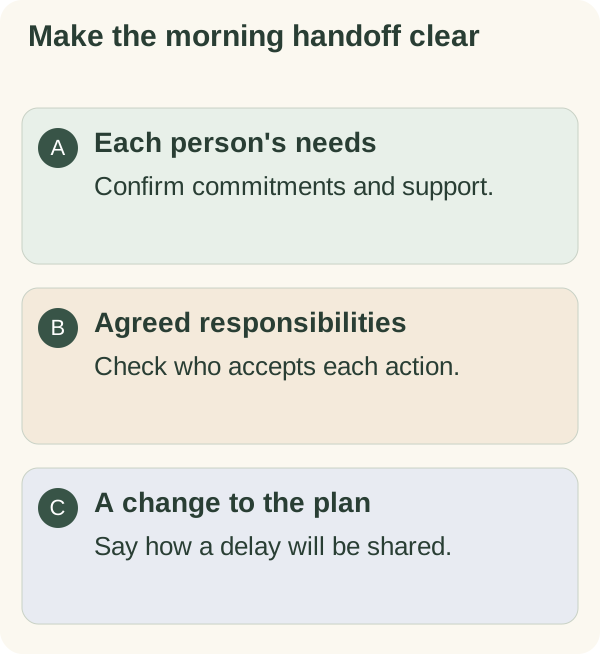
Agree on the morning plan
- Commitments:
confirm where everyone needs to be, and by when.
- Essentials:
list the necessary preparation for each person.
- Ownership:
agree who handles each shared job.
- Advance work:
choose what can be prepared the evening before.
- Change:
decide how you will tell each other about a delay or an unavailable helper.
Write the three versions
Here is a sample for a household with two adults and two school-age children. Replace it with your own jobs.
| Job | Full morning | Tight morning | One adult down |
|---|---|---|---|
| Breakfast | Sit-down breakfast | Simple breakfast at the table | Simple breakfast; older child sets out bowls |
| School bags | Checked together | Grabbed from the door hook | Grabbed from the door hook |
| Lunches | Made in the morning | Made the night before | Made the night before, or school lunch if offered |
| Clothes | Children choose | Laid out the night before | Laid out the night before |
| Journey | Walk to school | Car or bus | One adult does both drop-offs, or the agreed backup helps |
| Extras | Reading practice, tidy bedrooms | Dropped | Dropped |
Keep the table on the fridge or in a shared note. When the morning goes wrong, one adult says "tight version" or "one adult down" and everyone knows what that means.
Decide what to drop first
The drop order is a short list of extras in the order you will give them up. Agree it together, ideally when the children are not listening.
- Tidying bedrooms
- Reading practice (moves to after school)
- Walking to school
- Sit-down breakfast (becomes a simple breakfast)
Essentials never appear on this list. If you reach the end of it and the morning still does not fit, the plan needs changing, not rushing: ask for help, swap a drop-off or let the school know you will be late.
Make a door list for each departure
Many morning arguments are about one missing item. A door list, stuck by the front door, names what leaves the house with each person on each day.
DOOR LIST            week of ______

           | Mon      | Tue      | Wed      | Thu      | Fri
Child 1    | PE kit   | ________ | library  | ________ | ________
Child 2    | ________ | swim bag | ________ | ________ | ________
Adult 1    | ________ | ________ | ________ | ________ | ________
Adult 2    | ________ | ________ | ________ | ________ | ________

Night-before check done by: ________
Keep the list general. Sensitive appointment, medical or school details belong somewhere private; "doctor 9:00" on the fridge is enough.
Example: Daniel's Thursday mornings
Illustrative example only; this is not a real person's story. Daniel and his partner Alex have two children at the same primary school. Alex leaves early on Thursdays for a work shift, so Daniel handles the whole morning alone, and Thursday was reliably the worst morning of the week: late arrivals and a forgotten swim bag most weeks.
They changed three things:
- Thursday became a planned "one adult down" day. Lunches and clothes were done on Wednesday evening, and reading practice moved to after school.
- The swim bag went on the door list, with Alex checking it on Wednesday night as part of the handoff.
- They agreed a backup. A neighbour whose children went to the same school said she could take theirs on any Thursday Daniel was ill. They asked her directly instead of assuming.
After a month, the swim bag stopped going missing. What still did not work was the simple breakfast, which the younger child refused. They switched to a second option the child chose on Wednesday evening.
When one adult is suddenly unavailable
The hardest morning is the one where a helper drops out with no warning: a partner called into work, a grandparent who is unwell, a lift-share that cancels at 7 a.m.
- If you have a backup arrangement, use it. A backup only counts if the person agreed to it beforehand.
- If you do not, switch straight to the one-adult-down version and follow the drop order without debating it.
- If an essential task cannot be covered, such as getting a young child to school safely or giving medication, contact the school, your work or the right person and change the plan. Do not hurry a task that needs care just to keep the timetable.
- If this happens often, the household needs a standing backup, not a faster morning.
Review the friction once a week
If the same thing goes wrong repeatedly, look at how it is collected, stored or handed over. A missing item usually needs a clearer owner or an evening check rather than a louder reminder at 7:40.
A family morning that runs on agreed versions is a small, practical way of looking after the people around you, which sits at the heart of what Armored Kitten is for. For more on planning shared weeks, see the planning and reflection hub.
Use plan an overwhelming day to compare commitments. The weekly review template can provide a place to change the shared arrangement together. If breakfasts and packed lunches are a regular sticking point, the meal planner can help you settle the week's meals in one go.
Use the departure card in the Morning and evening preparation cards alongside the responsibilities you have actually agreed with the household.
Questions people often ask
How do I make a morning routine work for the whole family? Agree the essentials for each person, give shared jobs clear owners and keep shorter versions ready for bad mornings.
Should children have their own checklist? Many families find a short picture or word list helps older children take on parts of the morning. Match it to what your child can safely do.
What if my partner and I disagree about the routine? Talk about it at the weekend, not at 7:30 a.m. Start with the job that causes the most friction.
What time should we all get up? That depends on your family's commitments and needs. Work backwards from your departure times and the essentials.