A morning routine you can maintain starts with what your morning has to do, not with a list of good habits. Write down your commitments and the preparation they need. Build a minimum version you could manage on your worst morning, a standard version for ordinary days and a short list of optional extras. Then try it for two weeks and keep only the parts that actually helped.
Begin with the morning you have now, including travel, shared responsibilities and whatever you need for work, study or an appointment. When other people are part of your morning, their needs and agreement belong in the plan too; the guide to flexible family mornings covers that side in detail.
Why ideal morning routines are hard to keep
Search for morning routines and you find long lists: wake early, drink water, stretch, journal, read, plan, exercise, cook breakfast. Each item can be pleasant. Together they describe a morning that takes most of an hour and suits someone with no commute, no children and no bad nights.
When that routine meets a real week, it breaks on the first late night or early meeting. Then it feels as if you failed, when the routine was simply designed for a different life. A routine you can keep is built the other way round: from the fixed parts of your morning outwards.
List what your morning has to do
Write down what must happen before your first commitment. Check the actual requirements instead of assuming every item on an old checklist still matters.
Typical essentials are getting washed and dressed, eating if you want to, taking what you need for the day, any medication as prescribed, and leaving on time. Some mornings also include dropping someone off, an early call or an appointment.
Then write the optional things you would like: reading, a walk, writing, tidying, planning the day, a hobby. Keeping them on a separate list makes it easy to see what can move when the morning changes.
Build three versions with this template
MY MORNING              start date: ______

First commitment:   ______ at ______  (leave by ______)

MINIMUM (worst morning, 3 items max)
1. ______________________
2. ______________________
3. ______________________

STANDARD (ordinary morning)
Minimum, plus:
- ______________________
- ______________________

EXTRAS (only when there is room)
- ______________________
- ______________________

Ready the night before: ______________________
The minimum is the routine. If you do the minimum, you have kept your routine that day. The standard version is what an ordinary morning looks like, and the extras are a bonus.
Turn the template into a morning
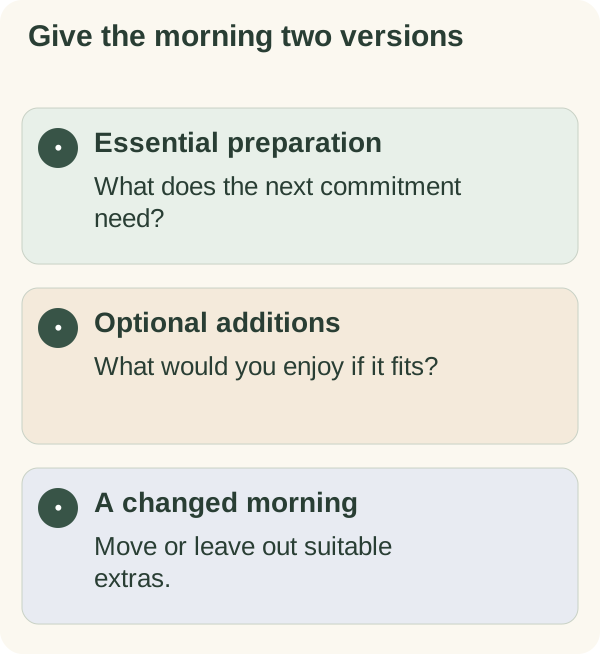
- Essential version:
what genuinely needs attention before the next commitment?
- Optional version:
what would you like to add when there is room?
- Changed morning:
what can move, be shared or be left out?
- Review:
which parts actually helped after you tried the arrangement?
Anchor steps to each other, not to the clock
Clock-based routines ("7:05 coffee, 7:15 shower") fall apart as soon as you wake late. Sequence-based routines survive: "after I put the kettle on, I set out my bag". If the whole morning shifts by twenty minutes, the order still works.
When you want to add something new, attach it to the end of a step you already do every day rather than squeezing it into a gap.
Move some preparation to the evening, but not all of it
Some preparation is easier the night before: setting out clothes, packing a bag, writing the day's first task. The evening wind-down checklist offers a way to do that without planning an entire perfect day.
Preparation still takes effort. If doing it the night before would be awkward or unnecessary, leave it in the morning. Shifting every morning task into the evening only moves the work.
Example: Maya's six-step morning
This is an illustrative example, not a real person's story. Maya decided to start a new morning routine on the first of the month: wake earlier, stretch, journal, read for twenty minutes, make a proper breakfast and plan her day, all before leaving for her 8:30 start at a council office. By the second week she was skipping it most days and feeling worse than before she began.
She rebuilt it with the template:
- Minimum: shower and dress, coffee, bag and keys by the door.
- Standard: the minimum plus breakfast at the table and her top task written on a sticky note.
- Extras: reading or a short walk, if she was ready early.
She moved bag packing to the evening and tied the sticky note to making coffee. After two weeks she had done the minimum every day and the standard version on most days. The extras happened twice. She dropped journaling from the morning altogether and moved it to Sunday afternoons, where it fitted better.
When your start time changes every day
Shift workers, students with changing timetables, freelancers and people with variable caring duties often have no fixed morning. Most routine advice assumes the same alarm every day.
- If your start time varies, anchor the routine to waking up rather than a clock time. "Within half an hour of getting up" works at 5 a.m. or 10 a.m.
- If you work some early starts, treat those mornings as minimum-only by default and plan them the night before. The guide on preparing for an early start covers that.
- If some days have no commitment at all, decide whether you want a routine on those days. A day off without one is still fine.
- If mornings are when you feel your worst, keep the minimum truly minimal and put the things you care about later in the day. If you regularly feel unwell or very low in the mornings, speak to a doctor.
Review after two weeks
Try the arrangement for two weeks before adding anything. Then look back:
| Question | If yes | If no |
|---|---|---|
| Did I do the minimum on most days? | Keep it | Make it smaller |
| Did an extra keep making me rush? | Move it to another time of day | Keep it as an extra |
| Did any step feel pointless? | Drop it | Keep it |
| Is there a step I now want every day? | Move it into standard | Leave it as an extra |
This is practical scheduling guidance. It does not recommend cutting sleep to fit a routine, or claim that a particular morning schedule improves health or productivity.
Tools for trying it out
A morning built on a small minimum is a clear case of Armored Kitten's approach: one manageable step done reliably beats an impressive plan dropped by Wednesday. There is more on planning your days on the planning and reflection hub.
Use the daily planner to make space for known commitments. If one action becomes something you want to repeat, the free habit tracker lets you explore a schedule with your own reporting days. If a walk is one of your extras, the guide to making walking part of your day has ideas for fitting it in.
Build one small routine for an illustrated next step. If you continue in Telegram, review the actual saving and reminder controls. Reading this page does not set an alarm, move an appointment or automatically create a morning habit.
Use the departure card in the Morning and evening preparation cards for confirmed requirements and suitable advance preparation.
Questions people often ask
How long should a morning routine be? As long as your mornings allow. Build from your leaving time and keep the minimum short enough for a bad day.
Do I need to get up earlier to have a routine? No. A routine can fit the time you already have. Decisions about sleep are separate; if you have concerns, ask a doctor.
What if I miss a day? Start again the next morning with the minimum. There is nothing to make up.
Should exercise be part of my morning? Only if it fits and you want it there. If you have a health condition, ask a doctor or suitably qualified professional what activity suits you.