To prepare for an early start, work backwards from the time you need to arrive. Confirm the place and arrival time at the source, check how the journey works at that hour, then set your leaving and wake-up times from there. Lay out what can be ready tonight, write a note for anything that has to stay in its usual place, and check the alarm yourself on the device you will rely on.
This page covers one-off early mornings close to home, such as an exam, an interview, an early shift or a first-thing appointment. For flights and longer trips, the travel-night checklist covers bookings and documents.
Work backwards from the arrival time
Most night-before lists start with clothes and chargers. The more important question is time. An early start usually goes wrong because the leaving time was a guess.
REVERSE TIMELINE        for: ______________ on ______

Must arrive by:            ______  (checked at: __________)
Buffer for delays:       - ______
Journey at that hour:    - ______  (route: __________)
= Leave home at:           ______
Getting ready takes:     - ______
= Wake-up time:            ______
Backup wake-up:            ______  (second alarm / person)
Fill in "journey at that hour" from a journey planner or the operator's timetable for that day and time, not from how long the trip takes you at midday. If you have not done the route before, check where you will park, which entrance to use or which stop to get off at.
The buffer is your call. A longer one suits a first-time route, an exam or anything where being late has a real cost.
Confirm what the morning requires
Check the appointment letter, rota, exam confirmation or invitation itself. Confirm the address, the arrival time (which may be earlier than the start time) and anything you must bring: ID, a letter, equipment, a uniform.
Write what you still do not know as a question, such as "Which building is room 4B in?", and try to answer it tonight. An alarm cannot supply a missing address.
Prepare a departure card
- Destination:
record the confirmed place and arrival requirement.
- Departure:
choose when you need to leave and what to check again in the morning.
- Essentials:
identify documents, clothing and other required items.
- First action:
write what you will do first when you wake.
- Change:
note who to contact if you are delayed or the arrangement changes.
Set out what you can, note what you cannot
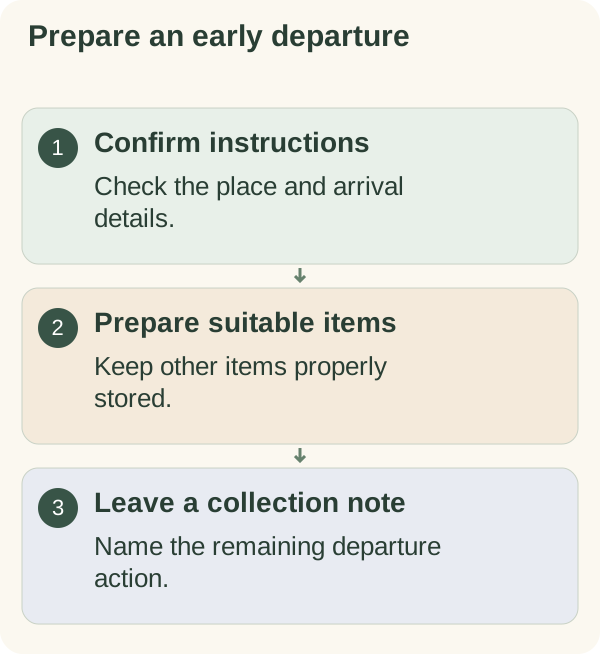
Put everything that can be ready tonight in one place, ideally by the door or with your keys: the bag, the folder, the clothes. Things that cannot be packed in advance, such as chilled food, medicines in their usual storage or a phone on charge, go on a short note at the same spot.
For example: "Bag by the door; ID in the front pocket. Collect: lunch from the fridge, phone from the charger." Name each item, so you do not have to reconstruct the list half awake.
Example: Alex's 8 a.m. exam across town
Illustrative example only; this is not a real person's story. Alex had a professional exam starting at 8 a.m. in a building on the far side of the city, with candidates asked to arrive by 7:30. During the day the bus there takes Alex about half an hour.
Filling in the reverse timeline turned up two surprises:
- The bus: at that hour the direct service ran less often, so the realistic journey was longer, with a possible wait. Alex chose an earlier bus and kept the next one as a fallback.
- The entrance: the exam letter named a side entrance. Alex found it on a map and wrote "side door, Hill Street" on the card.
The night before, Alex put the bag by the door with the exam letter, ID and two pens, left a note on top saying "water bottle from the fridge", set two alarms and asked a housemate to knock if Alex was not up by the backup time. Afterwards, the one thing Alex would change was adding the exam centre's phone number to the card, in case of a delay.
If you are worried about oversleeping
Most lists say "set an alarm" and move on. If oversleeping is your real worry:
- If you rely on your phone, check the alarm's time, day and volume, and that the phone will have charge. Look at the alarm screen itself rather than assuming.
- If you have slept through alarms before, add a second alarm on a different device, or put the phone where you have to get up to switch it off.
- If someone else in the home is up early, ask them to check you are awake at a set time.
- If you regularly struggle to wake, or feel very sleepy during the day, raise it with a doctor.
This article does not set an alarm or arrange a reminder for you. Use the controls on the device or service you choose.
If someone is depending on your early start
An early shift, a lift you are giving or a child's early trip adds another person to the plan. Write down who to contact if you are running late and how, and agree the meeting point and time with them tonight. If someone is travelling with you, agree who brings any shared items.
Leave optional preparation optional
An early morning does not call for a complete household reset the night before. Choose the preparation this departure needs and decide which other jobs can wait. If you are also planning an early workout, the guide on preparing for the gym the night before has a kit-focused version.
Stop when the card is done
Look once at the departure card and the reverse timeline, then put them where you will see them first thing. If a new concern appears, decide whether it needs action now or a note for the morning. Rebuilding the whole plan at midnight rarely makes the morning safer.
An early start shows what Armored Kitten means by one manageable step: tonight you only need a confirmed time, a packed bag and a first action. More guides on planning a real week are on the planning and reflection hub.
Try the evening wind-down guide to close the preparation period. Use wind down for the evening if you want a place to choose one final necessary action.
The departure card in the Morning and evening preparation cards has space for the confirmed destination, requirements and first departure action.
Questions people often ask
What should I prepare the night before an early start? Confirm the arrival time and place, work out your leaving and wake-up times, put essentials by the door and check your alarm.
How much buffer should I leave? It depends on the route and what is at stake. Allow more for a new route or when lateness has a serious cost.
Should I go to bed earlier than usual? That depends on you and your health. If you have questions about your sleep, ask a doctor.
What if worry about the morning keeps me awake? Write the worry on the card next to what you will do about it. If worry often keeps you awake, speak to a doctor.