To stop rewriting tomorrow's to-do list all evening, separate writing things down from deciding what to do. Give new thoughts a parking list that you add to but never reorder at night. Choose one fixed time to turn that list into a plan, such as first thing in the morning. And when the same task keeps getting moved, look for the missing question behind it instead of rewriting it again.
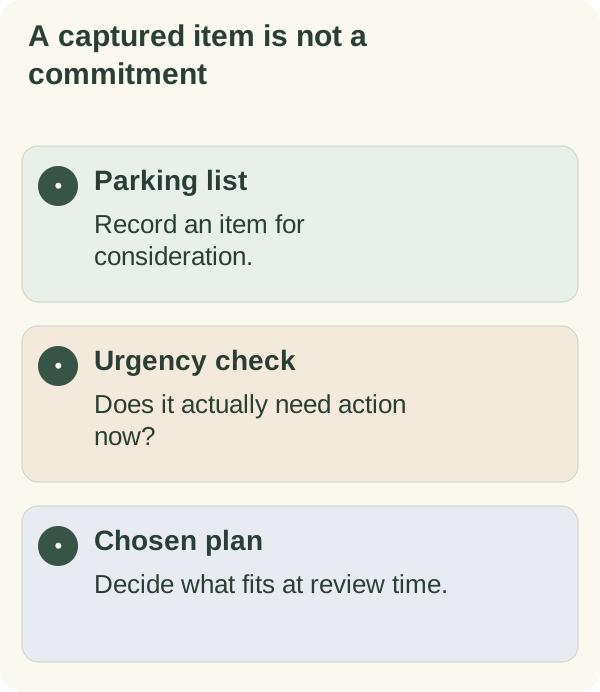
Why the evening rewrite happens
You make tomorrow's list as work winds up. An hour later you remember another task, so you add it. Now the order looks wrong, so you rearrange. Then you notice two items will not fit, so you move one to Wednesday, which means Wednesday needs rewriting too. By bedtime the list has been edited five times, and tomorrow feels heavier, not lighter.
Productivity advice often says to cap the list at three items or start a fresh one each day. Those help with the list's shape. They do not stop the loop, because the loop is not really about length. It comes from using the list to settle uncertainty at an hour when you cannot act on anything.
Split capture from commitment
The fix is structural: two separate places.
- The parking list is where anything goes the moment you think of it. It is unordered, unscheduled and allowed to be messy.
- Tomorrow's plan is short and gets made only at the review time you choose.
At night you can add to the parking list as much as you like. You do not touch the plan.
PARKING LIST (add anytime, sort later)

Thought                           | Tonight?  | Missing piece
----------------------------------|-----------|---------------------
Ring the garage about the noise   | no        | their opening hours
Reply to Daniel re: Saturday      | yes, text | none
Look into a cheaper phone deal    | no        | current contract end date
Book dentist                      | no        | none
_______________________________   | ______    | ___________________

Review time: ______ (when this becomes tomorrow's plan)
The "missing piece" column is where most of the evening loop gets broken. If you cannot plan a task because you do not know something, the honest next action is finding out that one thing.
The one check new items get tonight
When a new thought arrives in the evening, ask only this:
- Does it need action or a message tonight, because of a real deadline or someone relying on you?
- If yes, do that one thing now or hand it on.
- If no, write it on the parking list and stop.
Most items fail the first question. Feeling unfinished is not the same as being urgent.
Close tonight's planning
- Capture:
put the new thought in the chosen parking place.
- Check:
does it require action or communication tonight?
- Clarify:
write a next action if the item is too vague to understand later.
- Review:
choose the next appropriate occasion to consider the list.
- Close:
leave optional rearranging until that review.
Choose a review time and keep it
Pick one regular slot when the parking list becomes a plan. For many people that is the first few minutes of the working day, before opening email. Others prefer a short slot late in the afternoon.
At review time:
- compare the parked items with your real commitments for the day;
- choose what fits and leave out what no longer matters;
- leave some unplanned room, because something new will turn up.
Do not turn every evening thought into a morning obligation. The point of a parking list is that items can sit there for a while without costing you anything.
Example: Sam's five-version Tuesday list
Here is a made-up example to show how it can work. Sam manages a small team in an insurance office. Most evenings Sam rewrote the next day's list in a notes app three or four times, often in bed, and still started the morning unsure what to do first.
Sam tried the split for two weeks:
- A parking note on the phone's home screen, for evening thoughts only.
- Tomorrow's plan, written at 8:45 a.m. at the desk from the parking note and the calendar.
- One rule: no editing the plan after 7 p.m.
Two things changed. The evening edits mostly stopped, because there was nothing to edit; the plan did not exist yet. And the missing-piece column showed that "sort out the team rota" had moved every day for a week because Sam did not know who was on leave. One message to HR the next morning settled what five evenings of rewriting had not. Sam kept the split and dropped the 7 p.m. rule after a month, because it was no longer needed.
When the same task has moved five times
A task that keeps getting rewritten is telling you something. Use the pattern to decide what to do with it:
- If information is missing, the next action is getting it: "Ask HR who is on leave", not "Sort out the rota".
- If the task is too big, write only its first physical step.
- If you are avoiding it because it is unpleasant, give it a small, fixed slot in the plan with nothing else around it.
- If nobody would notice it disappearing, delete it. Some tasks quietly stop mattering.
- If it depends on someone else, move it to a "waiting for" line with their name.
When your list lives in three places
Rewriting gets worse when the same tasks exist in a notes app, a paper planner and your email flags. Each evening you reconcile them, and the reconciling becomes the rewrite.
Choose one place for the parking list and one place for the plan; they can be facing pages of the same notebook. Keep calendar entries for things with a fixed time. If you must keep a second system for work, use it for work only and avoid copying items between them without a clear reason.
What this method will and will not do
This is a way of organising ordinary tasks. It does not promise to stop worry, and it is not a treatment for sleep or mental-health concerns. If thoughts about tomorrow keep you awake most nights, or you feel anxious much of the time, speak to a doctor or another suitably qualified professional.
Writing a thought down once and letting it wait is one manageable step, which is what Armored Kitten tries to make easier every day. More on planning your days is on the planning and reflection hub.
Use wind down for the evening for a final practical choice. The daily planner can help compare captured tasks with tomorrow's actual room when you are ready to review them. If the list feels too long to plan at all, make room in an overwhelming day walks through choosing what fits.
Use the unfinished-work and what-can-wait fields in the Morning and evening preparation cards to close tonight's planning.
Questions people often ask
Is it bad to plan tomorrow the night before? Not if you do it once. The trouble starts with re-planning again and again after you have finished.
What if I am afraid of forgetting something? That is what the parking list is for. Once a thought is written down, you can stop holding it in your head.
Should I delete tasks I keep moving? Some, yes. First check whether a missing piece of information is what keeps moving them.
Is paper or an app better for this? Whichever you will keep in one place. Spreading tasks across several tools usually makes the rewriting worse.