To end a difficult day without finishing everything, sort what is left into three boxes: things that genuinely must happen tonight, things where someone needs to be told about a change, and everything else, which you park with a short note. Deal with the first two boxes, briefly. Then stop. Nothing in the third box needs to be repaid tomorrow with extra work.
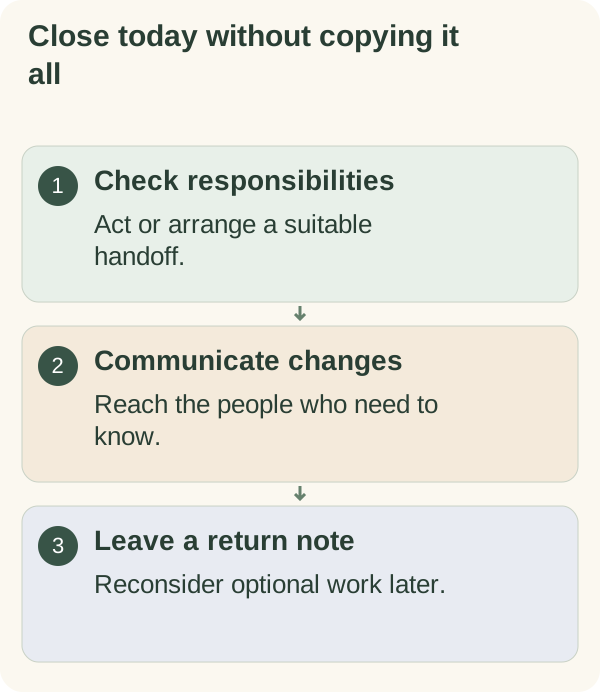
A hard day needs a different close
On an ordinary evening, closing the list is housekeeping. On a hard day, after bad news, an argument, a sick child, a crisis at work or simply a day where nothing went right, the unfinished list can feel like proof that you failed. The instinct is to stay up and catch up, or to copy every task onto tomorrow so it looks handled.
Both make tomorrow heavier. A difficult-day close has one goal: make sure nothing important is dropped, and let everything else wait without guilt.
Sort what is left into three boxes
| Box | What goes in it | What you do tonight |
|---|---|---|
| Must happen | A real deadline tonight, a care task, a safety step, something another person cannot manage without | Do it, or hand it to someone who can |
| Tell someone | Anything another person expects from you that will now be late or different | Send a short message (scripts below) |
| Park | Everything else: your own projects, chores, emails nobody is waiting on | Write one line about where it stands |
Be honest with the first box. Many tasks feel urgent simply because they are unfinished. Ask what actually happens if this waits until tomorrow afternoon. If the answer is "nothing much" or "I would feel uncomfortable", it belongs in the park box.
Follow any professional, medical or safety instructions that apply, such as medication for someone you care for or a safety step at work. This page does not decide which of those can be skipped.
Close today's plan
- Necessary:
identify anything needing action or an appropriate handoff now.
- Communicate:
update people whose expectations need to change.
- Park:
record the current state of work you may return to.
- Remove:
leave outdated or optional tasks off tomorrow's automatic list.
- Stop:
choose rest or one necessary preparation action.
Messages for when a plan has to change
A private note cannot tell someone else that their expectation has changed. When something in the "tell someone" box involves another person, a short honest message is usually enough. Copy and adjust:
To a colleague or manager:
"Today didn't go to plan, so the [report] won't reach you tonight.
I can send it by [time] tomorrow. Let me know if that causes a problem."

To a friend:
"I need to cancel tonight, sorry. It's been a rough day.
Can we find another evening next week?"

To someone you share a home job with:
"I can't do [the school run / the shopping] tomorrow morning.
Could you take it, or shall we work out another way?"

Asking for help:
"I'm struggling to get [task] done today.
Could you help with [one specific part]?"
You do not need to explain the whole day. A reason in a few words, a new time if you have one and an invitation to reply are enough.
If you must renegotiate a formal work or official deadline, use the channel that commitment normally goes through. A text to a friend about it does not count as notice.
Park work with a note, not a new promise
For the park box, write one line per item that says where it stands, with no date attached. For example: "Draft saved; next decision is which example to keep." That keeps the thread without making tomorrow responsible for finishing it.
Avoid writing "Do ALL of this tomorrow" at the top of the page. Tomorrow's plan should be made tomorrow, with that day's energy and information.
Example: Sam's day of hospital phone calls
An illustrative example (the person is made up): Sam's father had a fall, and Sam spent most of a working day on the phone with the hospital and family. At 7 p.m. the to-do list still held a client report, a dentist booking, the weekly shop and a friend's birthday drinks.
Sam sorted it:
- Must happen: confirm with the hospital when visiting started the next day, and tell a sister.
- Tell someone: a message to the client's manager moving the report to Thursday, and a message to the friend saying Sam would miss drinks but would call at the weekend.
- Park: "Report: data done, write summary." "Dentist: book when things settle." The shop became a short online order of basics.
Then Sam put the list away. The next morning, the parked items did not go onto the day's plan automatically. Only the report came back, two days later. The habit Sam kept for later hard days was sending the "tell someone" messages first, because they removed the most worry.
When someone else depends on you
Advice about leaving tasks unfinished usually assumes the tasks are yours alone. Care responsibilities are different. If you look after a child, an older relative, a pet or someone with a health condition:
- If a care task is due tonight, it stays in the "must happen" box, even on a hard day. If you cannot do it, arrange for someone who can and tell them exactly what is needed.
- If you are not sure whether a medical or care step can be skipped, do not decide alone; ask the relevant professional, pharmacist or service.
- If you have no one to hand a task to, make it as small as it can safely be and leave everything optional for another day.
- If you are the one who needs looking after tonight, tell someone you trust.
When tomorrow will not be easier
Some difficult days are the start of a difficult week: a bereavement, a family crisis, a long illness. In those weeks, parking everything until "tomorrow" stops working, because tomorrow is just as hard.
- Shrink the plan to essentials for several days, not one. The make room for a difficult day exercise helps you decide what is essential.
- Tell work, school or anyone else relevant early, through the right channel, rather than apologising one task at a time.
- Review the park box once at the end of the week instead of every night.
If your difficult days are about how you are feeling, or you feel unable to cope, talk to a doctor or a mental health professional. If you feel unsafe or might harm yourself, contact your local emergency number or a crisis line straight away.
Keep tonight's preparation small
One item ready for the next morning, such as the bag for an appointment, is often worth doing. Anything more can turn "getting ready for tomorrow" into another shift after an already full day.
A hard day is when Armored Kitten's idea of one manageable step matters most: decide the one or two things that cannot wait, and let the rest be. The planning and reflection hub has more on planning around difficult and interrupted days.
Use make room for a difficult day to compare the choices. Read simple evening wind-down for a practical closing exercise. These are planning supports, not treatment for a health concern.
Use the unfinished-work and what-can-wait fields in the Morning and evening preparation cards after checking any real responsibilities and handoffs.
Questions people often ask
Is it all right to go to bed with tasks unfinished? Yes, once anything that genuinely cannot wait has been done or handed over.
Should I move everything to tomorrow? No. Bring back only what you choose when you plan tomorrow.
What if I feel guilty about letting people down? A short, early message usually lands better than a late or missing result. Most people would rather know.
How can I tell whether a task is truly urgent? Ask what happens if it waits until tomorrow afternoon. If someone's safety, care or a firm deadline is affected, treat it as urgent.