Build a walk around a cue
- Step 1Pick an everyday cue
- Step 2Choose two route lengths
- Step 3Review after the trial
Attach a walk to something you already do every day, such as dropping children at school, finishing work or getting off the bus. Decide the smallest version you would still manage on a tired day, try the arrangement for two weeks and then review what to keep. You do not need a step target, new kit or a long walk to begin; you need one reliable moment and a route you have checked.
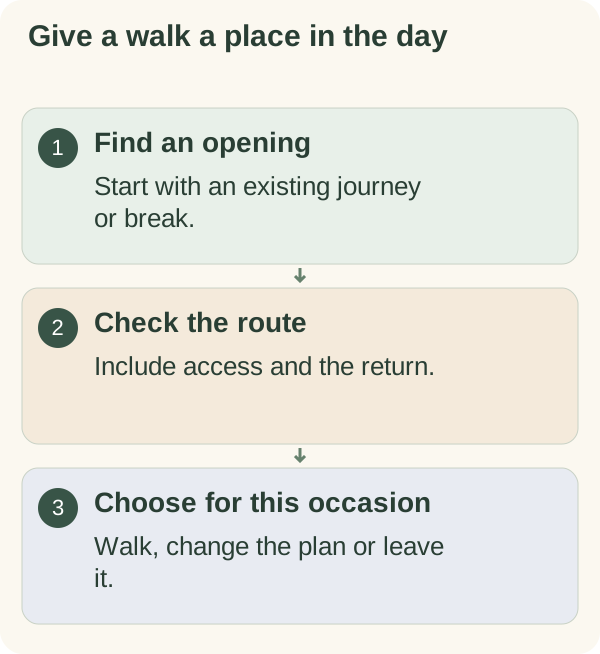
Most advice on starting to walk focuses on how many minutes to do and how fast to build up. Those are questions about your body, and the answers depend on your health. If you have a health condition, pain, a recent injury, a pregnancy or a mobility limit, ask a doctor or physiotherapist what kind of walking suits you. This guide deals with the other half of the problem: where a walk fits so that it actually happens.
Find an anchor in the day you already have
An anchor is something you do on most days without needing to remember it. A walk placed right after an anchor borrows its reliability. Look through an ordinary day and list the candidates.
| Existing moment | Walk that could follow it | What might get in the way |
|---|---|---|
| Dropping children at school | Walk the long way home, or a loop before going back in | Rain, an early meeting |
| Morning coffee | Step out to the end of the street and back | Rushed mornings |
| Lunch break | A loop near work (see the after-lunch routine) | Meetings booked over the break |
| Getting off the bus or train | A walk from a different stop (see fitting a walk around a commute) | Heavy bags, darkness |
| After the evening meal | A short loop before clearing up | Dark evenings, tiredness |
| A phone call you take anyway | Walk while you talk | Noise, needing to take notes |
Choose one row, not three. Then write it as a single sentence in this form: "After I ___, I walk ___." For example, "After I drop the kids off, I walk round the park before driving home." A clear sentence is easier to act on than a general wish to walk more.
Decide your usual version and your small version
The usual version is the walk you picture on a normal day. The small version is the one you would still do when you are tired, late or not in the mood: out to the corner and back, or once round the car park. Both count.
The small version is the part most people skip, and it is what keeps a new habit alive through its first bad week. Without it, an off day becomes a zero, and a few zeros feel like failure. With it, the anchor still leads to a walk, just a shorter one.
Check the route once before you count on it
The CDC's physical-activity guidance suggests choosing activities, locations and times you enjoy. Use that as a starting question rather than a reason to copy a fixed distance or pace from another person's plan.
Then walk the route once with a practical eye. Notice where you cross roads, whether the pavement is even, whether there is somewhere to sit or shelter, and how you get back if you want to stop early. If the walk will sometimes happen after dark, look at it in the evening too: choose lit, busier streets, carry your phone and let someone at home know your usual loop.
Your first walking card
- Anchor.
Write the moment the walk follows.
- Route.
Name the loop and check it once, including the return.
- Small version.
Decide the shortest walk you would still take on a hard day.
- Backup.
Choose what happens if the anchor does not happen: another moment, or no walk that day.
- Review date.
Put a day in your calendar two weeks from now.
A two-week trial card you can copy
Two weeks is long enough to meet a few awkward days and short enough that the plan still feels like an experiment. Copy this somewhere you will see it.
My walking trial: [start date] to [end date]

Anchor: After I ____________, I walk ____________.
Usual version: ____________
Small version (tired or busy days): ____________
If the anchor doesn't happen: ____________ (another moment, or skip)
Review on: ____________

Review questions:
- Which days did it happen? What made those days easier?
- Which days didn't it? What got in the way?
- Keep, move, shrink or pause?
Example: Sam swaps her evening plan for the school run
Here is a made-up example to show how it can work. Sam wanted to walk every evening. Evenings in her house mean homework, cooking and bedtime, and in three weeks she managed two evening walks. Each missed night made the next one feel less likely.
She went back to the anchor table and noticed the school drop-off happens every weekday at the same time, whatever else is going on. So she rewrote the plan:
- Anchor: after dropping the children at the gate, walk home the long way past the shops instead of going straight back.
- Small version: walk to the corner shop and back, for days when she has an early call.
- Backup: none. If she drives to drop-off because of a later appointment, there is no walk that day.
Over the two-week trial the walk happened on most school days. The misses were two very wet mornings and one day with a dentist appointment. At the review she kept the anchor, added a simple rain rule from the guide on walking when it rains and dropped the evening plan altogether. Weekends stayed open.
When there is no obvious gap in your day
Many articles on starting to walk assume free time that some readers do not have. If your day is full from start to finish, these if/then rules may help.
- If every minute is already spoken for, attach the walk to a trip you already make, such as part of an errand, rather than creating a new slot.
- If you care for someone at home, consider a short walk together if that suits them, or a loop while someone else is there. If you cannot leave the house for now, leaving walking for a later season is a reasonable decision.
- If your working hours change from week to week, plan by type of day instead of by clock time. See a walking plan for changing schedules.
- If you work from home and never leave the house, turn the end of the workday into the anchor. The guide to movement breaks at home has more ideas.
- If walking itself is uncertain because of pain, a condition or a mobility limit, ask a doctor or physiotherapist what is suitable before building a routine. The anchor method works the same way for any activity they recommend.
Make the backup a real choice
An alternative might be another suitable location, a different opportunity or a decision to leave the walk for another day. A backup is useful when it helps you decide quickly. It should not turn every interruption into a debt you have to repay with a longer walk tomorrow.
An illustrative backup line: "If the anchor doesn't happen, I'll take the small version after lunch. If that doesn't fit either, no walk today." That is more informative than marking every changed plan as a failure.
Invite someone without making the plan compulsory
Walking with someone can make the anchor easier to keep, but your plan should not depend on their diary. Offer a specific walk and let them decline or suggest another time. For a little help with the invitation, see small ways to reconnect. Keep the invitation separate from any habit you choose to track yourself.
Review after two weeks, not after one bad day
Starting with one anchor and a small version is the same idea that runs through Armored Kitten's guides to habits and goals: a step you can manage this week, adjusted once you see how it fits. At the review, look at what made the good days easy. That is usually the thing to protect. If you use step or distance data, it can sit alongside those notes, but it cannot tell you why a walk did not happen.
Try the free habit tracker to record the routine you choose. Then build one small routine if you want to decide how it could repeat. Opening the Telegram companion is optional; it does not automatically save the plan or arrange follow-ups.
Use the first card in the Flexible walking planner to put the opening, route and return boundary together. Other situations, from rain to travel, are collected under walking routines. If your routine also includes the gym, the Fitness page covers that side.
Questions people often ask
How long does it take for walking to become a habit? It varies a great deal between people and situations. Rather than waiting for it to feel automatic, review after two weeks and adjust the anchor or the small version.
Do I need special shoes or gear? Comfortable shoes you already own are enough to start. If walking causes pain, stop and ask a professional before carrying on.
What if I miss a day? Pick up at the next anchor. There is nothing to make up, and restarting after missed days helps if a few days have gone by.
Should I count steps from the start? Only if the number helps you. A note about what happened is often more useful in the first weeks.