Make a weather decision
- Step 1Check conditions before leaving
- Step 2Skip the outdoor walk for thunder, lightning or an applicable warning
- Step 3If caught in a thunderstorm, seek safe indoor shelter
Decide your rain rule before the rain arrives. In light rain, go with a waterproof layer and shoes that grip. In steady heavy rain, take a shorter or more sheltered route, move the walk to a drier part of the day or use a covered place you have already checked. With official weather warnings, flooding, ice or thunder and lightning, skip it. Write the rule down so a wet morning takes seconds to decide, and treat a planned skip as part of the routine.
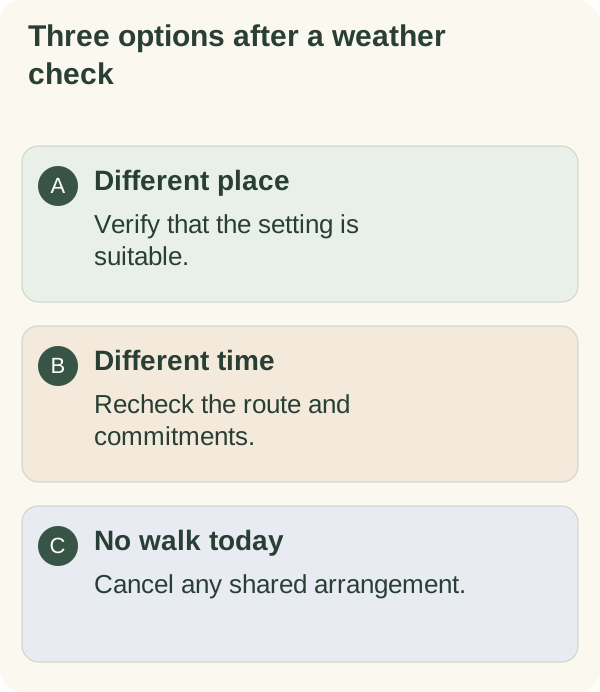
Articles about walking in the rain tend to fall into two camps: embrace the rain, or move indoors with a home walking workout. Neither tells you how to decide on a particular morning. The decision is where most routines break, because it happens at the worst moment, with your shoes half on and the rain loud against the window.
Write a rain rule by type of weather
Use this table as a starting point and change it to fit your route, your kit and how you feel about wet weather.
| Conditions | Default choice | What to check |
|---|---|---|
| Drizzle or light rain | Go, with a waterproof layer | Footwear grip on wet paving and leaves |
| Steady or heavy rain | Shorter or sheltered route, or move it to later | Visibility to drivers, puddles at crossings |
| Strong wind or official weather warnings | Skip, or use a checked covered option | Your national weather service's warnings |
| Flooding or very heavy rain overnight | Skip routes near rivers, underpasses or low paths | Local flood alerts, closed paths |
| Ice or freezing rain | Skip unless the route is gritted and you feel steady | Surfaces, especially steps and slopes |
| Thunder or lightning | Stay in | Wait until the storm has passed |
Local forecasts and official warnings matter more than how the sky looks at the door. Rain affects different routes differently; a familiar path may be fine in drizzle and unsuitable after a night of heavy rain.
Keep the kit by the door
Light rain mostly stops walks because the kit is in the wrong place. Keep these where you put your shoes on:
- a waterproof jacket or layer that packs small;
- a hood or hat that does not block your view to the side when you cross roads;
- shoes with grip you trust on wet ground;
- something bright or reflective for dark, wet evenings, when drivers see less;
- a small bag or pocket that keeps your phone dry.
Decide whether your available clothing, footwear, mobility equipment and transport suit the situation. If you cannot confirm that an option is appropriate, choose another arrangement. Nothing in this routine makes an unsuitable route necessary.
Deciding on a wet morning
- Look up the warnings.
Check the forecast and any official warnings for your area.
- Match the table.
Find the row that fits today's conditions.
- Follow the default.
Go, shorten, move or skip, as the rule says.
- Update anyone involved.
Send the agreed message if someone was joining you.
- Record it plainly.
Note "skipped for rain" or "short route", not a blank.
Check a covered option before relying on it
A covered public space may have opening hours, access restrictions or rules about how it is used. Check those details. Do not assume a shopping centre, community venue or workplace corridor is available for walking simply because it appears on a map.
At home, consider whether the space is suitable for the activity and for anyone sharing it. An indoor option is a choice, not a compulsory substitute for the original walk.
A rain rule card and a message you can copy
My rain rule
Light rain: ____________________ (e.g. go, with jacket)
Heavy rain: ____________________ (e.g. short route, or move to after lunch)
Warnings, flooding, ice or lightning: skip
Covered option (checked on ____): ____________, open ______ to ______
Kit lives: ____________

Message to a walking companion:
"Rain rule says [skip / short route] today. Same time on [day] instead,
or we leave it till next week? Either is fine with me."
Example: Maya and Sam's wet Thursdays
Here is a made-up example to show how it can work. Maya walks with her neighbour Sam on Tuesday and Thursday evenings. Through the autumn, every wet evening started a long exchange of messages: "Are you still up for it?" "I don't mind, are you?" Often they went out reluctantly; sometimes they cancelled and both felt bad about it.
They agreed a shared rule. Light rain: go, no message needed. Heavy rain or a weather warning: the walk is off automatically, and either of them can suggest the next evening. Ice: off.
The arguments stopped. After a month, though, they noticed the real problem with Thursdays was the combination of rain and darkness on an unlit stretch of their loop. They moved the Thursday walk to Saturday morning for the winter and kept Tuesday, switching it to a route along the lit main road. In spring they moved Thursday back.
When rain is the normal weather for months
Most rainy-day articles assume an odd wet day. In some places and seasons it rains for weeks on end, and a rule that skips every heavy-rain day leaves you with no walks at all.
- If wet weather is the norm, loosen the rule: heavy rain becomes a short route, and only warnings, flooding, ice or lightning cancel it.
- If wet and dark come together, move the walk to the lightest part of the day you can, and pick lit routes with good pavements.
- If the same route floods or gets muddy, keep a wet-season route on firmer, better-drained paths.
- If you walk before work, keep a dry change of clothes or shoes where you arrive.
- If cold or wet weather affects a health condition you have, such as a breathing or joint condition, ask a doctor or qualified professional how to plan for it.
- If you use a wheelchair, walking aid or other mobility equipment, check that wet surfaces, ramps and kerbs on the route are still manageable before you set off.
Record what changed
If you track walks, keep a planned cancellation distinct from a missing entry. A weather note may explain a changed arrangement; it is not evidence of how active the rest of the day was.
A written rain rule is a small piece of the steadiness Armored Kitten's habits and goals guides aim for: the routine bends with the weather rather than snapping the first wet week.
Read what a missing habit entry means for a clearer approach to blanks. When conditions improve, restart after missing days with the next suitable opportunity.
Use the weather-change card in the walking planner to name the information that will guide your decision and any cancellation message needed. If you walk with someone regularly, the guide to starting a walking routine with a friend covers agreeing cancellations in more detail.
Questions people often ask
Is walking in light rain worth it? If your rule says go and you have the kit, yes for the routine: the slot stays in your week. If you are unsure whether it suits your health, ask a doctor.
Does an indoor walk count? It counts as whatever you decide it counts as in your own record. Write down what you did.
What if my walking partner wants to go and I don't? Each person can follow their own rule. Agree in advance that either of you can skip without explaining.
How do I keep my phone dry? A zip pocket inside a waterproof layer, or a small sealable bag, is usually enough for light rain.