Before you leave, write a travel version of your routine that is deliberately smaller than the one at home: nothing planned on travel days, one checked option on each full day away, and a return to your usual pattern on the first normal day back. Walking is usually the easiest part to keep, because it needs no equipment, but check the streets around where you are staying before you rely on them, especially after dark.
Travel fitness articles tend to offer hotel-room workouts and a daily target. If your movement routine at home is mostly walking, a few gym visits or short breaks in the workday, the useful question is different: which part survives the trip, and what will you do on the days when the trip takes everything?
Shrink the routine before you pack
Write your home routine down, then write the travel version beside it. The travel version should feel easy on paper.
| At home | Travel version |
|---|---|
| Gym visits on set days | One walk on a settled day, or the venue gym if you have confirmed access and hours |
| A lunch walk on workdays | Walk to the meeting venue or breakfast if the route is short and checked |
| A longer weekend walk | An exploring walk on a free afternoon, with a turnaround time |
| Movement breaks at the desk | Stand or stretch your legs during long waits, as you are comfortable |
| Evening loop after dinner | Only on streets you have checked, or skip |
Sort the days into three kinds
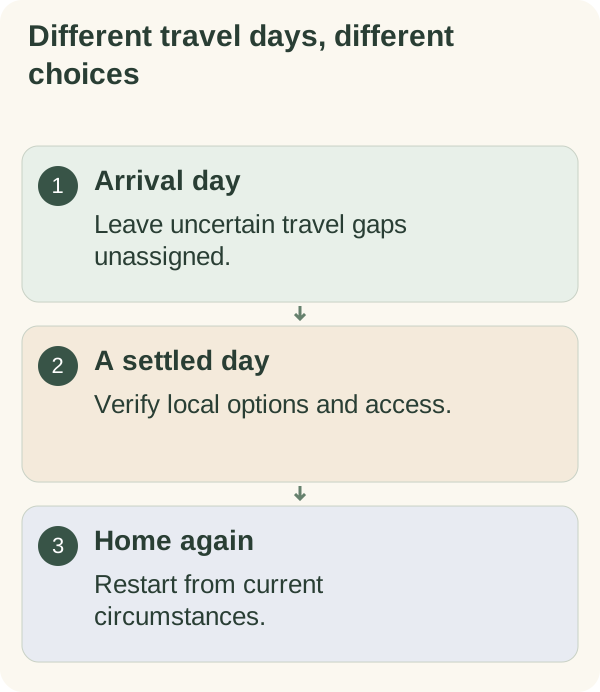
Travel days include the journey out, the journey back and any day with long connections. Plan nothing. If an option turns up, such as a walk while waiting for a delayed train, take it as a bonus.
Full days away are days when you wake up and go to bed in the same place. Plan one option per day at most, and keep it a maybe until you have checked the route or facility.
The first normal day home is when your usual routine restarts, on its usual schedule. Not the day you land, and not with extra sessions.
Plan the trip's movement before you go
- Mark the days.
Label every day of the trip as travel or full.
- Pick one option per full day.
Choose a walk or a facility, and note it as a maybe.
- List what to check.
Write down what you need to confirm on arrival.
- Pack for that option only.
Shoes you can walk in, plus anything the option requires.
- Name the restart day.
Put your first normal day home in your calendar now.
Check the area before you rely on it
Use current information from the accommodation, venue or local authority. If a facility matters, confirm access, opening hours, booking rules and any cost. A listing photograph does not establish that a space will be open to you during your stay.
For walking, the people at the front desk or your host often know which streets feel comfortable and which to avoid. In an unfamiliar place after dark, stay on lit, busy streets, keep your phone charged, carry the address of where you are staying and let someone know your plan. Check local weather warnings and heat or cold advice where you are, which may differ from home. Here is wording you can use on arrival:
Question for the front desk or your host:
"I'd like to go for a walk in the morning [or evening]. Is there a route
nearby you'd recommend that is well lit and easy to find my way back from?
Is there anywhere I should avoid?"

If you need a facility:
"Is the gym [or pool] open to guests during my stay? What are the hours,
and do I need to book or pay?"
Example: Daniel's three-night work trip
This is an illustrative example, not a real person's story. Daniel goes to the gym on Tuesdays and Saturdays and walks after lunch on workdays. A conference took him away from Monday to Thursday, and in the past trips like this had ended his routine for a fortnight, because he felt he had to make up the missed sessions before getting back to normal.
His travel version was small. Monday and Thursday were travel days with nothing planned. On Tuesday and Wednesday he would walk from the hotel to the conference venue if the route was suitable, and take an evening walk only if dinner finished early.
On Tuesday morning he found the route to the venue ran along a busy road with a narrow verge and no pavement for part of the way. He took the shuttle bus instead and walked a loop of the hotel grounds before breakfast, which the front desk had suggested. He skipped the evening walks. He did not count his missed Tuesday gym session. On Saturday he went to the gym as usual, and the routine carried on as if the trip had been a short pause rather than a break.
When the trip is for a hard reason
Most travel fitness advice assumes a holiday or a business trip. Some trips are not like that: a hospital visit, a funeral, looking after a parent, an emergency.
- If you are travelling for something difficult, you do not need a movement plan. Let the routine pause and name a restart day later.
- If a short walk would help you breathe, a few minutes outside the building, on a route you can see from the door, is enough.
- If you are travelling with children or someone who needs care, walks may need to be together, at their pace and on their schedule.
- If you have a health condition, an injury, a pregnancy or a mobility limit, ask a doctor or qualified professional how to manage activity while away, especially on long journeys.
For days when the trip fills everything, make room for a difficult day helps you decide what can wait.
Pack only for options you would use
Check what an activity requires and what you can reasonably carry. You do not need to buy travel equipment merely to preserve a routine label. Shoes you can walk in cover most options. If something essential for an option is missing, drop the option rather than improvising an unsuitable substitute.
Come home without a make-up total
Review which arrangements were useful and let the next home occasion start from current circumstances. A travel gap does not automatically become extra work in your first week back. Keeping a travel version small is how Armored Kitten approaches habits and goals more widely: a routine that bends for a trip is more likely to still be there when you get home.
The weekly review can help you adjust the routine after returning. The route and opportunity cards in the walking planner can hold what you have verified at the destination. Leave unconfirmed details as questions. For trips that often get cancelled by the weather, the rainy-day walking guide has a simple decision rule.
Questions people often ask
Should I bring workout kit just in case? Only for an option you have actually planned. Otherwise, walking shoes are enough.
Is it worth walking on a travel day? If a chance turns up, such as a long wait between connections, take it as a bonus. Do not plan around it.
How do I avoid losing the routine after I get back? Name the restart day before you leave and go back to your usual schedule that day, without adding extra sessions.
What if I am travelling across time zones? Plan nothing for the first full day and decide from there. If sleep or health is affected, ask a doctor for advice.