On Friday, sketch the weekend as six blocks (morning, afternoon and evening on each day) and decide which block holds the walk, which holds rest and which holds jobs, before anything else claims them. Give the walk a start time, a turnaround time and a cancel rule. Leave at least one block completely open. Rest is a block you plan, not whatever is left after the walk and the chores.
Printable walking planners usually give you a grid of days and a box for minutes or kilometres. That helps if you are following a training plan. It does little for the more common weekend problem: the walk, the shopping, the visit and the laundry all compete for the same two days, and rest loses. This planner starts from the weekend, not from the walk.
Map the weekend before you fill it
Copy this grid on Friday evening. Fill each block with one word: Walk, Rest, Jobs, People or Open.
| Block | Saturday | Sunday |
|---|---|---|
| Morning | ||
| Afternoon | ||
| Evening |
Three simple rules keep it honest:
- One walk block. If you want a second, it has to replace jobs, not rest.
- At least one rest block. Rest means nothing scheduled, not "errands I enjoy".
- At least one open block. This absorbs whatever overruns, so nothing else has to move.
Fill rest first if the week was hard. Fill the walk first if you have someone to meet. Either way, the grid makes the trade-offs visible before Saturday morning arrives.
Pick the walk to match what the weekend can hold
| What the weekend looks like | A walk that fits |
|---|---|
| Busy, with one free morning | A local loop from your door, no travel needed |
| One clear half day | A park or path you already know, with simple transport back |
| Clear, but you are worn out | The local loop again, and a full rest block after it |
| Visiting family or friends | A short walk together near where you are staying |
| Long, quiet weekend | A new place, with the extra checks below |
A walk that needs a long drive or two trains also costs travel time and energy. Count that when you choose the block, and pick closer on tired weekends.
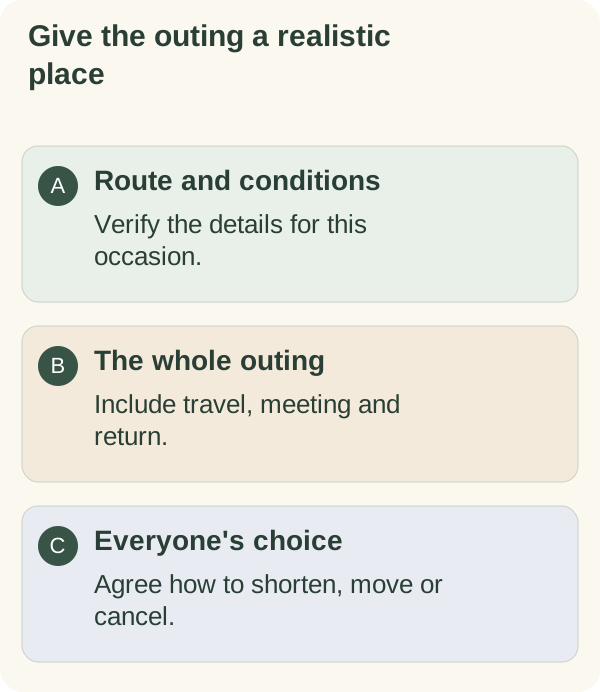
Check the outing the evening before
For a familiar route, a quick look is enough. For somewhere new or remote, do a proper check: official local information for closures and access, the forecast and any weather warnings, the time it gets dark, where the toilets and shelter are, and how you get back if you stop early. Tell someone where you are going and when you expect to be back, especially on quiet or unfamiliar paths, and take a charged phone.
Choose activity appropriate to your circumstances. This planner does not prescribe a route difficulty, distance, pace or required amount of activity. If you have a health condition, a pregnancy, pain when walking or a mobility limit, ask a doctor or qualified professional before trying a longer or rougher outing than usual.
Friday-evening outing check
- Getting there and back.
Note the route, transport and the latest way home.
- Morning check.
Write what you will look at before leaving: forecast, warnings, closures.
- Turnaround time.
Pick the time you head back, whatever point you have reached.
- Company.
Confirm who is coming and how anyone can cancel.
- Protected block.
Name the rest block that stays untouched whatever happens.
Example: Maya's weekends stop disappearing
The example below is illustrative; the person in it is not real. Maya works full time and kept planning big Sunday walks on routes an hour's drive away. Most weekends something got in the way, the walk was cancelled, and the chores she had pushed aside spread over the whole two days. By Sunday night she felt she had neither walked nor rested.
She started filling the Friday grid:
- Saturday: jobs in the morning, rest in the afternoon, people in the evening.
- Sunday: a walk in the morning with her friend Sam in the local park, starting at nine, turning back by half ten. Afternoon open.
- Cancel rule: if there is a weather warning or either of them is too tired, a message by eight o'clock cancels it, no reason needed.
The first weekend went to plan. On the second, Sunday was wet and they cancelled. Maya's instinct was to move the walk to Saturday afternoon, but that was her rest block, so she let it go. By the third weekend she noticed Saturdays were when she felt most drained, so she moved rest to Saturday morning and jobs to the afternoon. The longer routes became something to plan for a long weekend, not every Sunday.
When the weekend is the only time you have to recover
Weekend walking advice tends to assume energy to spare. If the week empties you, plan differently.
- If you finish the week exhausted, fill the rest blocks first and make the walk a maybe. A short local walk on Sunday is enough of a plan.
- If you work or care for someone at weekends, choose one short walk in the block that is least likely to be interrupted, and keep the small version available.
- If the walk needs a long journey, count the travel as part of the load and pick something nearer when you are tired.
- If you feel unwell, skip it. A planned walk does not outrank being ill.
- If the weekend is the only time you see your family, a walk together may be the people block and the walk block at once.
- If you have been ill, injured or are pregnant, check with a doctor or qualified professional before a longer outing than you are used to.
Plan company without handing over responsibility
Ask companions what setting and time suit them, and confirm the meeting point and how to tell each other about a change before anyone sets off. A walk invitation does not make another person responsible for keeping your routine going. If you are unsure how to ask, take a small connection step helps you find the words. A cancel agreement you can send:
"Shall we say: if there's a weather warning, or either of us isn't up to it, a message by eight cancels it. No explanation needed, and we pick another weekend later."
After the weekend: one note and no carry-over
On Sunday evening, write one practical note: a route detail to check, an easier meeting point, a better block for the walk. Do not carry a cancelled walk into next weekend automatically; plan next weekend from its own grid.
Protecting a rest block alongside a walk is a small example of what Armored Kitten's habits and goals guides aim for: routines that fit an ordinary week, including the part where you recover from it.
The weekly review template can help you give the outing a realistic place without filling the whole weekend. Use the opportunity and route cards in the walking planner to check the outing before fitting other commitments around it. If the weather is the usual reason walks fall through, the guide to walking when it rains has a ready-made rule.
Questions people often ask
Should I make up a missed weekday walk at the weekend? No. Plan the weekend from its own grid. Make-up walks tend to eat the rest block.
Is it fine to have a weekend with no walk at all? Yes. Sometimes the right plan is two rest blocks and an open one.
What should I take on a longer weekend walk? Water, a charged phone, layers for the forecast and anything you need for a health condition. For anything specific to your health, follow professional advice.
How do I try a new route safely? Use official local information, go in daylight, tell someone your plan and set a turnaround time before you start.