Ask your friend for one walk, not a routine: a specific day, a place you both know and an easy way to say no. On that first walk, agree on the three things that cause most trouble later: where and when you meet, how either of you cancels, and what each of you does when the other cannot come. Then decide together whether to repeat it, and how often. A shared walk lasts longest when neither person's routine depends on the other turning up.
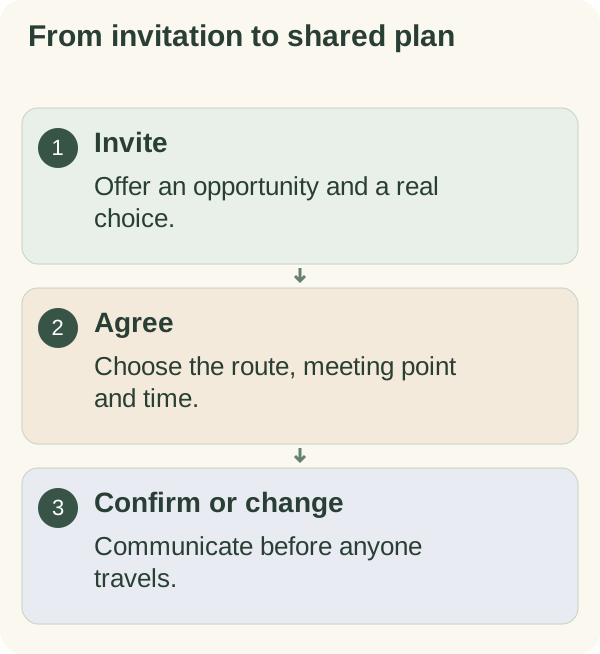
Walking with a friend is often suggested as a way to stay motivated, usually with a standing weekly date and the friend as your accountability. That can work, but it also puts pressure on the friendship: one person cancels, the other feels let down, and both start to dread the conversation. Agreeing a few details at the start avoids most of that.
Ask for one walk, not a routine
A first invitation should be easy to accept and easy to decline. Here are some messages to adapt.
First invitation:
"Fancy a walk round [place] on [day] morning? Nothing strenuous, just a chance
to catch up. No problem at all if that day doesn't work."

If they say yes:
"Great. Shall we meet at [exact spot] at [time]? I need to be back by [time],
how about you?"

After the walk, if you'd like to repeat it:
"I really enjoyed that. Would you want to do it again sometime? Happy to keep
it occasional, or make it a regular thing if that suits you."

If they say no or don't reply:
"No worries at all, the offer's open any time."
If they do not reply, respect the limits of your friendship and do not assume the walk is on. You can go on your own.
Agree the details that cause friction later
| Detail | What to agree | Why it matters |
|---|---|---|
| Meeting point | An exact spot both of you can find, such as a named gate or café | "By the park" leads to two people waiting at different entrances |
| Time available | Each person's latest finish time | One person rushing back spoils the walk for both |
| How you like to walk | Chatty and slow, steady, or a mix | Mismatched expectations make one person feel dragged or held back |
| Route needs | Step-free paths, toilets, a buggy, a dog, places to sit | Needs that are not mentioned become reasons to drop out |
| Cancelling | By what time, by what method, no reason needed | Removes the awkward conversation entirely |
| Weather | Your shared rain rule | Saves a round of "are you still up for it?" messages |
Check access needs, travel, local conditions and the time each person has. The person suggesting the walk should not assume the other wants the same pace, distance or setting. If either of you has a health condition, pain, a pregnancy or a mobility limit, each person should check with their own doctor or professional what suits them.
Turn one walk into a shared arrangement
- Walk once.
See whether you enjoy it before discussing a schedule.
- Choose a rhythm.
Weekly, fortnightly or whenever both of you are free.
- Fix the meeting point and time.
Write them in a shared message so neither of you has to remember.
- Agree the cancel rule.
A cut-off time and "no reason needed".
- Agree the solo plan.
Each of you says what you do when the other cannot come.
Example: Alex and Daniel find a rhythm that fits
Here is a made-up example to show how it can work. Alex wanted to walk more and asked his friend Daniel, whom he had not seen much since they stopped working together, to join him on Saturday mornings. They met three weekends running. Then Daniel started cancelling, usually late on Friday night with a long apology. Alex began to feel annoyed and Daniel began to feel guilty.
On the next walk they talked about it. Daniel's Saturdays had changed: he now had his children every other weekend. They agreed:
- Rhythm: every other Saturday, on Daniel's free weekends.
- Cancel rule: a message by eight on Saturday morning, no explanation needed.
- Solo plans: Alex walks the same loop alone on the other Saturdays. Daniel walks with his children when they want to.
The cancellations mostly stopped, because the rhythm now matched Daniel's real weekends. Alex's routine no longer depended on anyone else, and the shared walks became something both of them looked forward to.
When you walk at different speeds, or one of you keeps cancelling
Friend-walking advice usually assumes two people with the same pace and the same diary. Often neither is true.
- If one of you is faster or fitter, let the slower person set the pace for the shared walk. The faster person can add their own walk separately on another day.
- If one of you has mobility or access needs, choose the route around those needs and check it together before relying on it.
- If your friend keeps cancelling, move to occasional invitations instead of a fixed date, and keep your own solo walk on the original day.
- If you are the one who keeps cancelling, say so plainly and suggest a rhythm you can actually keep.
- If you meet after dark, choose a lit, busy meeting point and route, and agree how each of you is getting home.
- If the walks are starting to strain the friendship, pause them and keep in touch another way. A walk is one way to stay close, not the only one.
Keep your own routine separate
If you record attendance, record your own choices. Do not create a report of another person's activity or missed occasions without their informed agreement. For a private record of the routine you choose, try the habit tracker.
Inviting a friend to walk is one of the places where both halves of Armored Kitten's purpose meet: a manageable step for your own habits and goals, and a small step towards someone you care about. Use take a small connection step to prepare an invitation.
If you want your friend to check in on your progress more broadly, asking a friend to be an accountability partner covers that conversation. For walks that alternate with another shared activity, see starting a shared walking or reading routine.
Keep the route and time you agree in the walking planner. Use the messages above for the separate conversation with your friend.
Questions people often ask
How often should we walk together? Whatever both diaries can hold. Fortnightly walks that happen beat weekly ones that keep getting cancelled.
What if my friend wants to walk further or faster than I do? Say so before you set off. Agree a route that suits the slower person, or walk separately as well.
Should we track each other's walks? Only your own, unless you both explicitly agree otherwise.
What if I'd rather walk with a group? Local walking groups exist in many areas. Check who runs one, where it meets and whether the routes suit your needs before you join.