Choose the format before the schedule. You might walk side by side and talk, walk the same route at different times and compare notes, read the same book at your own pace with agreed stopping points, or read separately and then walk while you discuss it. Try one occasion, then decide together whether to repeat it. Keep the shared part small and let each person's pace stay their own.
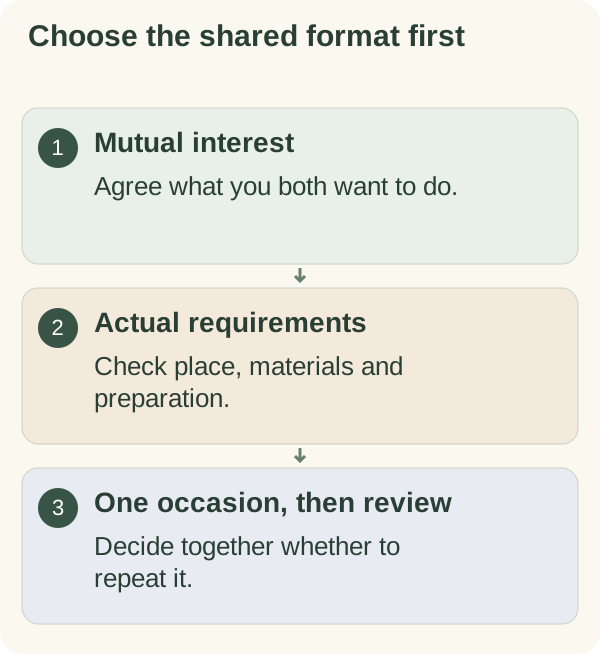
Agree on what "shared" means
One person's idea of a reading routine together is a book club for two. Another's is sitting in the same room, each with their own book, saying nothing for an hour. Both are good. They just are not the same plan.
| Format | What you actually do | Suits friends who |
|---|---|---|
| Walk and talk | Walk together at a gentle shared pace and chat | Want time together and fresh air |
| Same route, different times | Each walks an agreed route when free, then swaps a photo or a thought | Have schedules that rarely match |
| Buddy read with checkpoints | Read the same book, stopping at agreed points to discuss | Like talking about books |
| Quiet reading together | Read your own books in the same place, then chat briefly | Want company more than discussion |
| Read, then walk | Read on your own, then walk together and talk about it | Want both habits at once |
State the format clearly when you invite. Your preferred version is a suggestion, not an agreement for the other person.
Check the practical needs
For walking: choose a route that suits both of you, including surfaces, light, toilets, places to stop and how you will each get there. Have a plan for bad weather, such as a covered route or swapping to a call. If you have a health condition, an injury or any doubt about what is suitable, ask a doctor or suitably qualified professional before starting, and walk at a pace that suits whoever needs it gentler.
For reading: check that the book is available in a format each person can use, such as print, large print, ebook or audio, and whether it costs anything or can be borrowed. Agree how far to read before you meet and whether finishing early means you can talk about the ending.
Plan the first shared occasion
- Interest:
choose an activity you both want.
- Format:
pick a row from the table above.
- Arrangements:
confirm time, place, route or book, access and any cost.
- Preparation:
agree what, if anything, should be done before you meet.
- Change:
make it easy to cancel, postpone or swap formats.
A sample first month
This is a sample to adapt, not a target. There are no distances, durations or page counts you need to hit.
| Week | Walking version | Reading version |
|---|---|---|
| 1 | One walk on a route you both know | Choose a short book together; agree the first checkpoint |
| 2 | Check in by message about how it felt; pick the next date | Read to the checkpoint in your own time |
| 3 | Second walk, perhaps a route the other person picks | Meet or call to talk about the first part |
| 4 | Decide: same again, change something or stop | Decide: keep going, choose another book or pause |
The decision in week four matters as much as the walks or the chapters. A month is long enough to know whether the arrangement suits you both.
Example: Maya and Daniel read, then walk
The example below is illustrative; the person in it is not real. Maya wanted to read more. Daniel wanted to get out of the house more at weekends. They decided to read the same short novel and talk about it on a walk every other Saturday.
What went wrong: Daniel reads quickly and finished the book in a week. On their second walk he wanted to talk about the ending, and Maya, halfway through, felt behind and a bit flat.
What they changed: they split the next book into three checkpoints and agreed to discuss only up to the current one. Whoever finishes early can start the next book on their own or simply wait. They also took turns choosing the route, and swapped to a phone call on a weekend of heavy rain rather than cancelling.
After that: the walks became the part both of them looked forward to, and the checkpoints took away the race. Maya said she was reading more than she had in years, at her own speed.
When your paces do not match
This is where shared routines most often stall, and most advice does not mention it.
- If one of you walks much faster, the slower pace sets the speed on shared walks. The faster walker can do an extra stretch alone afterwards if they want.
- If one of you reads much faster, use checkpoints and a no-spoilers rule, or choose shorter books, essays or stories that both can finish in time.
- If one of you wants silence and the other wants to chat, agree a mix: talk for the first part, quiet for the rest, or quiet reading followed by a short chat.
- If one of you wants to track progress and the other does not, keep tracking personal. Nobody needs to report pages or distance to the other.
- If one of you has less free time, let them set the rhythm. A shared routine runs at the speed of the busier person.
Begin without a permanent promise
An illustrative invitation: "Would you like to read something together and talk about it on a walk in a couple of weeks? No pressure to finish anything first." Propose one occasion, not an open-ended weekly appointment.
If preparation is genuinely needed, such as reading a section first, say so honestly at the start rather than presenting it as optional and then expecting it.
Keep personal records personal
You can track your own part if it helps you. A small personal habit, such as reading a few pages after lunch on the days you choose, is a good fit for the companion; build a small routine once you know how the shared arrangement works. Do not keep an attendance or progress record for the other person without their clear agreement. A shared activity does not need to become mutual monitoring.
Decide on repetition together
After the first month, ask whether the same arrangement still suits you both. Occasional invitations may fit better than a fixed rhythm. Either of you can love the activity and still change how often you do it, or stop.
Doing one small thing alongside a friend is where Armored Kitten's two halves meet: a manageable routine for you, and a regular reason to spend time with someone you care about. For the solo side of each habit, see making walking part of your day and reading more when you never find the time. If walking together is the whole plan, starting a walking routine with a friend goes into meeting points and cancelling. If the invitation is the hard part, the guides in Find the words for someone can help.
When you are ready to ask, take a small connection step helps you shape the message. The shared-activity card in the Low-pressure connection cards has room for the format, the practical needs and how the plan can change.
Questions people often ask
Is it better to walk or read together? Whichever you both want. Combining them, reading apart and walking to talk, works well for friends who like both.
How do we pick a book we will both enjoy? Take turns choosing, or each suggest three and pick one from the other person's list.
What if one of us keeps cancelling the walk? Ask whether the time, route or format is the problem. Swapping to a call or a different day often helps more than pushing.
Do we need a fixed day? No. A loose "every couple of weeks" works for many people, as long as one person suggests the next date.