Have one catch-up first. Then, at the end of it, while it still feels easy, suggest how the next one will happen: a loose rhythm such as "every few weeks", an anchor such as "the first Sunday of the month", or a simple rule about who suggests the date. Agree in the same conversation that either of you can move or skip it without it meaning anything about the friendship.
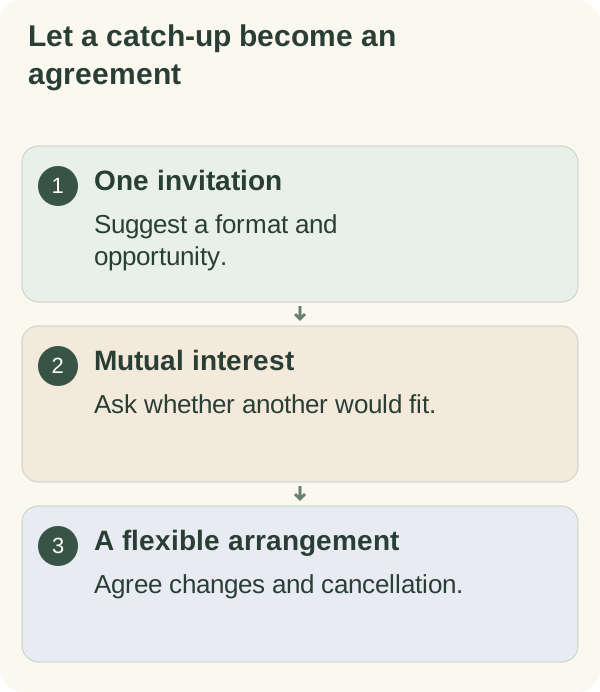
Choose someone you feel comfortable contacting. You can leave a relationship alone when contact would be unsafe, unwelcome or against a request for space.
Start with one catch-up, not a schedule
"We should do this every month" lands differently before you have met than after. Before, it can sound like a contract. After a good evening, it sounds like a natural wish. So begin with a single, specific invitation that fits your real availability: a call, a coffee, a walk, a meal at one of your homes.
Here is an illustrative message to edit:
Would you like to catch up one evening next week? A call works for me, or coffee near your office if that's easier. No problem if next week is already full.
You do not need to apologise for a quiet period before suggesting a conversation. If starting contact again is the hard part, read small ways to reconnect first.
Pick a rhythm that suits this friendship
There is no correct frequency. The useful question is which arrangement you would both still keep in a busy month. Each of these works for some friendships and fails for others.
| Rhythm | How it works | Suits friends who | Watch out for |
|---|---|---|---|
| Fixed slot | Same day and time each cycle, such as alternate Thursdays | Have stable weeks and like not having to plan | Shift work, school holidays and travel breaking it repeatedly |
| Anchored date | Tied to a repeating marker, such as the first weekend of the month | Want a reminder built into the calendar itself | Picking an anchor one of you is often busy for |
| Loose cadence | "Every five or six weeks", date chosen each time | Have changing schedules but want regular contact | Nobody suggesting the date, so the gap stretches |
| Taking turns | Whoever hosted or booked last time, the other picks next | Want to share the planning fairly | Losing track of whose turn it is |
| Open standing invite | "I'm at the café every Saturday morning; join whenever" | Like low commitment on both sides | Feeling unwanted if the other person rarely comes |
Pick one, try it for two or three cycles, and change it if it keeps slipping. A rhythm that suits the friendship is worth more than one that sounds devoted.
Ask at the end of a good catch-up
The best moment to propose a repeat is just before you part, when you both have the evening in mind. Say what you enjoyed, offer one option and leave room for a different answer.
I've really enjoyed this. Would you like to make it a regular thing?
Something like [rhythm, e.g. once a month on a Sunday morning]
could work for me, but I'm happy with whatever suits you,
including just doing it when we both feel like it.
If the answer is a warm "maybe", take it as a yes to another catch-up, not to a schedule. You can raise the rhythm again next time.
Agree the practical details
- Format:
what kind of catch-up do you both enjoy most?
- Rhythm:
which option from the table above would you both keep?
- Who suggests the date:
one person, taking turns, or whoever thinks of it first?
- Skip rule:
what happens when one of you cannot make it?
- Reminders:
does either person want a private prompt for their own planning?
Agree a skip rule before you need one
Regular catch-ups rarely end with a decision. They end after one cancellation, when nobody is quite sure whose job it is to rebook. A skip rule removes that uncertainty. Pick one of these, or write your own:
- Next slot as normal: if one is missed, you simply meet at the next anchor date. Nobody owes a make-up.
- The canceller rebooks: whoever cancels suggests the next date within a week.
- Swap the format: if meeting in person falls through, a short call that week counts.
A cancelled catch-up does not create an obligation to meet twice next time. If a reply to a rebooking message is slow, you do not know the reason, and repeated prompts make it harder to answer.
Example: Maya and Alex's monthly breakfast
This is an illustrative example, not a real person's story. Maya and Alex sat next to each other at work for years. When Alex changed jobs, they kept ending messages with "we must catch up properly" and never did.
What Maya did: she suggested one breakfast on a specific Sunday. At the end of it, she asked whether the first Sunday of every month could be their breakfast. Alex said yes.
What went wrong: Alex's new job had a weekend rota. Two of the first three first Sundays fell on her working weekends, and each cancellation left a long silence afterwards.
What they changed: they kept "once a month" but dropped the fixed Sunday. Now, in the first week of each month, whoever hosted last time sends two possible dates. If neither works, they swap to a phone call that month. Since the change, a missed breakfast just means a call, and the next date is already somebody's job.
A catch-up rhythm card
Fill this in together or for yourself before you suggest a rhythm.
| Question | Our answer |
|---|---|
| What kind of catch-up do we enjoy? | |
| Which rhythm will we try? | |
| What does it hang on (a date, a day, a habit)? | |
| Who suggests the next date? | |
| What happens if one of us cancels? | |
| When will we check it still suits us? | After ___ catch-ups |
When you are always the one who organises
This is the part most catch-up advice leaves out. Often one friend does all the asking, and over time that friend starts to wonder whether the other would notice if they stopped.
- If you suspect it but are not sure, look back honestly. Some people are reliable responders and poor initiators. They come every time they are asked and would never think to ask first.
- If it bothers you, say so lightly and specifically: "Would you mind suggesting the date next time? I always seem to be the one with the calendar out." Taking turns from the table above makes this a rule rather than a complaint.
- If they agree but still never initiate, decide whether you are happy to keep organising for a friendship you value. That is a fair choice. So is reducing the rhythm to something that feels balanced.
- If you feel resentful, stop keeping silent score and have the conversation. A friend cannot respond to a tally they do not know exists.
- If one of you has new caring duties or a new baby, make the catch-up easier to say yes to: shorter, nearer to them, or a call while they are already out with a pram or doing an errand.
And if your catch-ups have shrunk into status reports, do something together next time: a walk, cooking, a market. Starting a walking routine with a friend covers the practical side of meeting on foot.
Keep private notes modest
If a personal reminder helps, record only what you need: "Suggest dates to Alex in the first week". You do not need to save details of another person's life in a planning app.
A standing catch-up is the friendship version of the small routine Armored Kitten encourages elsewhere: easy to keep, easy to move and never a test of how much you care. The encouragement message helper can help you shape the invitation in your browser. Read and edit the result, then send it through your own messaging app if you choose to.
Choose a connection step when you want an illustrated planning card. The companion does not contact your friend, establish their consent or make an agreement on their behalf. Use the invitation and boundary fields in the Low-pressure connection cards before you raise a repeat arrangement. More guides on staying in touch sit under Find the words for someone.
Questions people often ask
How often should you catch up with a close friend? As often as you would both still manage in a busy month. For some friends that is weekly; for others, a few times a year is plenty.
Should we send each other calendar invites? Only if you both use them. For some people an invite feels helpful; for others it feels like a meeting. Ask.
We keep cancelling. Is it time to stop? Try a smaller format first, such as a call instead of dinner. If even that keeps slipping, a looser rhythm may suit you better than ending it.
How do I stop a regular catch-up without hurting someone? Suggest a change rather than an ending where you can: "Could we make it every couple of months? My weekends are full right now."