Agree on one live call at a rhythm you can both keep, and fill the weeks between with small messages that need no reply: a voice note, a photo from your day, a line about something that reminded you of them. Check the local time in both places for each call date, because clock changes do not happen on the same day everywhere. Then say out loud that slow replies are fine, so a quiet week never has to be explained.
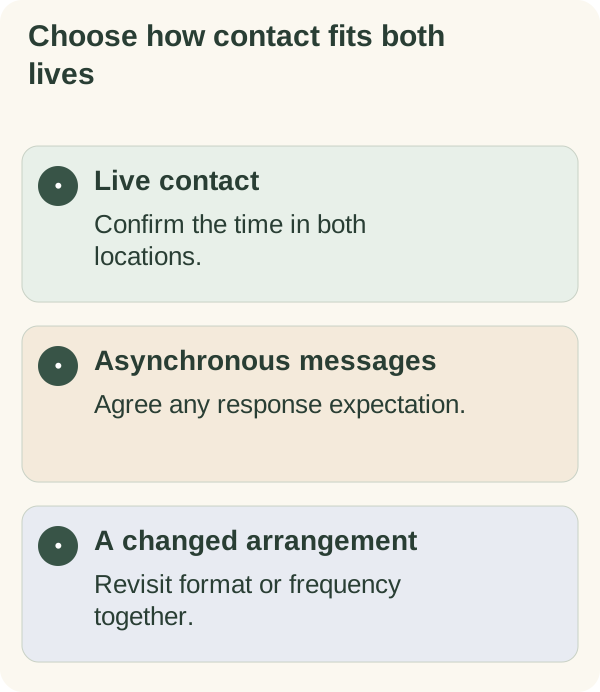
Separate the call from the in-between contact
Long-distance friendships often strain under one expectation: that you will talk properly, often. Calls across time zones are harder to arrange than a coffee across town, so they slip, and each slipped call makes the next one feel more overdue.
It helps to treat contact as two layers. The anchor is a live conversation at a rhythm you both choose, perhaps monthly. The in-between layer is small, low-effort contact that keeps you in each other's everyday lives. The anchor carries the depth; the small touches carry the continuity. Neither has to do both jobs.
Choose formats by effort and reply expectation
| Format | Effort to send | Reply expected? | Works well for |
|---|---|---|---|
| Photo of something from your day | Seconds | No | Staying part of each other's ordinary life |
| A one-line "this reminded me of you" | Seconds | No | Busy weeks, wide time differences |
| Voice note | A few minutes | Whenever, if at all | Friends who miss each other's voices |
| Card or letter by post | Longer, plus postage time | No | Birthdays, moves, hard news, something to keep |
| Watching or reading the same thing, then messaging about it | Your own time | Loosely | Friends who used to do things together |
| Live call | An agreed block of time on both clocks | It is the conversation | The anchor: the proper catch-up |
Discuss format before schedule. One of you may love voice notes; the other may find them hard to listen to at work. One may have privacy for calls only at certain times. Ask, rather than guess.
Find a call time that works on both clocks
Use real calendar or world-clock information for the date you are booking. Many countries change their clocks for daylight saving on different dates, and some do not change them at all, so the gap between you can shift by an hour for a few weeks of the year.
Copy this planning card and fill it in for your next call.
Call date:                  ____________
My local time:              ____  (my day: __________)
Their local time:           ____  (their day: __________)
Clock change near this date?  Yes / No / Check
Is either of us just waking up or about to sleep?  ____
Backup if it falls through: [voice note / try the next weekend]
The "their day" line matters. A Sunday morning for you may be Sunday evening for them, or even Monday.
Agree on a manageable check-in
- Format:
choose the anchor and the in-between contact you both like.
- Opportunity:
pick a call rhythm, or agree that contact is mostly asynchronous.
- Expectation:
say which messages need a reply and whether any timing matters.
- Privacy:
ask before sharing each other's messages, voice notes or photos with anyone else.
- Change:
make postponing or reshaping the arrangement easy to suggest.
Example: Sam and Daniel, eight hours apart
The example below is illustrative; the person in it is not real. Sam stayed in his home city when Daniel moved abroad for work, eight hours ahead. They promised to call every week.
What happened: the only overlap was Sam's early morning or Daniel's late evening. One of them was always tired, calls kept moving, and after two months they had managed three. Each missed week made the next message feel more like an apology.
What they changed: they kept one call a month, on a Sunday morning for Sam and Sunday evening for Daniel, and agreed that voice notes in between needed no reply. Sam records his on the walk to the shop; Daniel listens on his commute.
What they learned: in the spring, their countries changed clocks on different weekends and Daniel turned up an hour early. Now whoever suggests the date checks both local times the week before. When Daniel's birthday came round, Sam timed a card to arrive on Daniel's morning rather than his own. The guide to birthday messages for a long-distance friend has more ideas for that.
Leave room for ordinary gaps
An illustrative message to set expectations:
Would occasional voice notes suit you while our schedules are so different? No need to reply the same day, or at all. We can grab a call when there's a good opening.
Use that wording only if it reflects the arrangement you want. A delayed reply does not explain itself, and it is not a measure of how much someone values you.
When one life speeds up and the other does not
The moments most long-distance advice skips are the ones where the two lives stop moving at the same pace.
- If they have a new baby, a demanding new job or a parent to care for, shrink your expectations, not the friendship. Short messages that need nothing back become the main contact for a while. A call can wait for a quieter season.
- If you are the busy one, a single line now and then ("Still here, still thinking of you, life is chaos") keeps the door open better than silence followed by a long apology.
- If they have built a new circle where they live and you feel left behind, say so gently if it matters, and ask what contact they have room for. New local friends do not have to replace you.
- If there is no comfortable live overlap at all, make contact fully asynchronous and plan an occasional call as an exception, perhaps on a holiday or a weekend when one of you can stay up late.
- If one of you is moving again, agree to pause the rhythm until things settle, and name a rough date to restart.
Keep reminders about your own action
A private reminder can say "consider sending Daniel a voice note" without storing details of your conversations. It should support your choice to reach out, not score the other person's replies. Check the actual reminder settings in whatever you use; reading this article does not send a message or set up a notification.
Revisit the arrangement when life changes
If calls keep falling through, ask whether a different format or a slower rhythm would suit you both. You can value a friendship deeply and still change how often you talk.
Distance makes every check-in a little harder to arrange, which is why choosing one manageable step, such as one anchor call or one small message, works better than trying to keep up a perfect weekly record. More ideas for voice notes and well-timed greetings are in Make distance feel smaller.
Use take a small connection step to draft a message. The small ways to reconnect guide helps if the friendship has already gone quiet. The timing and boundary fields in the Low-pressure connection cards are a place to note the format and expectations you actually agree.
Questions people often ask
How often should long-distance friends talk? Whatever you can both keep without it feeling like a chore. Many friendships do well with an occasional call and small messages in between.
What if we always seem to be in different time zones' bad hours? Make contact mostly asynchronous and treat a call as a planned event a few times a year.
Is it okay if we go weeks without talking? Yes, if you both understand that. Saying so out loud removes the guilt from quiet stretches.
How do I bring up that the friendship feels one-sided? Gently and specifically: "I miss hearing from you. Would voice notes be easier than calls right now?"