Stop hunting for a weekly slot you both have. Instead, pick a format that works around the gap: each of you does the hobby on your own time and shares something from it (a photo, a page, a question), and the rare evenings when you are both free become a proper session together. Agree what the shared part is, and that replies can wait. The hobby stays shared even when the calendar is not.
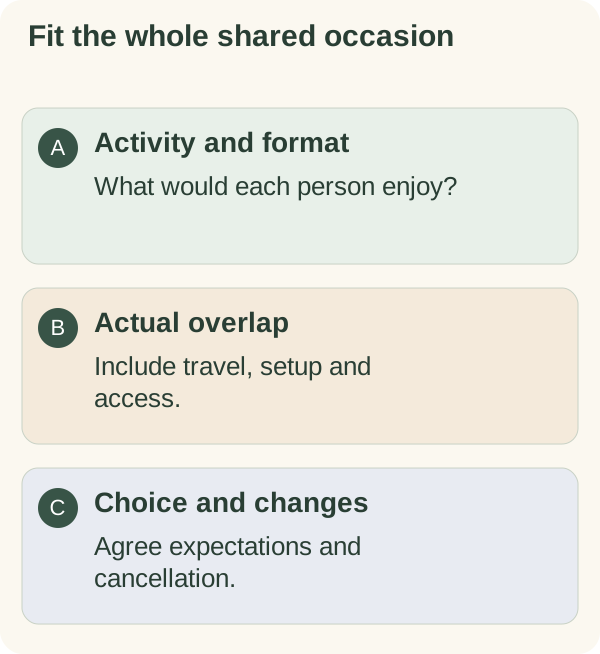
Ask about interest before availability
Two people can love the same hobby and want completely different things from doing it together. One wants to make something side by side. The other wants to work alone and compare results. One wants to improve; the other wants a reason to see a friend. Ask first: "What would you enjoy about doing this together?"
Keep the idea open to a no. Someone may like the hobby and still have no room for it right now. A free-looking evening in a shared calendar is not consent to a new commitment.
Map the overlap before choosing a format
Spend five minutes each writing down when you could genuinely do the hobby over the next four weeks, then compare. Mark only the windows long enough for the whole thing: travel, setup, the activity itself and packing away.
            Week 1        Week 2        Week 3        Week 4
Me:         Tue eve       Sat morning   Thu eve       none
Them:       Sat morning   Sat morning   Wed eve       Sun afternoon
Overlap:    none          Sat morning   none          none
Long enough for the full activity?      Yes / No
If the grid shows one or two overlaps a month, that is your answer: plan those as special sessions, and do the rest in a format that does not need you in the same place at the same time.
Formats that work when you are rarely free together
| Format | How it works | Suits |
|---|---|---|
| Parallel projects with a reveal | Each works on their own piece; you share progress at an agreed point, such as the end of the month | Crafts, writing, photography, cooking |
| Relay | One object or project passes between you, each adding a part | Shared sketchbooks, a puzzle, a story told in turns |
| Same prompt, different days | You pick one theme or challenge; each does it when free | Drawing, baking, music practice |
| Short overlap session | A brief call while you both work on your own pieces | Quiet hobbies that suit company more than conversation |
| Occasional long session | A planned meet-up when the grid shows a real overlap | Anything with travel, booking or setup |
Combine two: a same-prompt fortnight with a long session whenever the overlap allows is often enough to keep a hobby feeling joint.
Plan one shared occasion
- Activity:
agree what you will actually do together.
- Opening:
pick from the real overlaps on your grid.
- Arrangements:
confirm place, materials, access and any cost.
- Finish:
choose an end time or a point to stop.
- Change:
agree how either of you can postpone or cancel.
An illustrative invitation for a long session: "Would you like to bring our current projects to the community room on Saturday morning? We can stay as long as we both have. If the room or the day falls through, we'll keep sharing photos and try next month." Check the venue's actual arrangements before you confirm.
Example: Daniel and Sam's sketching
An illustrative example (the person is made up): Daniel and Sam both took up sketching in the same year. Daniel works evenings; Sam works most weekends. For two months they tried to find a weekly slot to draw together and managed it once.
What they did: they mapped a month and found two Saturday mornings that overlapped. They kept those for drawing together at a café. For the rest of the time, they chose one theme per fortnight, such as "something on your street", and each sketched it when they could, sending a photo by Sunday.
What went wrong: Daniel had a heavy month at work and missed two Sunday photos in a row. He felt he had let Sam down, and Sam worried he had lost interest.
What they changed: they dropped the Sunday deadline. Photos now arrive whenever they are done, and they look through the fortnight's sketches together at the start of each café morning. Missing a theme simply means one less drawing to show.
Consider an asynchronous option only if both people want it
Sharing a photo, a page or a question at different times suits some friendships and feels like homework in others. Agree whether a reply is expected, and how soon. The hobby can stay shared without a daily response requirement.
Keep private work and personal material within the limits you both understand. Ask before posting someone else's piece, or a photo of them working, anywhere public.
When one of you is far ahead, or spending more
Shared hobby plans often wobble on differences nobody mentioned at the start.
- If one of you is much more experienced, decide whether you want teaching. Some people love it; others would rather each work at their own level and only share results.
- If the hobby is costing one of you more than they want to spend, choose cheaper materials or venues together, or alternate who picks the activity. Say the cost question out loud early.
- If one of you wants to meet more often, the other can say what they can manage without it being a judgement of the friendship. Take the smaller number as the plan.
- If interest fades on one side, let the shared part pause rather than end. A quiet "shall we take a break and see how we feel in a couple of months?" leaves the door open.
Decide on repetition after trying the arrangement
One good session does not require a permanent slot. After a month, ask whether the format suits you both, whether it needs adjusting, or whether occasional invitations fit better. Keeping a hobby shared when calendars never line up is one of those small, steady ways of staying close to someone; the ideas in Make distance feel smaller apply to busy schedules as well as long miles.
If your own time for the hobby is the real squeeze, making time for a creative hobby during a busy week helps you find room for your half. Use take a small connection step to draft the invitation. The small ways to reconnect guide is a gentler start if you have not been in touch for a while. The shared-activity card in the Low-pressure connection cards covers mutual interest, practical needs and how the plan can change.
Questions people often ask
Can a hobby still feel shared if we never do it at the same time? For many friends, yes. A regular moment of showing each other what you made keeps the connection.
What hobbies work best for different schedules? Ones you can do alone in short bursts and share easily: drawing, writing, baking, photography, reading or learning a song.
What if my friend never sends their part? Ask whether the format still suits them. They may prefer the occasional session to the in-between sharing.
Should we use a shared calendar to find time? Only if you both want to. Comparing a month by message works just as well and shares less.