Ask for one specific job with an end date, not general help staying on track. For example: "For the next four weeks, could I text you on Sunday evening when I've sent my job applications? No reminders or advice needed." Say what you want them to do, what you do not need, how long it lasts and that no is a perfectly good answer. Your friend's role is to hear about the work. The work, and the result, stay yours.
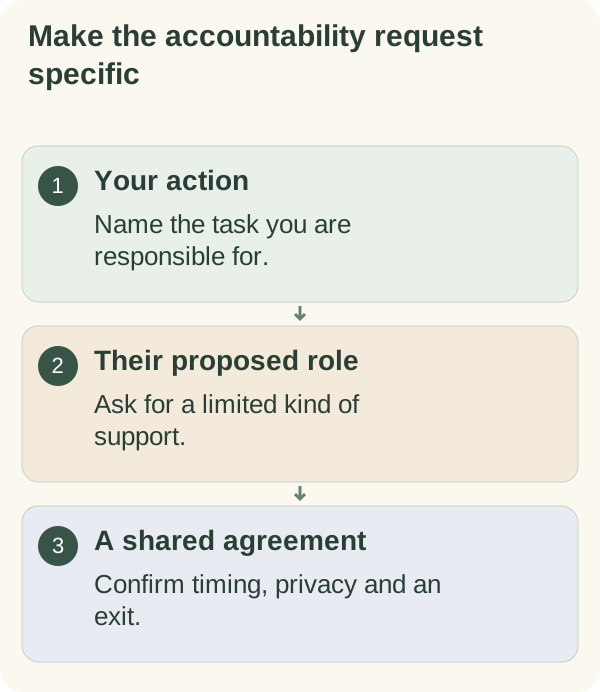
Pick the role before the person
"Will you be my accountability partner?" sounds simple, but it can mean very different things. One friend hears it as "listen to my updates". Another hears "chase me every day". Decide which job you are actually asking for.
| Role | What your friend does | What it asks of them | Often suits |
|---|---|---|---|
| Witness | Receives a short update after you act | A minute to read a message | Tasks you do alone, such as applications or writing |
| Co-worker | Works on their own task at the same time, in person or on a call | A block of time you both protect | Admin, study or any task you keep postponing |
| Prompter | Sends one agreed nudge at an agreed time | Remembering, every time | Starting something you tend to forget, only if they are happy to remember |
| Sounding board | Talks it through when you are stuck | Attention, sometimes at short notice | Bigger projects with decisions along the way |
Advice is a separate request. Do not assume that saying yes to any of these roles also means your friend wants to tell you what to do, or that you want to hear it.
For the co-worker role, planning a focus session with an accountability partner covers the start check-in and closing update in detail.
Who to ask, and who to skip
A good accountability friend is not necessarily your closest friend. Look for these qualities:
- They reply reliably. A witness who answers three days later turns your update into a message sent into the void.
- They will not judge a bad week. You want someone who can read "didn't manage it this week" and simply reply "next week then".
- They can say no. If you think they would agree out of guilt, the arrangement starts on the wrong foot.
- They are not affected by the outcome. A partner, parent or flatmate may have their own stake in whether you finish. That can make neutral support hard for both of you.
If nobody comes to mind, that is common, and it does not mean you lack friends. Some people prefer the structure of a tool for this. The guide to using an AI accountability partner explains where that helps and where human support matters more.
The ask, word for word
Pick the version that matches the role, then change it until it sounds like you.
WITNESS
"I'm trying to get back to [task]. For the next [four] weeks, would you
be happy to get a short message from me on [day] saying what I did?
You don't need to reply with anything more than a thumbs-up, and
there's no chasing if I go quiet. Totally fine to say no."

CO-WORKER
"Would you fancy doing an hour of boring admin together on [day]?
We'd each work on our own stuff and check in at the start and end.
If it helps, we could try it [three] times and see."

MUTUAL
"I'd like someone to report to on [task], and I'd be glad to do the
same for you if there's something you're working on. Want to try
swapping a quick update every [Sunday] for a month?"
Before you send the request
- Task:
name the routine or task in a way you could report on in one line.
- Role:
choose one from the table above.
- Timing:
suggest when updates or sessions happen.
- Limits:
say what you do not need, such as reminders, advice or quick replies.
- End date:
suggest a trial period and say either of you can stop sooner.
If they say no, maybe or yes too quickly
- If they say no, thank them and mean it. They have saved you both from an arrangement that would not have worked. Do not ask why.
- If they say "maybe" or "I'm not great at this", offer the smallest role: "Even just reading a Sunday message would help. You never need to reply."
- If they say yes instantly and enthusiastically, check you agree on the same thing. Read back the role: "So I'll text you Sunday nights, and you don't need to remind me. Right?"
- If they offer more than you asked for, such as daily check-ins or advice, it is fine to decline the extra kindly: "That's generous. Let's start with just the Sunday update and see."
Example: Daniel's job applications
An illustrative example (the person is made up): Daniel had been meaning to apply for new jobs for months. He asked his friend Sam to "keep me on track".
What happened first: Sam took the request seriously and started texting Daniel most evenings: "Done any today?" Within a week Daniel felt nagged, started leaving the messages unread, and then felt guilty about ignoring a friend who was only doing what he had asked.
What he changed: Daniel apologised for the vague request and asked again, more specifically. He would message Sam each Sunday evening with how many applications he had sent. Sam would not send reminders and would only reply with a short acknowledgement. They agreed to try it for four weeks.
What it looked like after: two Sundays had good numbers and one said "zero, rough week". Sam replied to all three the same way. At the end of the four weeks Sam asked whether Daniel would do the same for his evening course reading, and the arrangement became mutual.
Decide what happens when nothing is reported
Agree on this at the start, because it is where most friction comes from. A missed update may mean you were busy, forgot to send it or are having a hard week. It does not have to mean failure, and your friend should not have to guess.
Pick one rule together: no follow-up at all, or one light message after a set time ("Just checking you're okay, no need to report"). Keep sensitive details out of the arrangement unless there is a clear reason and both of you agree. Neither of you needs access to the other's accounts to support an ordinary task.
When the goal is private or sensitive
Many accountability goals touch health, money or mood. A friend can still help, but the request needs extra care.
- If the goal involves health or exercise, share what you did, not medical details. Your friend should not set targets or judge what is safe for you. Ask a doctor or suitably qualified professional for that.
- If it involves money, report actions ("paid the bill", "checked my spending"), never balances, passwords or account access.
- If it is linked to how you are feeling, a friend's check-in can be comforting, but it is not a substitute for professional support. If you are struggling, contact a doctor or a local support service as well.
- If you would be embarrassed for anyone else to see the updates, agree that messages stay between you and are not screenshotted or shared.
Review the arrangement as well as the task
At the end date, ask two questions: is this still useful for you, and is it still comfortable for them? A supportive arrangement can change frequency, swap roles or end. Your friend is not responsible for professional care or for your result.
A friend who hears about your step once a week makes that step a little easier to take, which is the same one-step-at-a-time idea Armored Kitten is built on, shared with someone you trust. Read working alone accountability for a bounded session card you can use on your own days. Use take a small connection step to prepare the request, then send it yourself.
The check-in-boundaries card in the Low-pressure connection cards has fields for the support you want, timing, privacy and what happens when it stops fitting. If finding the words is the hard part, the guides in Find the words for someone may help.
Questions people often ask
Should my accountability partner be my spouse or partner? It can work, but it often mixes support with everyday life. A friend who is not affected by the outcome can usually stay more neutral.
How often should we check in? Match it to the task. A weekly update suits many personal projects; a co-working session needs its own agreed time.
What if I keep missing my own updates? Treat it as information about the plan, not proof of failure. Make the task or the update smaller, or change the day.
Is it rude to end the arrangement? No. Thank them, say it has run its course and offer to return the favour if they ever want it.