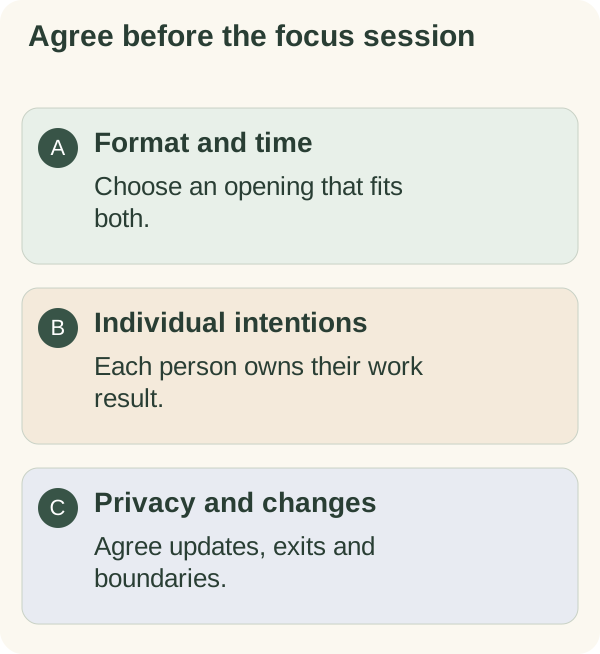
Before you pick a time, agree what a shared session means: how you will be together (video, same room or messages only), when it starts and stops, what each person shares and what happens if someone cannot make it. Then run every session the same way: a short opening message with each person's intended result, quiet work, and a brief closing report. Each of you is accountable for your own result. Neither of you is checking the other's work.
Pages about co-working or "body doubling" usually describe the benefits and then point you to a matching service. They say much less about the agreement between two people who already know each other: who cancels how, what you share and what to do when the arrangement starts to feel uneven. That agreement is what decides whether the sessions last past the first month.
Ask what kind of session fits both people
Live video, a shared room and asynchronous messages have different access and privacy implications. Choose a format both people want. A partner does not need to see your documents or screen to know the task you intend to work on.
| Format | Works well when | Watch out for |
|---|---|---|
| Video, cameras on | You both like visible company and have a private space | Being seen at home; background details you would rather keep private |
| Video, cameras off, sound muted | You want a shared start and end without being watched | Drifting, since nothing shows you are still working |
| Same room | You live or work near each other | Chatting; one person's phone calls disturbing the other |
| Messages only | Your free times differ or video feels like too much | Forgetting to send the closing report |
Check the actual opening and any need to finish promptly. A session should not silently replace an existing responsibility or extend because one person has more time available.
Agree on the session
- Format:
choose how, if at all, you will share the work period.
- Intention:
each person names a result appropriate to their own task.
- Boundary:
agree when to start and stop.
- Privacy:
decide what stays private and whether any update is expected.
- Change:
make cancellation or early departure straightforward.
The first conversation, settled in one message
You can agree everything above in a single message. Adapt this one:
"Want to try a focus session together? My suggestion:
- When: ________, starting ________ and finishing ________
- How: ________ (video with cameras on / cameras off / messages only)
- At the start we each say one result we're aiming for.
- At the end we each say how it went: done, partly, blocked or not started.
- We don't share screens or documents unless one of us asks.
- Either of us can cancel with a quick message, no explanation needed.
Try it twice and then decide whether to keep going?"
The last line matters. A trial period makes it easy for either person to stop without it feeling like a rejection.
Keep the intention observable
An example start message could be: "I will outline the three sections before our finish time. I will keep the document private and report whether I have an outline." That does not ask the partner to assess the quality or monitor every minute.
If you need a reminder or timer, set and verify it in the service you choose. The session plan itself does not create one.
A running order for each session
The same shape every time means no time is lost deciding how to begin. An illustrative order:
OPENING (a couple of minutes)
"Today I'm aiming for: ________. First move: ________."

WORK
Quiet. Questions wait until the end unless agreed otherwise.

CLOSING (a couple of minutes)
"Result: done / partly / blocked / not started. Next: ________."
Keep the opening short. If it turns into a long chat, the session has quietly become a catch-up, which is fine sometimes but is a different thing.
Let the closing report describe the state
You can say the result is complete, partly complete, blocked or not recorded. Add the next action if useful. An unfinished task does not require the other person to chase you afterwards unless you have separately agreed appropriate follow-up.
Do not share another person's work, image or report without permission. If the arrangement stops being useful or comfortable, discuss a change or end it.
Example: Maya and Sam's Thursday mornings
An illustrative example (the person is made up): Maya is a freelance illustrator and Sam works remotely for a small charity. Both found Thursday mornings slipped away, so they agreed a two-week trial: video with cameras on, a start time and finish time, and the opening and closing messages.
The first two sessions went well. In the third, Sam spent the opening ten minutes describing a difficult week, and both lost most of the session. At the next closing they changed one rule: catch-ups happen after the closing message, not before the work. They also switched to cameras off, because Maya felt self-conscious drawing on camera. The sessions continued, and the catch-up became something they looked forward to at the end rather than something that ate the start.
When the arrangement starts to feel uneven
Shared sessions often stop not because they fail, but because one part quietly becomes awkward. Most articles skip this entirely.
- If one person cancels much more often, raise it once, kindly, and ask whether a different time or a lighter format would suit them better. The arrangement should fit both lives.
- If one person always finishes their result and the other rarely does, the second person may be choosing results that are too big. Suggest smaller results; it is not a contest.
- If your partner starts commenting on the quality of your work, remind them of the agreement: you share results, not reviews. Feedback is fine only when you ask for it.
- If your free times stop overlapping, switch to messages only: each person sends the opening and closing whenever their own session happens.
- If you want to stop, say so plainly and thank them. "This has helped, but I'm going to pause it for now" is enough.
For more on keeping check-ins comfortable, see setting boundaries around accountability check-ins. If you have not found a partner yet, how to ask a friend to be an accountability partner covers the first conversation.
Working beside someone you trust is one way Armored Kitten's idea of one manageable step at a time extends to the people around you: each of you takes your own step, and the other simply notices that you took it. More planning guides are collected in the planning and reflection hub.
Read working alone accountability for a work-session card. Use focus when working alone for your own next action before inviting a partner.
Each person can use their own first card in the One-session work kit, sharing only the intention and update they agreed to share.
Questions people often ask
Does my partner need to do the same kind of work? No. You are sharing a start, an end and two short reports. The work itself can be completely different.
How long should a shared session be? Long enough for a real result and short enough that both can reliably attend. Start with something easy to keep, and adjust after the trial.
Is it all right to work in silence the whole time? Yes. Many people prefer it. The opening and closing messages are what make it a shared session.
What if I do not want anyone to know what I am working on? Describe the result in general terms, such as "finish the section I'm stuck on". Your partner needs to know whether you did it, not what it says.