When you work alone, nothing around you signals that the day is over, so the ending has to be something you do. Pick a time to start closing, then run the same short sequence: save and note where the work stands, send any update you owe, write tomorrow's first action, and finish with one physical signal such as closing the laptop into a bag. Once that signal is done, the workday is done, even if the project is not.
Shutdown routines are well covered online, usually as a checklist for office or remote employees. This page is about the version that has no backup: no colleague saying goodnight, no train to catch and often no separate room. It covers the trap of "one more thing", what to tell clients about your hours and what to do when the work refuses to stop at a clean point.
Why stopping is harder with nobody else around
In a shared workplace the end of the day arrives on its own. People pack up, the lights go off, the commute begins. Working alone, none of that happens. The laptop is still open on the kitchen table, a message arrives at seven, and finishing "one more thing" feels harmless because nobody is waiting for you to leave.
The cost shows up the next morning. Without a clear stop, evenings fill with small bursts of work, tomorrow's first action is a mystery and the open tabs from yesterday are still asking for attention. A shutdown routine gives the day an edge that the setting no longer provides.
Choose the boundary before the final task expands
Look at the time you intended to finish and any real responsibilities still due. If something needs urgent communication, handle it through the appropriate channel. Distinguish that requirement from an optional desire to polish another paragraph.
The stopping point needs to fit your actual work agreements. If you are on call or providing coverage, follow that arrangement rather than treating a personal shutdown checklist as an override.
A practical rule: set an alarm a little before your intended finish and treat it as the start of the shutdown, not as a reminder that you have a little longer.
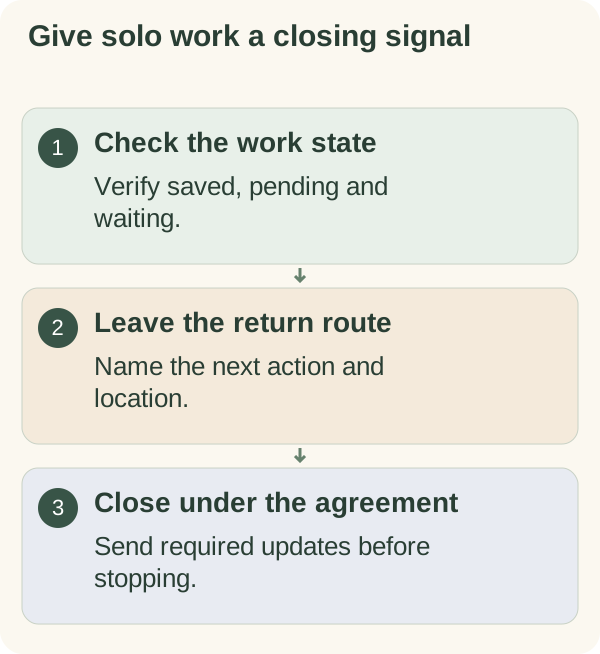
Finish a solo work session
- Save:
verify important work is in its approved location.
- State:
record what is complete, pending or waiting on someone.
- Return:
write the next action and where to find the material.
- Communication:
send any required update or handover.
- Close:
end the session and choose the next appropriate review occasion.
A shutdown card to keep beside the desk
Print it, or keep it as the last note you open each day. Same order every time.
SHUTDOWN
[ ] Everything saved where it belongs
[ ] Where things stand: done ____ / in progress ____ / waiting on ____
[ ] Owed today? Sent ____ / nothing owed
[ ] Tomorrow I start with: ____________________
[ ] Closing signal: ____________________
Work is finished for today.
The last line is deliberate. Writing or reading it is a small, plain decision that the day has ended. If an idea arrives later, add it to tomorrow's note instead of reopening the work.
Leave a note that answers the return question
An illustrative note could say: "The draft is saved; the final section still needs the updated figures. Next: check the project message for that file before editing." The note identifies both a dependency and an action.
Store the detail with the project where possible. You do not need to copy confidential work into a separate habit tracker to remember that the session ended.
Make messages part of the agreement
Decide when you are expected to read and respond, using your work arrangements. If a boundary needs discussing with a client or colleague, have that conversation. Muting a device changes notifications; it does not change the other person's expectation by itself.
If your hours have never been stated, say them once, plainly. An illustrative message to adapt:
"A quick note on how I work: I'm usually available on weekdays between
________ and ________. Messages after that get a reply the next working
morning. If something is genuinely urgent, ________ is the best way to
reach me."
Only offer an urgent route you are willing to answer. If you would not want a call at nine at night, leave that part out.
Keep a closing action you can actually use
Putting away materials, signing out as required or clearing the shared desk may provide a practical finish. If you have little control over the space, choose an action available to you. A dedicated office is not necessary to write a return note.
Signals that work in a small space: closing the laptop and putting it in a bag or drawer, switching off a desk lamp used only for work, changing out of work clothes, or a short walk around the block as a stand-in commute. For ideas on fitting movement into a home-working day, see adding movement breaks to a work-from-home day.
For a broader list of household and evening items to close alongside work, an end-of-work checklist for people who work from home covers the home side.
Example: Alex in a one-room flat
The example below is illustrative; the person in it is not real. Alex builds websites for small businesses from a desk in the corner of a studio flat. The desk is visible from the sofa, and most evenings Alex drifted back to it to "just check" a message or fix one small thing.
Alex started with the shutdown card and a closing signal of putting the laptop in a drawer. The first week, three evenings went well. On the other two, a client message arrived after the drawer had closed, and Alex reopened the laptop to answer it. Neither message was urgent.
Two changes followed. Alex sent each regular client the availability note, with a phone number for genuine emergencies only. And the card gained one more line: "Anything that arrives tonight goes on tomorrow's list." After that, evening messages were still read on the phone sometimes, but the laptop stayed in the drawer.
When the work does not stop at a clean point
Real work often ends mid-sentence or mid-problem. These situations need their own rules.
- If you are in the middle of a problem, write down your current guess about it and the next thing you would try. You will usually find the thread faster tomorrow than if you push on tired.
- If you work with clients in another time zone, choose one short overlap window for their messages rather than staying reachable all evening.
- If you are on call or covering for someone, that agreement comes first. Do the shutdown for everything else and keep the on-call channel open as arranged.
- If you keep thinking about work after closing, write the thought on tomorrow's note and leave it there. If work worries are keeping you awake most nights, it is worth talking to a doctor or another qualified professional.
Closing the day properly is one of the smallest steps in Armored Kitten's approach to planning your days: it protects tomorrow's first step as much as tonight's rest.
Read working alone accountability for the start and review of one session. Use wind down for the evening to choose what follows the work boundary.
The restart-note card in the One-session work kit can preserve the work state and next action without copying confidential project detail into a general planner.
Questions people often ask
How long should a shutdown routine take? Long enough to do the card properly, which for most people is a few minutes. If it keeps growing, some of the steps have turned back into work.
What if I finish at a different time each day? Tie the shutdown to the end of your last block of work rather than a clock time. The card works the same whenever it happens.
Do I need a separate workspace to switch off? No. A closing signal you repeat every day does much of the job a separate room would. Pick one you can do wherever you work.
Should I check messages after the shutdown? That is your call, within your work agreements. If you do, read without replying unless something is truly urgent, and add anything else to tomorrow's note.