Subtract the parts of the gap that are not really yours: the earlier meeting overrunning, notes from it, a break, travel and getting ready for the next one. Whatever is left is the usable gap. Choose a task that fits it and can stop in a tidy state, pick it from a short list you keep for exactly these moments, and stop on time. Often the best use of a short gap is preparing for the next meeting.
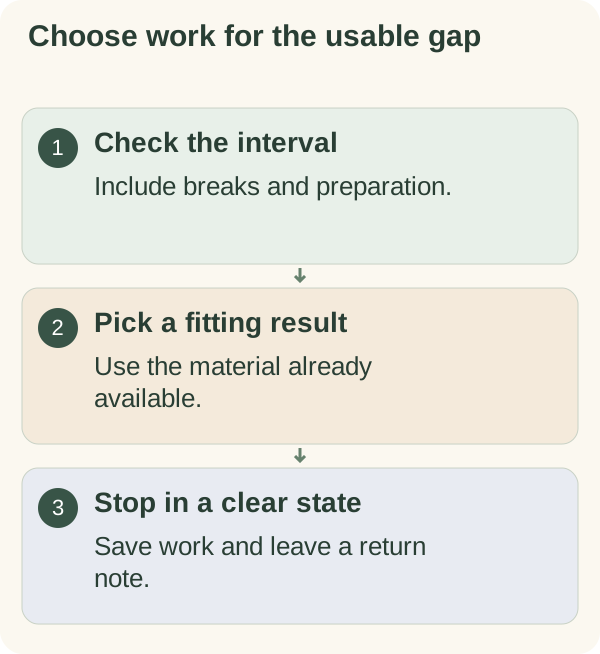
Lists of "things to do in 30 minutes between meetings" are easy to find. They suggest email, tidying the desk or a quick tutorial. What they rarely do is help you work out whether you actually have 30 minutes, or how to choose real project work that will survive being cut off. This page does both.
Measure the usable gap
Confirm when the previous meeting is likely to release you and when preparation for the next one needs to begin. Account for travel or a change of room if relevant. Keep any break you need visible instead of assuming the whole interval belongs to work.
The arithmetic looks like this for an illustrative gap from 10:00 to 11:00:
Calendar gap:                        60 min
Earlier meeting tends to run over:  - 5 min
Notes and actions from it:          - 10 min
Break (water, stretch, bathroom):   - 5 min
Getting ready for the 11:00:        - 10 min
Usable gap:                          30 min
Your numbers will differ. The point is to do the subtraction once, out loud or on paper, so you choose a task for the time you have rather than the time the calendar shows.
If the remaining time is uncertain, choose an action that can be left in a clear state. Some tasks need a longer uninterrupted period; it is reasonable to schedule them elsewhere rather than repeatedly reopening them in short gaps.
Make a between-meetings card
- Boundary:
when must you stop and prepare for the next commitment?
- Result:
what useful piece of work could fit before that boundary?
- Material:
is the necessary information already available?
- First move:
what will you open, find or write first?
- Return note:
how will you leave the task if it is unfinished?
Match the task to the minutes you have
| Usable time | Work that tends to fit | Work to avoid starting |
|---|---|---|
| Under 10 minutes | Notes from the last meeting, one reply, a quick decision | Anything you need to read in full first |
| 10 to 25 minutes | A short draft, a set of replies, checking one document | Work that needs a long warm-up before it is useful |
| 25 to 45 minutes | One section of a larger piece, a focused review | The hardest part of a big project, unless it can stop cleanly |
| Longer than 45 minutes | A real piece of project work with a clear end | Filling it with small tasks out of habit |
These are rough guides, not rules. A task fits if you can name the place where you would stop and know you could pick it up again quickly.
Choose a result smaller than the project
"Work on the proposal" could mean many things. An illustrative result might be "list the unanswered pricing questions for the project owner." That result has a visible end and can be useful even if the whole proposal needs a longer session.
Check whether your chosen action depends on another person responding. If it does, the achievable result may be sending a clear question rather than resolving the whole issue within the gap.
Keep a short list of gap-sized tasks
Choosing what to do takes time, and a short gap does not have much of it. Keep a separate list of tasks that already fit, sorted by size. Add to it whenever you notice something small during the week.
GAP LIST
Under 10 min:
- ________
- ________
10 to 25 min:
- ________
- ________
25 to 45 min:
- ________
When a gap opens, you only choose from the right row. If the row is empty, use the gap for preparation or a proper break.
Set the stopping arrangement yourself
Use a clock or an actual reminder tool if you need a prompt. Reading this article or opening a companion link does not create a timer. Check the arrangement you intend to rely on before beginning.
At the boundary, save the work and write the next action if needed. Do not let a promising start silently replace preparation for the meeting you have already agreed to attend.
Use a small gap for preparation when that fits better
Sometimes the useful action is collecting the next meeting's documents or writing the question you need answered. A gap does not have to produce an unrelated completed task to be well used.
A quick preparation check for the next meeting: what is it for, what do I need open, what do I want to ask or decide, and is there anything I promised to bring?
Example: Daniel's Tuesday gap
This is an illustrative example, not a real person's story. Daniel inspects buildings and spends Tuesdays on calls with clients. One Tuesday he had a calendar gap from 10:00 to 11:00 and planned to finish a whole inspection report in it.
The 9:00 call ran ten minutes over, and Daniel spent the next twenty writing the report's first half. At 10:55 he realised he had not opened the drawings for the 11:00 call, joined late and spent the first part of the call searching for them.
The following week he did the subtraction first. Usable time came out at about 30 minutes, so he picked "write the findings section" from his gap list and set a reminder for 10:45 to switch to preparation. The section was done, the drawings were open on time, and the rest of the report went into an afternoon block. He kept the 10:45 reminder as a fixed habit for every gap before a client call.
When the earlier meeting runs over
This is the most common way a gap disappears, and few guides plan for it.
- If the overrun leaves you under ten minutes, drop the planned task and use the time for notes and preparation. The task stays on the gap list for next time.
- If it happens in most of your meetings, plan every gap as if it starts later. It is easier to gain time than to lose it.
- If you are the person who chairs the earlier meeting, finishing a few minutes early is a gift to everyone's gaps, including yours.
- If the whole day is back-to-back gaps of a few minutes each, stop trying to fit project work in at all. Do notes and replies, and protect a longer block on another day.
- If you need the gap for a break more than for work, take it. A short walk can be the better choice on long meeting days; an after-lunch walking routine for busy workdays has ideas for fitting one in.
Treating a 30-minute gap as one small, finished step, instead of a failed attempt at a big one, is the Armored Kitten way of planning your days.
Try the daily planner to compare possible next actions. Use focus when working alone to prepare a bounded session when a longer opening becomes available.
The result, boundary and review fields in the One-session work kit can hold the work you choose for the usable gap.
Questions people often ask
Is it worth starting deep work in a short gap? Only if you can name a clean stopping point within the usable time. If not, save deep work for a longer block and use the gap for something that fits.
Should I always use gaps for work? No. Sometimes the right use is a break, a snack or preparation. A gap used for rest is not wasted.
How do I stop when I am in the middle of something good? Write the next sentence or step as a note before you stop. That makes it far easier to leave, because the thought is saved.
What if my calendar has no gaps at all? Then the issue is the calendar, not your use of gaps. Look at which meetings you could shorten, decline or turn into a message.