If your lunch break has room after you eat, put the walk in the middle: food first, walk second, then a few spare minutes before the afternoon starts. Let your first afternoon commitment decide when you turn back, not a step count or a distance. Keep a short version for squeezed days and a skip option for days when the break is already full, and decide which one applies when you look at your calendar in the morning.
This guide covers the timing and logistics of a lunchtime walk. It does not tell you how fast or how far to go, or whether walking soon after a meal suits your body. If you have diabetes or a digestive condition, are pregnant, feel pain when you walk or have been given advice about activity around meals, check with a doctor or qualified professional first.
Split the break before you choose a route
Lunch walks usually fail on paper before they fail on the pavement: the break was already full. So before you think about where to go, write down everything your break has to hold on an ordinary day.
| Part of the break | What to note | Why it matters |
|---|---|---|
| Getting food | Queue, microwave, trip to a café | Often takes longer than people expect |
| Eating | How long you like to sit | A rushed meal to make room for a walk rarely lasts |
| Walk | Whatever time remains | This is the only flexible part |
| Buffer | Getting back, settling in, checking messages | Without it the walk feels risky and gets dropped |
| Personal admin | Calls, errands, the bank, the post office | These compete for the same window |
If the walk row is empty on most days, lunch may simply be the wrong slot for you, and that is useful to know early. Look at making walking part of your day for other places a walk can sit.
Check your actual break arrangements too. Whether the break is paid or unpaid, fixed or flexible, and whether you can leave the building all change what is possible. Ask rather than assume.
Work back from the afternoon's first fixed point
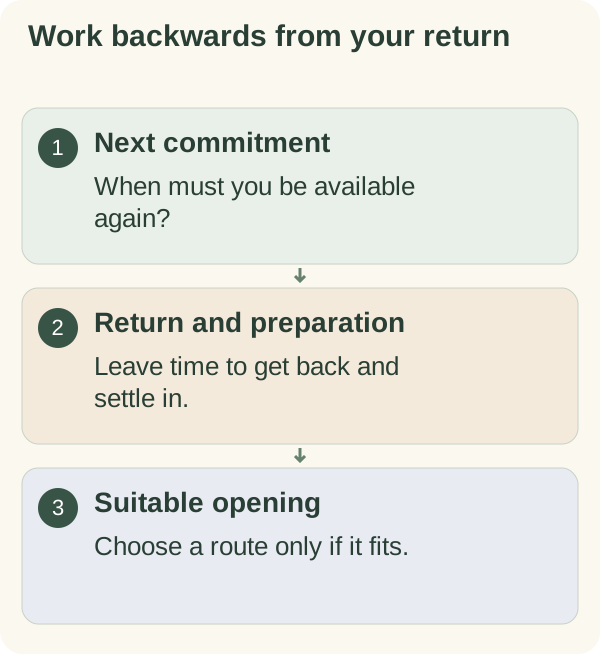
Find the first thing after lunch you cannot be late for: a meeting, a shift handover, a client call, a delivery. Count backwards from it. Subtract your buffer, then the walk back, and you have your latest turnaround time. On a light afternoon that may leave plenty of room; on a crowded one it may leave almost none.
Landmark loops make this easier than watching a clock. Pick two you can name, such as "round the block" and "to the park gate and back". Walk each once on a quiet day and note how long the whole loop takes you, door to door. Then, on a busy day, you can choose a loop from the calendar without guessing.
The CDC's getting-started guidance includes choosing convenient opportunities for activity. A break you already take is one of the more convenient openings in a working day. That guidance does not set your pace or distance, and nor does this page.
Keep three versions of the walk
Three lunch walks for three kinds of day
- Open day.
Your longer familiar loop, with the full buffer still in place.
- Squeezed day.
The short loop you can finish even when the morning ran over, such as once round the building.
- No-room day.
Skip the walk, or take the slightly longer way to fetch food. Record it as a choice.
- Morning check.
Glance at the afternoon calendar and pick today's version before lunch arrives.
Choosing the version in the morning takes seconds and removes the lunchtime debate. It also means a squeezed day still has a walk in it, rather than being written off.
Protect the slot in your calendar
Meetings, not motivation, end most lunch walks. A visible block in your calendar gives colleagues a reason to look for another time. Here is wording you can paste in and adapt.
Recurring calendar entry (on the weekdays you choose)
Title: Lunch + short walk
Time: [start of break] to [end of break]
Note to self: Back at desk by [time]. Squeezed day = short loop. No-room day = skip.

If someone books over it:
"I usually take my lunch break then. Could we do [earlier time] or [later time]
instead? If it can only happen at that time, that's fine, I'll move my break."
The last line matters. Offering to move your break keeps the block from looking like a refusal, and it keeps you in charge of whether the walk survives that day.
Example: Daniel's walk that kept losing to meetings
This is an illustrative example, not a real person's story. Daniel works in an office and takes lunch around half past twelve. He planned a walk after lunch every weekday. Over his first two weeks it happened on three days, and he started to think he was bad at routines.
When he looked at the calendar, the walk itself was never the problem. A standing meeting at one o'clock on Tuesdays and Thursdays cut his break short. On Mondays the canteen queue swallowed most of the time. Here is what he did:
- Cut the plan to three days. Monday, Wednesday and Friday, the days without the early meeting.
- Moved the queue time. He brought food from home on Mondays, so the minutes he used to spend waiting went to the walk instead.
- Timed two loops. A block loop for squeezed days and a longer one past the river for open days.
- Blocked the slot. He added the calendar entry and used the reply above twice in the first week.
After a month, Wednesday and Friday walks were steady. Mondays still slipped whenever the weekly planning call overran, so he made Monday the short loop by default. Tuesdays and Thursdays stopped counting as misses, because they had never been on the plan.
When the break is short, split or spent at your desk
Many lunch-walk articles assume an hour off with nothing else to do. Real breaks are often shorter, broken up or tied to the desk.
- If your break is short, walk on the way to get food rather than after it, or make the short loop your only version.
- If you eat at your desk because you cover phones or a shared inbox, ask whether a colleague can cover a small window in exchange for you covering theirs. Agree the swap before relying on it.
- If your break time moves with shifts or appointments, plan it day by day from the rota. The guide to walking with a changing schedule shows how.
- If the route near work is quiet or isolated, stick to busier streets, keep your phone charged and let someone know when you expect to be back.
- If it starts to rain or the weather turns, use the rules in keeping a walking routine when it rains rather than deciding at the door.
- If walking soon after eating feels uncomfortable, try walking first and eating after. If the discomfort keeps happening, mention it to a doctor.
- If you come back warm and your work has a dress code, take the shaded or flatter loop and keep a spare top in a drawer.
Inviting a colleague without making it a duty
Company can make a lunch walk more likely to happen, as long as nobody feels they owe attendance. Make the invitation open-ended:
"I'm heading out for a short loop after lunch on Wednesdays. Join any week you like, no need to tell me in advance."
That keeps your walk independent. If your colleague drops out, the walk still has a day and a route. For a regular shared arrangement, see starting a walking routine with a friend.
Record what helps the next decision
A lunch walk is a small, real version of the idea behind Armored Kitten's habits and goals guides: use a break you already have, and let a short loop count on a busy day. What you write down afterwards should help you plan, not judge. Useful notes look like "Friday meeting moved to 13:00", "river loop is muddy after rain" or "Wednesday works best".
Try the free habit tracker if you want to record chosen opportunities. Then build a small routine when repeating the arrangement seems useful. Opening the companion does not automatically save a walking plan, set a reminder or decide what exercise is appropriate for you.
The opening and return fields in the walking planner give you a place to check the whole lunch-break arrangement. If mornings keep spilling into lunch, planning a work session between meetings can help you protect the edges of the break.
Questions people often ask
Should I walk straight after eating or wait a while? Go with what feels comfortable. Some people like to sit for a bit first; others walk first and eat afterwards. If you have a condition such as diabetes, or a professional has given you advice about timing, follow that advice.
Is a very short loop worth doing? As a routine, yes. Keeping the slot alive on squeezed days makes the longer version easier to take on open days.
What if I'm expected to stay available over lunch? Break arrangements come from your contract and workplace rules. Ask your manager or HR what applies, and plan the walk around the answer.
What should I keep at work? Comfortable shoes in a drawer and a light waterproof layer cover most days. Anything else depends on your route and the season.