When your hours change from week to week, plan your walks by type of day instead of by clock time. Decide once what a walk looks like on an early shift, a late shift, a night and a day off, then each time your rota arrives, copy the matching plan onto each day. Mark some days as no-walk on purpose, so rest is part of the plan, and review after a full rotation rather than after one rough week.
Standard walking advice says to walk at the same time each day. That suits people whose days look alike. If you work shifts, freelance, care for someone or have hours set at short notice, a fixed time will clash with your week again and again, and each clash will look like a failure when it is really a scheduling mismatch.
Plan by type of day, not by date
Most changing schedules are made of a handful of repeating day types. Name yours, then give each one a walk moment that fits its shape. Here is a starting table to adapt.
| Type of day | Possible walk moment | Watch out for |
|---|---|---|
| Early shift | A loop after you get home, before you sit down | Tiredness that makes the sofa win |
| Late shift | A morning walk after breakfast, before errands | Jobs piling into the only free hours |
| Night shift | Nothing planned, or a short walk after you wake | Walking in the dark, disturbed sleep |
| Split shift | The gap between the two parts, if you stay near work | The gap being swallowed by admin |
| Day off | One walk at a time you choose, or none | Trying to make up for the working days |
| On call or short notice | The small version only | Being called in halfway round |
Every row has a small version as well as a usual one: a loop of the street, a walk to the shop. On the hardest day types, the small version may be the whole plan.
Separate a plan from a maybe
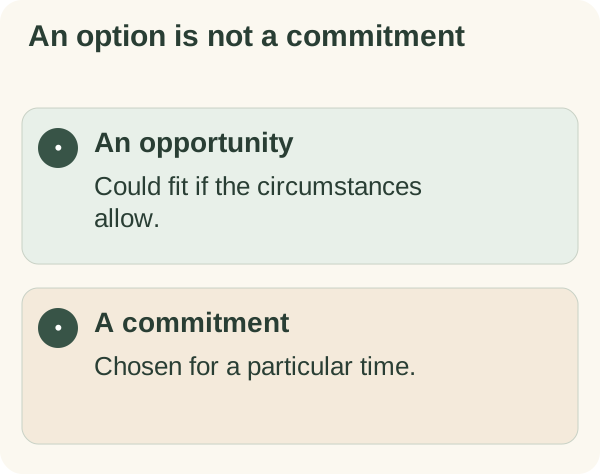
Give each walk on your week one of two labels. A plan means you have decided to walk at that moment. A maybe means it could fit if the day goes as expected. Keeping those labels apart stops a week of possibilities turning into a list of broken promises.
Leave some days with neither label. You may need them for rest, overtime or responsibilities that are not on the rota yet.
Turn the new rota into a walking week in ten minutes
When the rota arrives
- Label each day.
Write early, late, night, split, off or on call beside every date.
- Copy the moment.
Fill in the walk moment from your day-type table.
- Mark plan or maybe.
Be honest about which days are likely to hold.
- Pick the empty days.
Choose one or two days with no walk at all.
- Check the light and weather.
Note which planned walks fall in darkness this week.
- Set a review point.
Choose the day the next rota is due.
Here is a grid to copy into a notes app or onto paper.
Week of: ____________

Day | Type of day | Walk moment | Plan / maybe / none | What happened
Mon |             |             |                     | done / changed / skipped / not recorded
Tue |             |             |                     |
Wed |             |             |                     |
Thu |             |             |                     |
Fri |             |             |                     |
Sat |             |             |                     |
Sun |             |             |                     |

Darkness this week on: ____________
One thing to check before the next rota: ____________
Example: Alex on a rotating rota
This is an illustrative example, not a real person's story. Alex works in a warehouse on a rota that runs a fortnight of early shifts, then a fortnight of lates, with the occasional extra night. He tried walking every morning before work. That fell apart on his first early week, because there is no "before work" when the shift starts at dawn.
He built a day-type table instead:
- Early shifts: a loop of the estate when he gets home, before he sits down.
- Late shifts: a walk after breakfast, through the park to the shop and back.
- Nights: nothing planned. Rest first.
- Days off: one walk if it fits, chosen on the day.
After one full rotation he looked at the grid. Late-shift mornings had held almost every time. The after-early loops rarely happened, because he got home exhausted. He made the small version, once round the block, the default for earlies, and added a maybe walk on his first day off after nights. He stopped seeing the early weeks as failures, because the plan now matched what those days could hold.
When you only learn your hours a day or two ahead
Most walking plans assume you know next week. Many people do not, and a few changes help.
- If hours arrive with short notice, cut your table down to two types: work day and not-work day. Fewer plans are easier to apply quickly.
- If your hours come the night before, make the walk decision at that point and write it down, so the morning is already settled.
- If you are called in on a day off, let the walk go or take the small version. Do not move it to a day that is already full.
- If your walk moments fall in darkness for months, for example in winter or around nights, pick lit routes with other people about, wear something visible, carry a charged phone and tell someone your usual loop. Moving the walk to the lighter side of your sleep is another option.
- If shift work is affecting your sleep or health, talk to a doctor or your occupational health service. This guide plans walks; it cannot give advice on sleep or recovery.
- If you have a health condition, pain, a pregnancy or a mobility limit, ask a qualified professional what activity suits you on demanding shift patterns.
Walking with someone when your hours keep moving
A standing weekly walk with a friend rarely survives a rotating rota. Occasional invitations work better: send them once you know your days, say which ones are a maybe and agree on how either of you can cancel without explaining. Avoid making a single free evening the backup for work, shopping and every social plan at once.
Review by rotation, not by week
One rough week tells you little when your schedule repeats over a longer cycle. Review when the cycle completes and ask which day types held and which kept slipping. Fix the plan for the slipping type, not for the whole week.
Planning by day type is a good fit for Armored Kitten's wider approach to habits and goals: a small step that matches the week you are actually given, rather than the week a generic plan expects.
The weekly review template can hold those observations. Use build a small routine to select one opportunity to consider next. If you also train at a gym, building a gym routine around a busy schedule uses similar ideas for visits.
Use the opportunity card in the walking planner to record a cue, nearby route and return boundary you can reconsider on the day.
Questions people often ask
Should I walk after a night shift? That depends on how you feel and how you sleep. Many people rest first. If you have concerns about shift work and your health, ask a doctor or occupational health.
Is it a problem to go a whole week without a walk? Not if it was a deliberate choice for a heavy week. Start again from the next rota.
Do fixed-time reminders work on a rota? They often go off at the wrong moment. Set them each week when the rota arrives, or tie them to an event such as getting home.
What if my rota has no pattern at all? Use the two-type version, work day and not-work day, and plan one walk per week as a maybe until you see what holds.