A gym routine survives a busy schedule when it is small, tied to things you already do and planned with a backup. Start with two visits a week that you can protect, count the whole trip rather than only the workout, and decide in advance what happens when one of those visits gets squeezed out. You can add more later, once two visits have held for a few weeks.
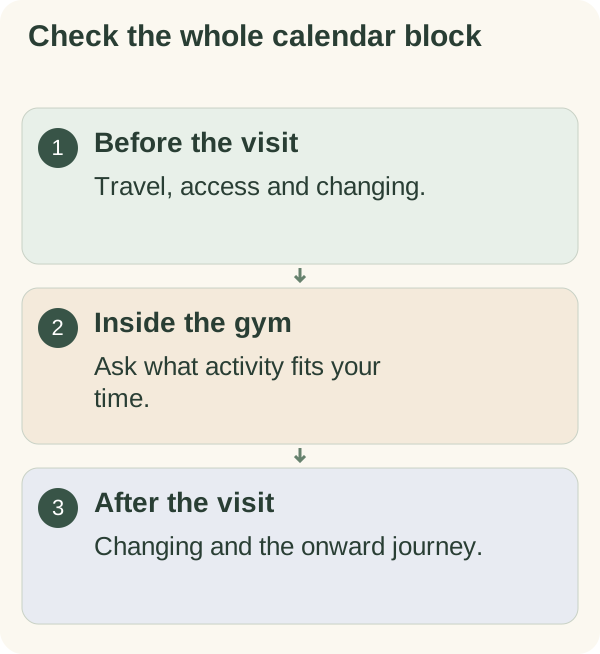
Count the whole block, not the workout
A common planning mistake is treating a free hour in the calendar as an hour of exercise. Before any time on the gym floor, you have to get there, check in and change. Afterwards you change again, maybe shower, and travel on.
Here is how a 90-minute gap after work might really look:
| Part of the visit | Example time |
|---|---|
| Leave work and travel to the gym | 15 minutes |
| Check in, locker, change | 10 minutes |
| Time on the gym floor | 45 minutes |
| Shower and change | 15 minutes |
| Travel home | 5 minutes (gym is on the way) |
Write your own numbers down once for each slot you are considering. If the floor time left over is less than the session you were planning, that slot needs a shorter plan or a closer gym. Our guide on planning a session for a short window covers what to do when the remainder is tight.
Find the openings in an ordinary week
Take a normal week, not your best and not your worst. Put the fixed things on the page first: work hours, commutes, care responsibilities, regular appointments. Then label each gap that is left:
- Reliable. You have this gap almost every week and nothing else competes for it.
- Sometimes. It is usually free, but meetings, overtime or family plans often take it.
- Wishful. It looks free on paper, but in practice you are usually tired or already committed.
Be strict. A Friday evening you have kept free in theory for months, but never used, is wishful. Also check what each slot depends on: opening hours, a bus that runs at that time, someone to watch the children, a class that sells out. A slot is only reliable if its dependencies are reliable too.
Pick fewer visits than you think
When people feel motivated, they often plan four or five visits and manage one. Two visits that happen every week build the habit faster than four that happen sometimes.
A simple rule: start with the number of reliable slots you found, up to two or three. If you found only one, start with one. That is a real routine, and it is easier to grow than to rescue.
What you do during those visits is a separate question. If you have a health condition or an injury, or are unsure what suits you, ask a doctor or a suitably qualified professional. This guide is about when visits fit, not about how hard to train.
Tie each visit to something already in your day
A visit that hangs off an existing event is easier to keep than one floating in an empty evening. The event acts as a cue and often removes a journey.
- Commute. A gym near work or your station lets you go straight from the train, before you get home and sit down.
- School or nursery drop-off. If you are already out at 8:30, a gym near the school turns that trip into a visit.
- A fixed weekly event. A child's sports practice near the gym can give you a natural window nearby.
If you have not chosen a gym yet, location matters most here. Our guide on choosing a gym you will actually use shows how to test the journey at your real times.
Give every visit a fallback and a minimum
A good fallback is a different slot from your other planned visits, is not already the backup for something else, and has its dependencies sorted. A minimum version is the smallest thing that still counts: a shorter visit, a walk past the gym, or packing your bag for the next slot. Our guide on preparing for the gym the night before makes that last one quick.
- If a visit gets cancelled by work, move it to its named fallback, once. Do not chain it through the week.
- If the fallback is lost too, do the minimum version and count the week as kept.
- If you lose the same slot three weeks in a row, replace it with a different regular slot.
- If two visits land on the same spare evening, keep one. One spare hour cannot be the backup for everything.
Build your week in five steps
- List the fixed things.
Work, commutes, care, appointments and anything already promised.
- Label the gaps.
Mark each opening as reliable, sometimes or wishful.
- Measure the whole block.
Add travel, changing and the onward trip to each reliable gap.
- Choose one to three visits.
Use only reliable gaps, and tie each to something already in your day.
- Write the fallback and minimum.
Name a different slot for each visit and the smallest version you would still do.
A weekly plan you can copy
Copy this into a notes app or onto paper and fill it in each Sunday. Keep it to one line per visit.
| Visit 1 | Visit 2 | Visit 3 (optional) | |
|---|---|---|---|
| Day and time | |||
| Tied to (commute, drop-off, other) | |||
| Whole block, door to door | |||
| Depends on | |||
| Fallback slot | |||
| Minimum version | |||
| Happened? (yes / fallback / minimum / no) |
The last row is the useful one. After two weeks it tells you which slots are real.
Example: how Maya set up her first two weeks
A fictional example, written to show the steps in practice.
Maya works in an office with a 40-minute train commute and picks up her son from after-school club on Wednesdays. Her first plan had three visits: Monday after work, Wednesday lunchtime and Saturday morning. The fallback for all three was "Thursday evening".
After two weeks, the last row of her template read: Monday no, then yes; Wednesday no, no; Saturday yes, yes. Wednesday lunch never had enough time once she added the walk and changing. And Thursday could not be the fallback for everything.
She changed two things. She dropped Wednesday and moved Monday to Tuesday, straight from the station, because Monday meetings often ran late. She gave each visit its own fallback: Thursday after work for Tuesday, Sunday morning for Saturday. Her minimum became a walk home from the station. Two planned visits, two different fallbacks, one minimum.
If a work trip or deadline breaks the week
Some weeks will not hold any version of the plan. Decide the rules now, so you do not spend the week feeling behind.
- If you know about a trip in advance, plan that week as a minimum week before it starts. One walk or one short visit counts.
- If a deadline takes your evenings, keep only the weekend visit and drop the rest without moving them.
- If you are away and your hotel or a local gym is easy to reach, treat a visit as a bonus, not a target. Our guide on keeping a movement routine while travelling has ideas.
- When you get back, restart with your normal plan the next week. Do not add extra visits to make up.
When the plan keeps breaking
If the routine keeps failing, look for the pattern before adding more willpower.
| What keeps happening | Likely cause | What to try |
|---|---|---|
| You skip the same weekday | The slot is wishful, not reliable | Swap it for a different regular slot |
| You arrive and have no time left | Travel or changing was not counted | Remeasure, or choose a closer gym |
| You skip after long days | The slot sits at your lowest-energy time | Try a morning or weekend slot |
More reminders rarely fix a transport or timing problem. Change one thing, then watch for two weeks. If a whole week goes, our guide on starting again after a missed week has a gentle way back.
Review after two weeks
Use the weekly review to compare your plan with your actual week. Then build a small routine around the next workable opportunity. To record visits without chasing a perfect run, see tracking gym attendance without a perfect streak.
Write one possible visit and its dependencies in the gym visit planner. Keep an unconfirmed option distinct from a booking.
Building around the slots you really have, not the ideal week, is the same rule the habits and health guides use for meals, walking and reading; the Fitness page turns those slots into a weekly plan.
Questions people often ask
Is it better to go early in the morning when I am busy? Only if mornings are reliable for you. It depends on sleep, family routines and the gym's opening time. Test it for two weeks before you commit.
What if my week is different every week? Plan one week at a time instead of fixing weekdays, with the same rule: reliable gaps only, each with a fallback. For shift work, see planning gym visits around changing shifts.
Should I add a third visit once two are working? Wait until two visits have held for a few weeks without relying on fallbacks. Then add one slot using the same checks. If it makes the other two slip, go back to two.