Track gym attendance against the visits you planned, using a handful of plain marks, and judge it by the week rather than by an unbroken run of days. A streak counter only knows two things: you went, or the count goes back to zero. A log that says "2 of 3 planned visits, one moved because of a late shift" tells you far more about whether your arrangement fits your life.
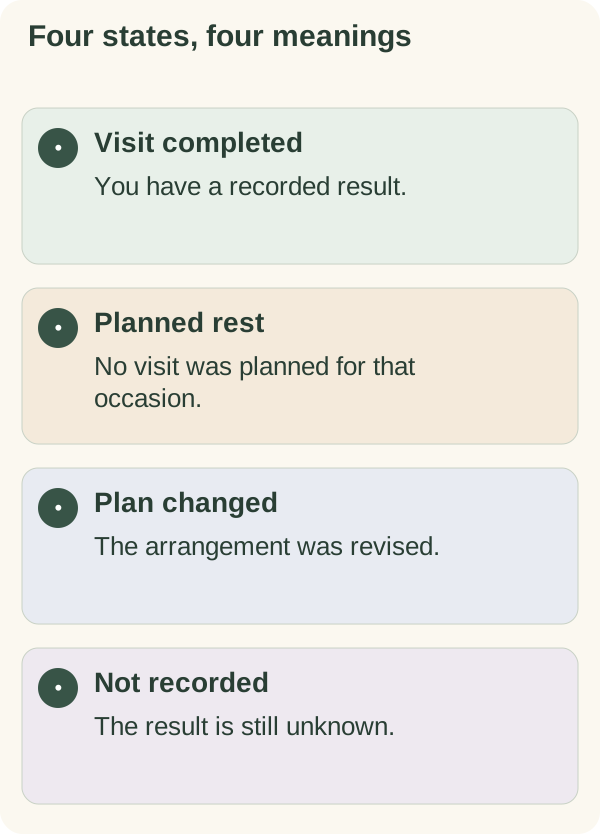
Why a streak is the wrong scoreboard for gym visits
A streak suits something you can do anywhere in a minute, like reading a page. Gym visits depend on opening hours, travel, shifts, family plans and how your body feels. Rest days are meant to be part of most routines anyway.
That makes a streak fragile in a way that has nothing to do with commitment. One cancelled bus or a week with a cold, and the number drops to zero. People then tend to drag themselves in when they should rest, or give up tracking because the chart looks like a failure.
A plan-based count avoids both. If you planned three visits and made two, you made two. Next week starts fresh, and the record still shows the good weeks behind it.
Use more than two marks
Most of the useful information sits between "went" and "didn't go". Give each situation its own mark.
| Mark | Meaning | What it tells you at review |
|---|---|---|
| Went | You made the visit you planned | The slot works |
| Short | You went, but for less time than planned | The slot works; the session plan may be too long |
| Rest | A rest day you chose in advance | Part of the plan, not a gap |
| Moved | You changed the visit to another time | Flexible, but check why it moved |
| Missed | You planned a visit and did not go | Look for a practical cause |
| Not recorded | No entry, and you do not clearly remember | You lack the information |
"Not recorded" matters more than it looks. If you fill blanks with guesses, the log stops being reliable. Use the states your chosen tool actually supports. If it cannot show the difference you need, keep a separate note or switch to paper rather than reading the display as more precise than it is.
Example: Sam's month with gaps
This is an illustrative example, not a real person's record. Sam planned three visits a week: Monday and Wednesday after work, plus Saturday morning.
| Week | Mon | Wed | Sat | Planned | Went | Note |
|---|---|---|---|---|---|---|
| 1 | Went | Went | Went | 3 | 3 | |
| 2 | Went | Missed | Went | 3 | 2 | Meeting ran late |
| 3 | Short | Moved (Thu) | Went | 3 | 3 | Wednesday clash again |
| 4 | Went | Missed | Not recorded | 3 | 1 or 2 | Away Saturday, forgot to log |
A streak app would have shown Sam starting over twice. The log showed something more useful: Monday and Saturday held up, and Wednesday failed or moved three weeks running for the same work reason.
What Sam did: at the end of the month, Sam stopped promising to "try harder on Wednesdays" and moved that visit to Thursday, when meetings rarely run late. Sam also started logging on the walk out of the gym, because the missing Saturday entry showed that logging at home was easy to forget. Week 4 stays as "1 or 2". An honest range beats a tidy number made up later.
Set up a log in ten minutes
- Write the question.
For example: "Does three visits a week fit my current job?"
- List only this week's planned visits.
Day, rough time and place, with rest days marked.
- Pick your marks.
Use the table above or a shorter set you will actually use.
- Log within a day.
Same place every time: a phone note, a paper card or a tracker.
- Review once a week.
Five minutes, looking for patterns rather than grades.
A fill-in attendance log you can copy
Copy this into a note or print it. Fill in one block per week.
Week starting: ____________
Question this log answers: ______________________________

Planned visit 1: Day ____ Time ____  Mark: Went / Short / Moved / Missed / Not recorded
Planned visit 2: Day ____ Time ____  Mark: Went / Short / Moved / Missed / Not recorded
Planned visit 3: Day ____ Time ____  Mark: Went / Short / Moved / Missed / Not recorded
Planned rest days: ____________

Practical note (only if something happened): ______________________
This week: ___ of ___ planned visits

Review: Did one slot fail again?  Yes / No
One change for next week: ______________________________
Keep notes practical, such as "gym closed for a holiday" or "train delayed". An attendance record does not need private medical details, body measurements or anyone else's activity history.
Turn the log into decisions
A log is only worth keeping if it changes what you do. These rules help at review time:
- Same slot missed or moved three weeks in a row: change that slot or remove it. A promise to try harder will not fix it.
- Most entries "not recorded": the logging is the problem. Make it easier, such as a card on the fridge or a note as you leave.
- A run of short visits: shorten the plan to match your time. The guide on planning a session for a short window helps.
- Plan hit every week for a month: keep it. Adding visits is a separate choice, not a reward you owe yourself.
- A whole week missed: do not add make-up visits. Read what to do after a missed week.
If you want one number, use "weeks with at least one visit". It survives a bad week and still shows whether the habit is holding. If your hours change often, see building a routine around a busy schedule and planning visits around changing shifts.
If friends or apps make streaks feel like pressure
Shared streaks, leaderboards and a friend who posts every visit can turn a helpful record into something you feel judged by. Concrete ways to handle it:
- If an app shows a streak you cannot turn off, ignore that number and read only your weekly count. Or keep your own log alongside it.
- If a friend's streak makes yours look poor, remember their week has different hours, travel and rest needs. Compare your month with your plan, not with them.
- If you feel you must go to keep a shared streak alive while unwell or in pain, rest. Ask a doctor or suitably qualified professional before going back.
- If you are tempted to add an extra visit to fix the chart, say to yourself: "Missed is a fact for my review, not a debt I have to repay."
- If you dread opening the log, stop tracking for a while. The habit can carry on without it.
Keep the log separate from training decisions
An attendance count says nothing about which exercises, amounts or intensities suit you. Use guidance from your gym induction or a qualified professional for those choices. A missed visit should not become an extra or harder session designed to repair the chart.
Try the habit tracker, which distinguishes scheduled entries from rest days and allows a not-recorded state. Read what a missing habit entry means, then restart after missing days if you want a fresh plan.
The attendance card in the gym planner keeps the occasion, recorded state and useful practical detail together.
Recording what happened instead of chasing a streak is how the habits and health guides approach every habit; the Fitness page shows how visits and reviews fit together.
Questions people often ask
Does a short visit count? Yes, record it as short. It shows the slot works and that you got there. If short visits are common, adjust the plan rather than the mark.
What if I forget to log for several days? Fill in only what you clearly remember and mark the rest "not recorded". Then make logging easier next week.
Is paper or an app better? Whichever you will look at. The marks matter more than the tool.
Should I set a target number of visits? A planned number per week works well because it resets every Monday. Start with what you managed in a typical recent week, and change it after a month of honest entries.