An empty entry in a habit tracker means nobody recorded anything for that occasion. It does not tell you whether you did the action, skipped it, had a rest day or simply forgot to tap the box. Before you change the plan, decide which of those it was. If you remember, record it. If you do not, leave it blank and say so. Then choose your next step from what you actually know.
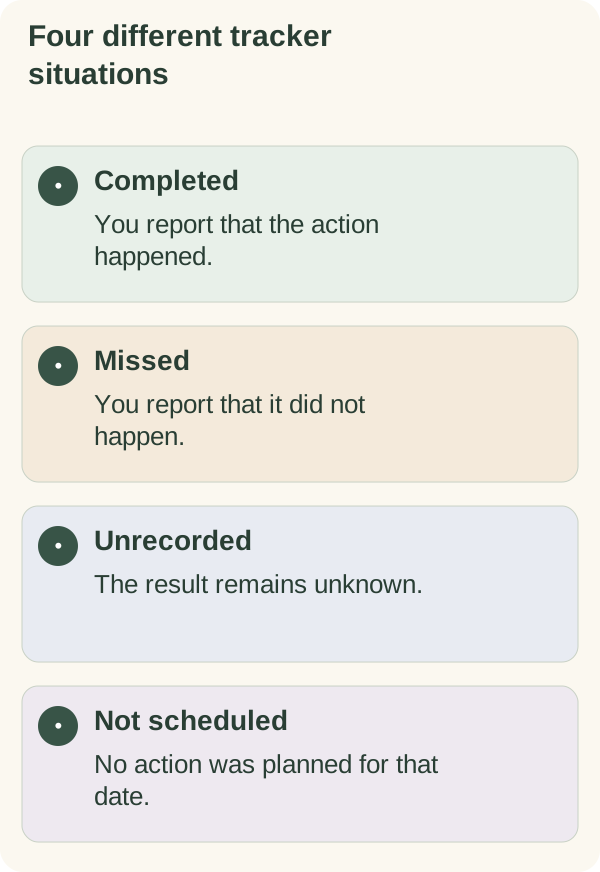
Five things an empty cell can mean
Most trackers show one blank square for several very different situations. Reading them correctly is the whole job of this page.
| What actually happened | What the record should say | What to do next |
|---|---|---|
| You did it and forgot to log it | Done, if you clearly remember | Make logging easier, not the habit |
| You did not do it | Missed (or "Not today" in the companion) | Ask what got in the way |
| It was a planned rest day | Rest, or no scheduled action | Nothing; it went to plan |
| The habit was paused | Paused, with a note of why | Decide later whether to resume |
| You genuinely cannot remember | Not recorded | Leave it, and look forward |
The last row is the one people struggle with. Leaving a cell open feels untidy, so there is a pull to fill it with whichever answer feels right on the day. On a good day you guess "done". On a bad day you guess "missed" and feel worse. Neither guess gives you better information than the blank already did.
Why the summary line can flatter or punish you
The free browser habit tracker shows a summary under each habit: how many sessions were completed, how many were recorded, how many were not recorded, and the share of recorded sessions that were completed. That last figure only counts sessions you actually marked.
This has two practical effects:
- Leaving known misses unrecorded makes the percentage look better than the week was. If you skipped on Wednesday and know it, mark it as missed.
- Marking unknown days as missed makes it look worse than the week may have been. If you cannot remember Thursday, the honest state is "not recorded", and the separate count of not recorded sessions keeps that uncertainty visible.
Read the two numbers together. A high completion share with a large not-recorded count tells you something different from the same share with almost nothing left blank.
What each tool lets you record
The browser tracker lets you tap any scheduled date up to today. Each tap cycles through not recorded, done and missed, so you can correct a past day if your memory is clear. Days that are not on your chosen weekdays show as rest, and dates still to come show as later. Your entries stay in that browser; they do not sync with Telegram.
The Telegram companion works differently. Its daily buttons are Done and Not today, and /habit log records a report for the current local day only. The habit check-in guide explains that you can replace today's report, but the command does not choose a past date. A paused habit cannot receive a new report until you resume it. So in the companion, yesterday's blank usually stays a blank. That is fine. It is a true record of what was reported.
Sort one blank in under a minute
- Was the action planned for that day?
If not, it is rest, not a miss.
- Was the habit active?
A paused habit has no expected result.
- Do you clearly remember the outcome?
If yes, record it where your tool allows.
- If you do not remember,
leave it open and move on without a story.
- Look at the next planned occasion
and decide whether anything about it needs to change.
Example: Sam's fortnight with three blanks
An illustrative example (the person is made up): Sam made a two-week browser tracker for two habits, "Read ten pages" and "Practise for five minutes", scheduled on Monday, Wednesday, Friday and Sunday. At the end of the fortnight there were three blanks.
- Blank one, a Wednesday: Sam remembered reading on the train that evening. That was a clear memory, so Sam tapped the date to done.
- Blank two, the following Friday: Sam knew there had been no practice because of a late dinner with friends. Sam marked it as missed rather than leaving it open to protect the percentage.
- Blank three, the second Sunday: nothing came to mind either way. Sam left it as not recorded.
Before sorting, Sam's first thought was "I've let both habits slip." After sorting, the picture was narrower: one real miss with an obvious cause and one unknown day. The practice habit needed no change at all. What Sam did change was the recording. All three blanks had something in common: each was on an evening away from the desk where the tracker was open. Sam started marking the tracker on the way to bed, from a phone, instead of the next morning at the desk. The following fortnight had no unknown days.
A blank-entry triage card
Copy this into a notes app or print it beside your tracker. Fill in one line per blank.
Date: ________   Habit: ______________________

Was it scheduled?            yes / no (rest)
Was the habit active?        yes / paused
Do I clearly remember?       done / not done / no memory
What I will record:          done / missed / leave blank
Anything in common with
other blanks?                ______________________
One change, if any:          ______________________
The last two lines matter most. A single blank rarely means anything. Three blanks that all fall on the same evening, after the same kind of day, usually do.
When most of your blanks are forgotten logging
Sometimes the action is happening and the record is not. You read most nights, but the tracker shows half the week empty. If that sounds familiar, the habit is fine and the recording routine needs attention. Treat them as two separate routines.
- If you forget because the tracker lives somewhere you are not, move the record closer to the action. Keep the tracker open on the device you use at that time of day, or print a copy and keep it next to the book.
- If you forget because logging comes too long after the action, attach it to the end of the action itself: close the book, tap the box.
- If you use the companion and its daily buttons arrive at a time that does not suit you, reply with
/habit logwhen you finish instead, using the habit's actual ID. - If you only remember to record on some days, record only those. A partial record that is accurate is more useful than a complete one that is half invented.
If you still find the record is mostly blank after changing where and when you log, ask whether you want to track this habit at all. Some routines are easier to keep without a chart. Stopping the tracking is a decision, not a failure.
When a long gap is impossible to reconstruct
After an illness, a trip or a hard fortnight, you may open the tracker to a run of a dozen empty cells. Do not try to rebuild them. Fill in the ones you are sure about, if any, and leave the rest. Then write one plain line in the weekly review worksheet or a note: "No record from the 3rd to the 14th. Away, then unwell." That sentence carries the context the cells cannot.
If the gap involved being unwell or a change in your health, your decisions about when and how to return to an activity belong with a doctor or a suitably qualified professional, not with a chart.
Once the context is written down, the next question is the same as after any gap: do you still want this routine, and what is the next occasion that fits? The restart guide covers that decision, and the illustrated restart exercise walks through keep, shrink or move.
Let the record serve the next step
Armored Kitten is built around one manageable step at a time, and an honest record is what lets you choose that step well instead of reacting to a chart that looks worse, or better, than your week really was. The guides on the habits and goals path cover setting up, keeping and changing routines in more detail.
When you are ready to decide what comes next, use the "Interpret a blank entry" card in the Restart and review workbook. It asks whether the action was scheduled, what your tool's state means and what you know independently, before you change any plan. Copying an answer from the workbook does not correct an entry or schedule anything; you make those changes in the tool itself.
Questions people often ask
Should I go back and fill in every blank to keep my tracker tidy? Only fill in the days you clearly remember. A tidy chart built on guesses is less useful to you than an untidy one you can trust.
Does an empty day break my streak? That depends on the tool. In the browser tracker, the summary simply counts done, recorded and not recorded sessions, so one blank does not wipe anything out. Either way, a streak is a display choice, not a measure of whether the routine is working.
Can I backdate a check-in in the Telegram companion? The /habit log command records a report for the current local day. If you want to note something about an earlier day, write it in a weekly review instead.
What if I honestly do not know whether I did it? Leave it as not recorded. Then make the next occasion easier to remember, for example by logging straight after the action.