Restart with one action
- Step 1Shrink the next step
- Step 2Attach it to a real cue
- Step 3Review what happened
Choose the next realistic occasion to return to a routine you still want. Check what made the old arrangement difficult, then keep, move, shrink or pause it as appropriate. Leave the recorded history accurate rather than filling missed days with make-up work.
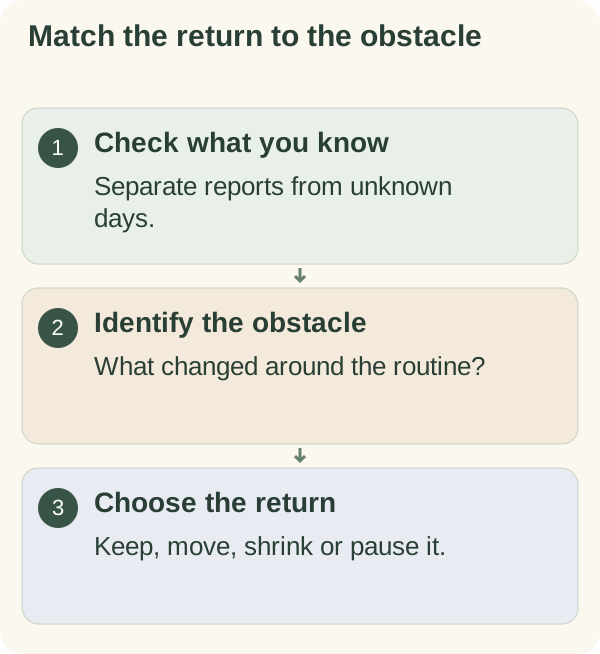
This is a planning exercise, not a prediction about how long habit formation takes. It works just as well for returning to a book as for restarting a short creative practice.
First decide what the blank means
A blank square might mean that you did not do the action. It might also mean that you forgot to record it, had a planned day off or had not reached that date yet. Those are different situations.
The flexible habit tracker keeps recorded outcomes separate from unrecorded sessions, rest days and future dates. If you cannot remember what happened, leave the entry unrecorded instead of inventing a result.
Ask what made the plan hard to use
Choose the explanation that best fits this attempt:
- The action needed more time than I had.
- The chosen time kept being interrupted.
- I did not have the materials ready.
- I no longer wanted this particular routine.
- Something more important needed my attention.
You can write another explanation. The point is to change something concrete rather than label yourself inconsistent.
Use a small restart worksheet
Complete these four lines:
I want to return to: The smallest useful version is: My next realistic opportunity is: If that time disappears, I can:
For a reading routine, an illustrative answer might be: “Read two pages after breakfast on Tuesday. If the morning becomes busy, leave the book beside lunch.” For drawing, it might be: “Open the sketchbook and draw one object for five minutes on Saturday.” These are examples to adapt, not required amounts.
Decide whether to shrink, move or pause
Shrink the action when its size is the obstacle. Move it when the timing is the obstacle. Pause or remove it when it no longer serves a purpose. Keeping an unwanted routine in a tracker does not make it more useful.
If you use the companion, the habit management tutorial explains the actual edit, pause and delete controls. Read the deletion explanation before choosing it; removing a routine can also remove related history.
Review the next attempt without a catch-up debt
After trying the revised plan, note what happened. Did the smaller action fit? Was the timing realistic? Would you choose it again? A short review gives the next plan something specific to use.
For a larger deadline, use the daily goal calculator to recalculate remaining work across the sessions you still have. It will show the arithmetic, including rest days, instead of assuming missed work vanishes.
Continue with the part that helps
Try daily check-in questions if you need a prompt for reflection, or the weekly review worksheet if you want to look at the whole week. You can return to the habits and goals path whenever you want the full picture.
Match the adjustment to the obstacle
A useful review connects what changed with a possible response. If the old opportunity clashes with a new commitment, reconsider its timing. If the required materials are elsewhere, preparation may be the next action. If the routine is no longer something you want, a pause or removal may describe your decision more honestly than another target.
For an illustrative reading habit, reducing the page count would not solve a book being unavailable. Finding the book or choosing an available alternative is the useful first decision. For a routine that does not fit a new shift, the next opportunity may need to change instead.
The illustrated restart exercise offers a keep, shrink or move choice. Review the practical circumstances yourself; neither a blank chart nor a chat suggestion can establish what happened on an unreported day.
Use the first card in the Restart and review workbook to connect what you know, the obstacle and your chosen next occasion.