When your working hours change, your routines usually do not fail because you stopped caring. They fail because the moment each one was attached to has gone: the train ride, the lunch break, the quiet hour after you got home. Write down what each routine used to follow, check whether that moment still exists, and give the routine a new place in the new day. Keep the first couple of weeks provisional, because you will not know how the new hours feel until you have lived them.
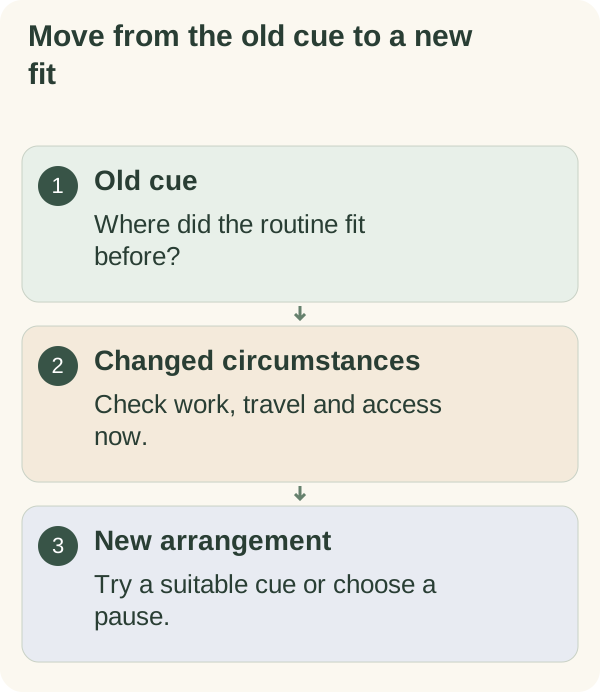
Your routines were hooked to your old hours
Most routines that last are attached to something that already happens. You read on the commute because you were sitting on a train anyway. You walked at lunch because the office emptied at one o'clock. You cooked on Thursdays because you got home early that day.
A change in hours can remove those hooks without you noticing. Common ones that move or disappear:
- The journey: a different route, a drive instead of a train, or no commute at all.
- The break: a shorter lunch, a break at a different time, or no fixed break.
- The arrival home: later, more tired, or at a time when the house is busy.
- Other people's timetables: a partner, children, a friend you walked with, a class.
- Opening hours: a gym, library or pool that suited the old day.
- The quiet stretch: the hour before everyone else woke up, or after they went to bed.
The routine itself may still be a good idea. What it needs is a new hook.
Map the old day against the new one
Before changing anything, fill in this table for every routine you had. It takes about ten minutes and saves a lot of guessing.
| Routine | What it used to follow | Does that still exist? | Possible new anchor | Decision |
|---|---|---|---|---|
| ____________ | ____________ | yes / moved / gone | ____________ | keep / move / pause |
| ____________ | ____________ | yes / moved / gone | ____________ | keep / move / pause |
| ____________ | ____________ | yes / moved / gone | ____________ | keep / move / pause |
Three patterns usually show up. Some routines are untouched, because their anchor is outside work. Leave those alone. Some anchors have simply moved, such as lunch now being at noon instead of one, and the routine can move with them. The rest have lost their anchor entirely. Those are the ones to work on, and you do not have to rescue all of them at once.
Re-home one routine at a time
- Pick the routine you miss most.
Start there rather than with the one you feel guilty about.
- Name the moment it used to follow,
in plain words.
- Find something in the new day that happens reliably,
such as arriving home, a meal or a fixed break.
- Check what the new slot needs:
materials in the right place, opening hours, another person's agreement.
- Try it on the next few occasions,
then decide whether it fits or needs another move.
Example: Daniel's move to an early shift
A fictional example, written to show the steps in practice. Daniel used to work nine to five with a forty-minute train ride each way. He read on the morning train and walked for half an hour after dinner with his neighbour. His new role starts at seven and finishes at three, and he now drives.
His map looked like this:
- Reading: anchor was the train. Gone, because he drives.
- Evening walk: anchor was after dinner with his neighbour. Still exists, but Daniel is now tired by eight and has to be up early.
- Sunday food shop: anchor was Sunday morning. Untouched.
He left the food shop alone. For reading, his first idea was to read before bed, which kept failing because he was falling asleep. He tried something different: reading for a short while in the car park after his shift, before driving home, when he was already sitting down and the day was over. That stuck. For the walk, he talked to his neighbour rather than quietly dropping it. They moved it to straight after Daniel got home on two weekdays, and kept a longer walk on Saturday.
What he changed after the first fortnight: the car park reading worked on most days, but not on the days he collected his son from school. He made those days reading-free on purpose instead of counting them as misses.
Give the new hours a trial before you judge
The first weeks of a new schedule are rarely typical. You may be more tired than usual, you are still learning the work, and other people around you are adjusting too. A routine that fails in the first week may fit well by the fourth.
So decide in advance when you will review, and do not make big decisions before then. A short note after each occasion is enough: did the slot exist, did you have what you needed, and how did it feel? The weekly review template gives you a place to collect those notes without carrying forward an old commitment that no longer applies.
If the new hours affect your sleep, energy or health, or you work nights, ask a doctor or a suitably qualified professional for advice about rest and activity. This page helps you place routines in a day. It does not set a sleep pattern or a shift-work health plan.
Retire the reminders that still follow your old hours
Old reminders keep firing long after the routine has moved. A phone alarm that says "Read" at 8:15 a.m. now goes off while you are already at work, and each time it does, it looks like a failure.
Go through these once, on the day the new hours start:
- Phone alarms and repeating reminders: edit the time or delete them.
- Calendar entries: change recurring events in the calendar itself. Editing your plan on paper does not update them.
- Companion messages: if you use the Armored Kitten companion on Telegram, check whether its daily messages still arrive at a useful time for you. The habit check-in guide explains that turning daily messages off removes the daily buttons, and that
/habit logremains a manual way to report. - Other people: if a friend, partner or class was part of the routine, tell them what changed and ask what works for them now. Their timetable may not move with yours.
When your hours keep changing before anything settles
Some changes are not one move but a series: a rota that changes every week, a temporary project with long days, or a role that is still being defined. A fixed new slot will keep breaking in those weeks. Try these instead.
- If you get your rota a week or two ahead, plan routines week by week as soon as it arrives. Pick specific days for that week only. The approach in planning gym visits around changing shifts works for any routine, including ones that have nothing to do with the gym.
- If the change is temporary, with a known end date, consider pausing the routine with a written return date instead of forcing it into an exhausting stretch.
- If your days have no pattern at all, anchor routines to events rather than times, such as "after I get home, whenever that is". The guide on keeping a work routine when every day looks different has more on working without a fixed day.
- If the new hours have squeezed out almost everything, choose one routine to keep and pause the rest on purpose. One that survives is worth more than four that all slip.
Start small in the new day
Armored Kitten's approach is one manageable step at a time, and a new working pattern is a good moment to take that literally: find one routine a new home, let it settle, then look at the next. The guides on the habits and goals path cover building and keeping routines once they have a place.
To choose a new anchor for a routine, build a small routine walks through picking a repeatable action and giving it a place in your day. If a routine has already slipped because of the change, the restart exercise linked at the top of this page helps you return without treating the missed days as debt.
Use the "What changed?" and "Keep, shrink, move or pause?" fields in the Restart and review workbook to plan around your new work pattern.
Questions people often ask
Should I keep my routines at the same clock time even if my hours changed? Only if the moment around them still exists. A routine at the same time but in a different situation, for example during your new commute, is effectively a new routine.
How long should I give a new slot before changing it again? Long enough to see it on ordinary days as well as the first tiring week. Set your own review point in advance so you are not deciding on a bad day.
I used to do this routine with someone else. What now? Ask them directly what suits them under your new hours, and be ready for the answer to be a different day or a pause.
What if the new job leaves no room for the routine at all? Pause it with a note of where you stopped and what would let you restart. Look at it again once the new hours feel normal.