If a habit keeps failing at the time you picked, the slot is usually the problem, and a different reminder will not fix it. Look at a few occasions you remember, work out what beat the habit each time, and choose a new slot that does not have the same problem. Then try the new time on the next few planned occasions and delete the old one, so you do not end up owing the habit twice.
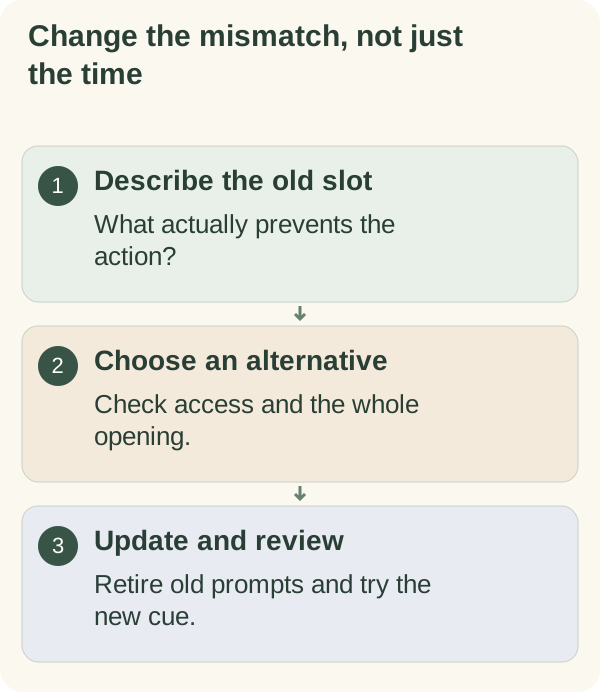
Look at the slot, not your willpower
When a habit fails three or four times at the same point in the day, the natural conclusion is "I'm not disciplined enough." A more useful question is "what happens at that time instead?" Something reliably wins that slot. Until you know what it is, any new time you pick may lose in the same way.
Use only occasions you remember clearly. If some days are blank and you cannot recall them, leave them out. The page on what a missing habit entry means explains why an unknown day is not evidence of anything.
Five reasons a slot keeps losing
| What wins the slot | How you notice it | What usually helps |
|---|---|---|
| Another demand | Work, family or chores fill that time most days | A time before the demand starts, or a different day |
| Low energy | You are free, but too tired to start | A time when you are fresher, even if it is shorter |
| Missing materials | The book, kit or notes are somewhere else | Move the materials, or move the habit to where they are |
| Closed doors | The place or service is not available then | A time inside its opening or contact hours |
| Another person | Someone else's timetable keeps changing | Agree a time together, or make the habit solo |
More than one can apply. Pick the one that won most often, because that is the one the new time has to beat.
Sometimes the honest answer is that the time is fine and the habit is too big, or you no longer want it. Changing the time will not help then. The guide on whether to pause a habit or make it smaller covers that decision.
Score the candidate times before you pick one
Choose two or three realistic alternatives and test each against the same questions. Copy this card and fill it in.
Habit: _________________________

                              Option A   Option B   Option C
Time or anchor:               ________   ________   ________
Free on most planned days?    yes / no   yes / no   yes / no
Energy usually OK then?       yes / no   yes / no   yes / no
Materials within reach?       yes / no   yes / no   yes / no
Place or service available?   yes / no   yes / no   yes / no
Anyone else needed?           yes / no   yes / no   yes / no
Room for setup and clean-up?  yes / no   yes / no   yes / no

Beats the old problem?        yes / no   yes / no   yes / no
The most important line is the last one. An option that scores well everywhere but still runs into the same demand that beat the old slot is not a real change.
Where you can, anchor the new slot to an event rather than a clock time: "after I drop the children at school" or "when I sit down after lunch" tends to survive small shifts in the day better than "10:30".
Run a short trial of the new time
- Pick the option that beats the old problem,
even if it is less tidy on paper.
- Set it up the day before:
materials in place, anyone involved told.
- Try it on the next few planned occasions,
without changing anything else at the same time.
- Write one line after each try:
did the slot exist, and did you use it?
- Decide:
keep it, adjust it slightly, or try your second option.
Example: Alex's guitar practice
The example below is illustrative; the person in it is not real. Alex wanted to practise guitar for a short while on weekday evenings at nine, after the dishes. It almost never happened. Looking back at the occasions Alex could remember, the pattern was clear: by nine Alex was on the sofa, the guitar was in its case in the spare room, and getting it out, tuning it and putting it away felt like a whole project.
Two things were winning the slot: low energy and the setup. Alex scored three options:
- Before work: free most days and energy was fine, but practising early would disturb a housemate.
- Straight after getting home, before cooking: free most days, energy acceptable, and no one else around.
- Weekend mornings only: reliable, but much less often than Alex wanted.
Alex picked "straight after getting home" and changed one more thing: the guitar moved onto a stand in the living room, already tuned, so the setup took almost no time. The first week, practice happened on three of the four planned days. The fourth was a day Alex came home late, and Alex decided those days would simply be off. After that trial, Alex kept the new slot and deleted the nine o'clock reminder.
Count the setup and the clean-up
A slot is longer than the activity. A short walk needs shoes, a coat and getting out of the door. Cooking a meal needs shopping beforehand and washing up afterwards. Paperwork may need the right office or phone line to be open. When you check a new time, count the whole thing from first step to finished.
This is often why a habit that "only takes ten minutes" never fits a ten-minute gap. If the full version does not fit, you can either find a longer slot or reduce the setup, as Alex did with the guitar stand.
If the habit depends on someone else, such as a walking partner or a shared meal, confirm the new time with them before you commit. A slot that suits you but not them will lose in the same way the old one did.
Remove the old slot so you only owe one
People often add the new time and forget to remove the old one. Then the old reminder keeps going off, and every time it does, it records a small failure you never meant to sign up for.
- Phone and calendar: delete or edit the old reminder in the app itself.
- Browser tracker: the free habit tracker uses one shared weekday schedule for all its habits, so if the new time also means new days, make a fresh tracker for this habit.
- Telegram companion: if the habit's title includes a time, such as "Read at 9", use Edit or
/habit editwith the habit's ID to change it. The habit management guide explains the controls. - Other people: tell anyone involved that the old time no longer applies.
When no time of day seems to fit
If you have tried two or three slots and every one fails, the time is probably not the problem. Use these checks before moving it again.
- If every slot fails for the same reason, such as being too tired, the habit may be too large for this period of your life. Try a much smaller version, or pause it.
- If every slot fails for a different reason, your days may be too irregular for a fixed time. Try anchoring it to an event that happens most days, wherever it falls.
- If it fits the week but not the day, try fewer, longer occasions, for example twice a week instead of every weekday.
- If you notice relief every time it is skipped, ask whether you still want it. Dropping a habit you have outgrown is a reasonable choice.
If the habit is part of advice from a doctor or another professional, such as timing around medication or treatment, ask them before you change when you do it.
Make the next attempt easier
Armored Kitten is about taking one manageable step at a time, and moving a habit to a slot where it can actually happen is often the smallest step that makes the biggest difference. The habits and goals path has more on setting up and keeping routines.
If the habit has slipped while you were working this out, use restart after missing days to choose a fresh occasion without carrying the old slots forward as debt.
Use the "What changed?" and "What is the next suitable occasion?" fields in the Restart and review workbook to connect a time change to the problem it is meant to solve.
Questions people often ask
Is morning always better for habits? No. The best time is one that is reliably free, when you have the energy and the materials, and where nothing keeps winning the slot. For some people that is morning; for many it is not.
Should I change the time and the size at once? Change one thing first, so you can tell what helped. If the setup is the obstacle, reducing it is part of the time change, as with moving equipment closer.
How many tries should a new time get? Enough planned occasions to include a normal week rather than only a quiet one. Decide the number before you start.
What if the new time only works on some days? Schedule it only on those days. A habit on three reliable days is more useful than one on five unreliable ones.