A routine that used to work and now keeps slipping has usually lost one specific part, not all of its value. Compare how it was when it worked with how it is now, across six parts: why you did it, what started it, where it happened, how big it was, who was involved and what you got from it. Then repair the part that changed, redesign the routine around the new situation, or retire it if its job is already done some other way.
Signs a routine is drifting before it stops
Long-standing routines tend to fade gradually. You may notice some of these weeks before the routine disappears altogether:
- You start it later, or put it off more often.
- It takes longer than it used to, or feels heavier.
- You do it, but you cannot remember why it mattered.
- You feel relief when something cancels it.
- You keep promising yourself you will get back to how it used to be.
None of these mean you have lost discipline. They mean something around the routine has changed. A review is how you find out what.
Compare then and now in six parts
Fill in both columns. Be specific: "after the school run" is better than "mornings". Where you genuinely do not know, write "not sure" rather than inventing a reason.
| Part | When it worked | Now |
|---|---|---|
| Purpose: why I did it | ______________ | ______________ |
| Cue: what started it | ______________ | ______________ |
| Place: where it happened | ______________ | ______________ |
| Size: how long or how much | ______________ | ______________ |
| People: who was involved | ______________ | ______________ |
| Payoff: what I got from it | ______________ | ______________ |
Most people find that one or two rows have changed and the rest are the same. That narrows the problem a lot. A routine that has lost its cue needs a new one. A routine whose purpose has changed may need a completely different shape, or none at all.
Repair, redesign or retire
| What the comparison shows | Choice | What that looks like |
|---|---|---|
| One part changed, purpose still matters | Repair | Replace the missing cue, place or person; keep the rest |
| Several parts changed, purpose still matters | Redesign | Build a new routine for the same purpose, from today's life |
| Purpose is now met some other way | Retire | Stop the routine and remove its reminders |
| Purpose no longer matters to you | Retire | Stop without replacing it |
| Not sure yet | Pause and observe | Watch for a couple of weeks before deciding |
Retiring a routine is not giving up. If a routine existed to solve a problem and the problem has gone, keeping it is just extra work.
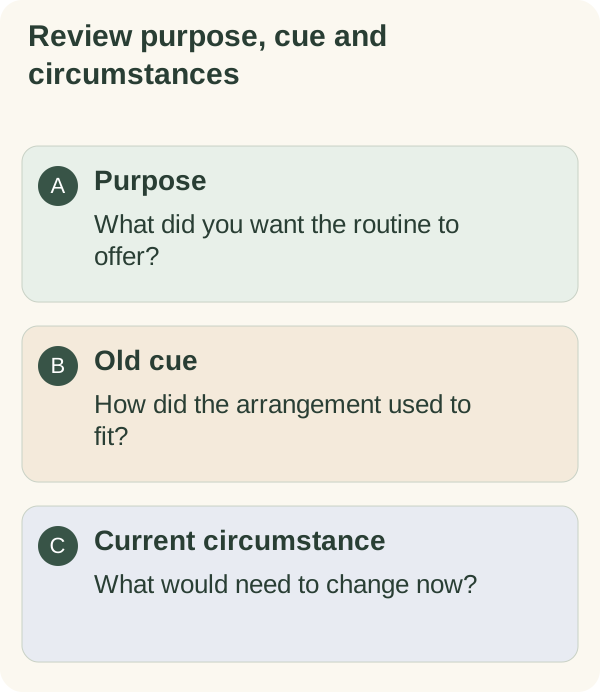
Review the old arrangement
- Purpose:
write down what the routine was meant to give you.
- Then and now:
fill in the six-part comparison.
- Changed parts:
circle the rows that are different.
- Choice:
repair, redesign, retire or pause and observe.
- Next:
choose one occasion to try the change, or remove the routine cleanly.
Example: Maya's Sunday batch cooking
This is an illustrative example, not a real person's story. For two years Maya spent Sunday afternoon cooking three or four meals for the week. It worked well: she lived alone, got home late, and without it she ordered takeaway most evenings.
Over a few months it started slipping. She postponed it, cut it short, then skipped it entirely for three weekends and felt guilty each time. Her six-part comparison showed:
- Purpose: then, to avoid takeaway on late evenings. Now, the same, but her partner had moved in and cooked most weeknights.
- Cue, place, size: unchanged.
- People: then, just her. Now, two people with different tastes.
- Payoff: then, easy dinners. Now, a fridge full of food that was often wasted because her partner had already cooked.
The purpose was being met another way, so the routine was mostly redundant. Maya retired the big cooking session. She kept one part that still mattered: the Sunday food shop, which she now did with her partner. On the two evenings a week when her partner worked late, she cooked something simple on the night.
What changed after trying it: the guilt went away almost at once, because the routine she was "failing" no longer existed. Later she noticed that one batch-cooked lunch for work would still help, and added that back as a small, separate routine.
When the routine still happens but has stopped helping
Some routines do not slip at all. You still do them every week, and they still take time, but you no longer get much from them. This is easy to miss, because a tracker shows a perfect record.
- If the payoff row has changed but the purpose still matters, the routine may need a new form. For example, a weekly planning session that now produces a list you never look at may need to become shorter and more focused.
- If the routine has become a box to tick, ask what would happen if you skipped it for two weeks. If nothing would change, it may be ready to retire.
- If you keep it mainly for the streak, consider stopping the tracking rather than the routine, and see whether you still choose to do it.
- If it now takes much longer than it used to, the size row has changed. Cut it back to the part that gives you the payoff.
When you cannot tell what changed
Sometimes the comparison does not show a clear difference, and the routine still feels harder than before. That can happen when your overall energy or mood has changed, rather than anything about the routine itself.
- If you cannot point to a change, pause and observe for a couple of weeks. Write a one-line note after each occasion: did it happen, and how did it feel?
- If several routines are slipping at once, the cause is probably something bigger than any one routine, such as a busy period, a change at home or how you are feeling. Look after the basics first.
- If you have felt low, anxious or exhausted for a while, talk to a doctor or another qualified professional. Changing your routines is not a substitute for that conversation.
Keep the routines that still earn their place
Armored Kitten is built around one manageable step at a time, and reviewing a routine is one of those steps: you decide, on purpose, which routines still help you and which can go. The habits and goals path covers building and keeping routines from here.
If the "people" row is what changed, and a friend used to keep you going, the guide on asking a friend to be an accountability partner can help you set that up again in a new form.
Use the weekly review template to record the decision, or the free weekly review worksheet if you prefer to fill it in in your browser. Then restart after missing days to bring a repaired routine back, or build a small routine to design a new one from current circumstances.
Use the "What still matters?" and "What changed?" fields in the Restart and review workbook to make one current decision about the old arrangement.
Questions people often ask
How do I know whether to fix a routine or start a new one? If only one part has changed and the purpose still matters, fix that part. If most parts have changed, a new routine built for your current life is usually easier than patching the old one.
Is it bad to drop a routine I kept for years? No. If it has done its job, or the job no longer matters, dropping it frees time for something that does.
How often should I review my routines? When one starts slipping, and otherwise whenever your life changes noticeably, such as a new job, a move or someone joining or leaving your household.
What if I miss how the routine used to feel? Write down what you miss about it. That is often the purpose row, and it can guide a new routine that fits now.