Make a habit smaller when the problem is size or time and a smaller version would still give you something you care about. Pause it when the obstacle is temporary and any smaller version would feel empty, or when the habit depends on something you cannot have right now. Keep it as it is if the obstacle was a one-off, and stop it if you no longer want it. Whichever you choose, write it down, so the decision replaces the vague guilt of a habit that is neither on nor off.
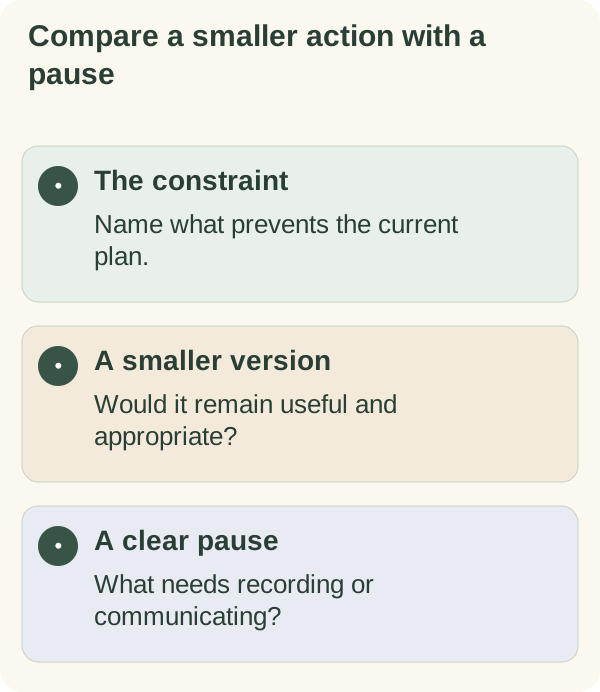
Four questions that settle most cases
- Why did you start this habit? Write the reason in one line, for example "to keep my Spanish from fading" or "to have ten quiet minutes for myself".
- What exactly is stopping the current version? Lack of time, low energy, a missing tool, a place you cannot reach, or someone else's needs.
- Is that obstacle temporary? Does it have a likely end, such as a busy month, a move or a project, or is it the new normal?
- Would a smaller version still give you the reason in question one? Not a token, but a real piece of it.
Your answers to questions three and four do most of the work.
A decision table you can use
| Your situation | Usually the better choice | Why |
|---|---|---|
| Less time, same interest, smaller version still useful | Make it smaller | You keep the thread and the reason |
| Obstacle has an end date, smaller version feels pointless | Pause with a return note | Rest from it cleanly instead of half-doing it |
| Habit needs a place, tool or person you cannot access | Pause, or change the habit | Shrinking does not create a missing ingredient |
| You are keeping a mini version only for the record | Pause, or stop tracking | The record has stopped describing the habit |
| One unusual week, normal life returns next week | Keep it as it is | No change needed for a one-off |
| You feel relief whenever you skip it | Stop, or pause and reconsider | Your interest may have moved on |
Notice the third row. A smaller reading target does not help if the book is packed in a box. A shorter swim does not help if the pool is closed. Shrinking only solves problems of size.
The test for a useful smaller version
A smaller version earns its place if it passes all three of these checks:
- It still gives you part of the original reason. Five minutes of conversation practice keeps a language alive; opening the app and closing it again does not.
- You would actually do it on a bad day. If even the small version feels like a chore you will skip, it is still too big, or the timing is wrong.
- It is the real activity, just less of it. Writing one sentence in a journal counts. Ticking the journal box without writing does not.
If the smaller version fails these checks, a pause is the more honest choice. You are not failing at a mini habit. You are resting from a habit you intend to come back to.
How to pause so it actually feels like a pause
A habit you have stopped doing but never officially paused keeps nagging. Reminders still fire, the tracker fills with gaps, and you feel behind. A clear pause removes that. Copy this note and fill it in.
Pause note

Habit:                 _______________________________
Paused from:           ____________
Reason:                _______________________________
Where I stopped:       _______________________________
  (page, lesson, level, last thing I did)
Reminders turned off:  yes / not needed
Who needs to know:     _______________________________
I will look at this again when:
                       _______________________________
  (a date, or an event such as "after the move")
You do not need a return date if nothing real depends on one. "When the project ends" is a perfectly good answer. The point is that you, not the gaps in a chart, decide when the pause is over.
In the Armored Kitten companion on Telegram, Pause stops a habit being active while keeping its earlier check-ins, and Resume makes it active again. Deleting a habit is different: it also removes that habit's check-in history. The habit management guide explains both controls. If you want to keep a record of what you did before the break, pause rather than delete.
If the habit is shared, such as a weekly walk with a friend, tell the other person what you have decided. They may be relying on the arrangement.
Make the call in five steps
- Write the reason
you started, in one line.
- Name the obstacle
and whether it has a likely end.
- Try to describe a useful smaller version.
If you cannot, that is your answer.
- Choose:
keep, shrink, pause or stop.
- Record it:
change the habit, fill in a pause note, or remove it from your tracker.
Example: Maya's language practice during a house move
Here is a made-up example to show how it can work. Maya practised Spanish most evenings with a course book and audio lessons. Then she moved flat. For six weeks, evenings were boxes, viewings and paperwork, and the course book was packed.
Her first plan was to shrink it: one audio lesson a night instead of a lesson plus book work. It lasted three days. The audio lessons built on the book exercises, so listening without them was confusing, and she was too tired to concentrate anyway. The smaller version failed two of the three checks.
So she paused. Her note said: "Paused from the 4th. Moving. Stopped at unit 9, page 112. Will look again the first weekend after the move is finished." She turned off her daily reminder and told her conversation partner she would be back in a few weeks.
What she changed after trying it: she kept one tiny thing that did pass the checks. On her commute she listened to a Spanish radio station, with no lessons and no tracking. It kept the language in her ear without becoming another obligation. When the move was done, she restarted at unit 9 rather than trying to catch up on six weeks of lessons.
When you have paused before and never come back
Some people avoid pausing because a past pause turned into quitting. If that has happened to you, these adjustments help.
- If you worry you will forget, set the review point as an event you cannot miss, such as "the Saturday after the project deadline", and put it in your calendar now.
- If restarting from where you stopped feels too big, plan the first session back as a short review of the last thing you did, not new material.
- If the pause stretched because life never calmed down, ask whether the habit belongs in your current life at all. Stopping it is also a legitimate outcome.
- If you came back once and quickly stopped again, the habit probably needs a different time or size before it needs another restart. See changing the time of a habit that never fits.
The guide on keeping a return note when you pause a project has more on writing down where you left off so the restart is easier.
When the habit is part of care or treatment
This decision is for ordinary personal routines. Some routines are not optional in the same way: exercises from a physiotherapist, medication timing, a care routine for someone else, or a safety procedure. Do not shrink or pause those on your own. If one no longer fits your life, ask the doctor, pharmacist, therapist or professional who set it what you can safely change.
Decide, then let it rest
Armored Kitten helps you take one manageable step at a time, and sometimes the right step for a habit is a clear, written pause rather than another shrunken attempt. For a day that needs to be smaller overall, beyond one habit, make room for a difficult day helps you sort what is essential, and the guide on making a smaller plan on difficult days goes further. The habits and goals path has the wider set of habit guides.
The weekly review template can hold a reconsideration note without creating a daily obligation.
Use the "What still matters?" and "Keep, shrink, move or pause?" fields in the Restart and review workbook to compare the available options.
Questions people often ask
Is making a habit tiny always better than stopping? No. A tiny version helps when it still gives you something real. When it only keeps a box ticked, a pause is cleaner and easier to come back from.
How long can I pause a habit for? As long as the obstacle lasts, unless something real depends on a date. Write down what would tell you it is time to look again.
Will pausing in the companion lose my history? Pausing keeps earlier check-ins. Deleting a habit removes its check-in history after confirmation, so choose pause if you want to keep the record.
What if I cannot decide? Pick a pause with a short review point, such as two weeks. You can always restart early or turn it into a smaller version when you know more.