When a day turns hard, stop trying to squeeze the old plan into it. Take five minutes and put every item into one of four piles: keep (something real happens if it waits), move (it can wait), ask (someone else could take it) and stop (the point where today ends). Then do only the first small action of what you kept. You do not have to explain why the day is difficult, even to yourself, before you are allowed a smaller plan.
You can use this page without saying what made the day hard. It is a way to organise practical tasks, not a test of how well you are coping. If difficult days have become most of your days, or you feel unsafe, please talk to a doctor or a qualified professional. In an emergency, contact your local emergency number.
Sort the list into four piles
Write everything down first, in any order. Sorting is easier once the list is outside your head. Then give each item one label.
| Pile | The test | What you do with it |
|---|---|---|
| Keep | Something real happens to you or someone else if it waits | Shrink it to an opening move |
| Move | Nothing changes if it happens on another day | Give it a day, or no date at all |
| Ask | Someone else could reasonably do it, and you would welcome that | Send one specific request |
| Stop | This is not a task; it is where today ends | Write a time or a finishing point |
Most lists shrink a lot at this stage. The hopes you had for the day ("tidy the spare room", "finally sort the photos") usually land in Move. That is the point. They were intentions, and an intention is allowed to wait.
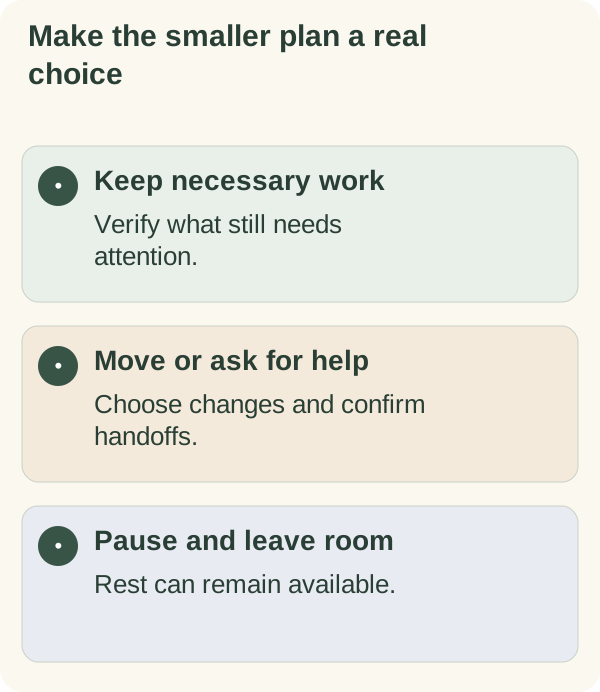
A lighter plan
- Keep:
name the essential thing that still needs attention.
- Move:
choose what can wait and where to put it.
- Ask:
decide whether there is one practical request you want to make.
- Pause:
leave rest and stopping available, even if the list is unfinished.
How to tell an obligation from a wish
"Essential" is slippery on a bad day, because everything feels urgent. Ask what would actually happen if the item waited one day, and write the answer next to it.
- A real consequence: a missed appointment you agreed to attend, a payment due today, a colleague who cannot start their part without yours.
- A feeling of consequence: you would be annoyed with yourself, the room would stay messy, a plan you liked would slip.
Only the first kind goes in Keep. If you are not sure whether a deadline is real, check the source: the letter, the email, the booking, or the person who set it. Check any obligation with the person or organisation involved before assuming you can move it.
Shrink the kept item to its opening move
If the essential task still feels too large, find the first physical action: open the document, find the appointment letter, look up the travel time. Do that, and then decide again. You might find that finding the document is enough for now. If an outside deadline still applies, check what you can agree with the person relying on the task.
Changing a date in a personal list does not change an outside deadline. If someone is waiting on the work, send a short message through your normal channel. "Something has come up today. I can send a rough version by 4, or a finished one tomorrow morning. Which works better?" gives them a real choice.
If you want to ask for help, make it specific: "Could you collect the parcel today?" gives the other person something clear to consider. The guide to asking for practical help has scripts for this.
A smaller-plan card you can copy
Copy this into a note or onto paper. Fill it in from the top. Leave any line blank that does not apply.
TODAY, SMALLER VERSION

Keep (real consequence today): ____________________
  Opening move: ____________________

Tell (who is waiting on a result): ____________________
  Message sent?  yes / not yet

Move (can wait, and where it goes): ____________________

Ask (one specific request): ____________________
  Answer:  yes / no / waiting

Stop here: ____________________
  (a time, or "after the opening move")

Return note for anything I set down: ____________________
The Stop line matters as much as the Keep line. Without it, a smaller plan quietly grows back into the old one by mid-afternoon.
Example: Daniel's Thursday
A fictional example, written to show the steps in practice. Daniel woke to difficult news from home. His Thursday list said: finish the slides for Friday's meeting, gym after work, call the bank about a card, clear the spare room, post a birthday card to his aunt.
He sorted it in a few minutes:
- Keep: the slides, because a colleague had to add her section by 3 p.m. Opening move: open the file and fill the two empty slides.
- Tell: a message to the colleague saying the draft would be rough but on time.
- Move: the spare room (no date) and the gym (Saturday). The bank call had no deadline, so he moved it with a note: "Card works; ask about the new fee."
- Ask: his partner, who was going past the post box anyway, agreed to post the card.
- Stop: 5 p.m., laptop shut.
He sent the slides at 2:40. What changed afterwards was the order he fills in the card. On the next hard day he wrote the Stop line first, because on Thursday it was the line that made the rest feel possible. A difficult day is where Armored Kitten's one-step-at-a-time approach is most useful: one kept task and one opening move count as a whole plan.
When every item insists it is essential
Some days the sort does not shrink anything, because every item seems to carry a consequence. Try these rules in order.
- If you cannot tell whether a deadline is real, check the source before deciding. Many "today" items turn out to be "this week".
- If two items both have a consequence today, keep the one someone else is waiting on, and send a message about the other asking what is possible.
- If nothing can move and the day still does not fit, the plan is not the problem. Tell the people involved what you can do and ask what options exist. An honest update is more useful to them than a missed deadline.
- If you cannot decide at all, ask someone you trust to look at the list with you. A second person can often see which pile an item belongs in.
When the difficult day belongs to someone else
Sometimes the day is hard because someone you care about is going through something, and your plan has to make room for them. Sort your own list the same way, and put "be available to them" in Keep with a realistic shape: a phone call at lunch, an evening visit, a message. If you want help finding words, encouragement messages has examples you can adapt. Keep your Stop line too. Supporting someone well over several days needs you to stop at some point.
Keep control of the companion
You can ask the companion for a smaller plan, decline its suggestion or use the stop and pause controls. A page visit cannot change those settings. Ask directly if you are unsure what is saved or scheduled.
For an obligation you cannot move or complete, consider asking the person or organisation involved what options are available. This page cannot change an appointment or agreement for you.
Use the lighter-plan exercise, try the daily planner, or return to a routine after a break.
Leave yourself a useful return note
When you set something down, write where it stands and the next action you would recognise. An unresolved question can stay open without deciding when the whole project resumes. A note like "The documents are collected. Check which file is required before filling in the next section" is far easier to come back to than "finish everything".
Before carrying anything forward, ask whether it still matters and whether tomorrow has room for it. Optional tasks can be removed. A personal project can stay paused. If another person's deadline is involved, agree the next step with them; a worksheet cannot change the agreement. The guide to return notes goes further.
The Smaller-day planning cards open with a card for exactly this sort: what needs attention, what can wait, help, and where to stop.
Questions people often ask
Is a smaller plan just giving up on the day? No. A plan that fits the day you actually have is more likely to get the important thing done than a full plan you abandon at noon.
What if the difficult day turns into a difficult week? Use the same sort each morning, and see planning a gentle return after a demanding week when it eases. If it keeps going or is affecting your health, talk to a doctor or qualified professional.
Do I have to tell people why I am changing plans? No. "Something has come up today" is enough for most practical updates. Share more only if you want to.
Can the companion decide what is essential for me? It can ask questions and suggest a sort. You make the decisions, and you can decline any suggestion.