On a heavy caregiving day, your minimum routine has three layers. The care layer is whatever the existing care instructions say must happen, and this page does not change it. The household layer is the smallest amount of housework that keeps tomorrow workable. The personal layer is one optional thing for you, which is allowed to stay undone. Everything outside those three layers can wait, and any help you rely on should be help someone has actually agreed to give.
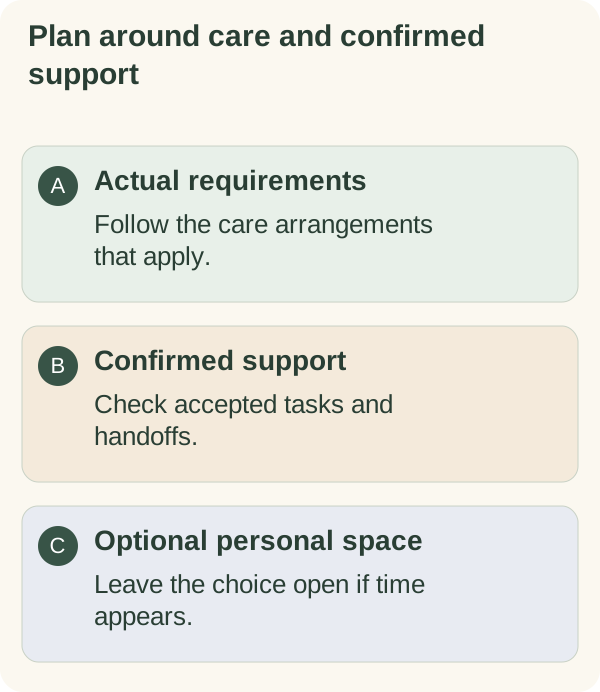
What this page decides, and what it leaves to others
Caregiving days mix two kinds of task. Some are care: medicines, appointments, personal care, anything set by a doctor, nurse, care plan or care service. Others are ordinary: shopping, laundry, meals for the household, your own errands.
This page only helps with the ordinary kind and with arranging the day around the care. It does not decide which care tasks can be reduced, delayed or skipped. If you are unsure about a care requirement, ask the professional or service responsible. Keep sensitive care details in a suitable place, not in a general shared planning note.
Three layers of a minimum day
Think of the day as three layers, filled in that order.
| Layer | Where it comes from | Example entries |
|---|---|---|
| Care | Existing care instructions, appointments and agreements | Times already set by the care plan, an outpatient appointment, a booked home visit |
| Household floor | Your own decision, made on a calmer day | Clean dishes for the next meal, bins out on collection day, clothes for tomorrow |
| You | One optional choice | A coffee outside, a short call with a friend, a chapter of a book |
The household floor is the part most people skip, and it is where heavy days go wrong. Without a floor decided in advance, every household job feels equally necessary at 7 p.m., and you end up doing all of them or none. Decide the floor once, when the day is ordinary, and reuse it.
Make a smaller day plan
- Necessary:
identify the responsibilities that require attention today.
- Support:
note who has agreed to help and what they are handling.
- Flexible:
choose which nonessential tasks can wait.
- Personal:
consider one optional action you would welcome if space appears.
- Change:
decide who to contact when the day's arrangement no longer fits.
A minimum-day card and a handover note
The card below is for you. The handover note is for anyone stepping in, so they do not have to phone you with questions halfway through. Keep the handover practical: times, where things are, who to call. Detailed care information belongs wherever the care team keeps it.
MINIMUM DAY: ____________ (date)

CARE (copied from existing instructions, not changed here)
  ____________________   time: ______
  ____________________   time: ______

HELP AGREED (confirmed by the person, not just asked)
  Who: ________  doing: ____________  until: ______

HOUSEHOLD FLOOR
  [ ] dishes for the next meal
  [ ] bins / recycling if it is collection day
  [ ] clothes ready for tomorrow
  [ ] ____________________

CAN WAIT
  ____________________

FOR ME (optional, can stay blank)
  ____________________

IF THE PLAN STOPS FITTING, CONTACT:
  ____________________
HANDOVER NOTE FOR ____________

Already done today: ____________________
Still to happen, with times: ____________________
Where things are kept: ____________________
Who to call with questions: ____________________
Who to call if something changes urgently: ____________________
I'll be back / reachable at: ____________________
Example: Alex's Tuesday without the usual helper
Illustrative example only; this is not a real person's story. Alex supports an older parent who lives ten minutes away. On Tuesdays a regular helper usually covers the afternoon visit, but on this Tuesday the helper is ill, and Alex also has a work deadline and an empty fridge at home.
Alex filled in the card. The care layer was copied from the parent's existing arrangements, unchanged. For help, Alex messaged a brother: "Could you do the 6 p.m. visit tonight? I'll leave the handover note on the kitchen table." The brother said yes, and Alex wrote the note. The household floor was dishes and clothes for the next day. The big shop moved to Thursday, with an online order for the two things that could not wait. For the personal layer, Alex wrote "coffee on the bench outside work" and left it optional.
What changed after trying it: Alex realised the slow part of the day was deciding the household floor while tired. Now there is a saved "helper unavailable" version of the card with the floor already filled in, so on the next short-notice Tuesday only the care and help lines need writing.
Small, repeatable plans like this are how Armored Kitten's small-steps approach applies to looking after someone else: you protect the essential care and one manageable piece of your own day, and let the rest wait.
When the helper cancels or the day changes
Caregiving plans rarely survive the day unchanged. Decide your responses in advance.
- If a helper cancels at short notice, look at what they were covering. Care tasks need another confirmed person or the care service's own backup arrangements; ordinary tasks can usually move to Can wait.
- If the person you care for has new or worrying symptoms, contact the doctor, care service or emergency number as appropriate. Then re-sort only the ordinary tasks around whatever they advise.
- If an appointment runs long, let anyone relying on you know, and drop the household floor to its smallest item for that day.
- If you are unwell yourself, treat that as a reason to ask for cover, not a reason to push through the whole card. Ask a doctor about your own health.
Make support requests concrete
If you want help, name a task someone could understand and say when it is needed. "Could you collect the groceries we have listed?" gives more information than a general request to be more helpful. The other person still needs room to decline or explain their availability. The practical help guide has scripts and a plan for a no.
Keep the personal action genuinely optional
You might want a quiet drink, a short conversation or something that interests you. You might also want any unexpected half hour to stay empty. Both are fine. Avoid turning every pause into a target to log.
If a personal routine has its own health instructions, follow the advice that applies to you; a minimum-day card is not a substitute for that guidance. On heavy weeks a simple default for meals can take one decision off the list. The weekly meal planning routine for busy beginners shows one way to set that up.
When minimum days become most days
If most of your days now look like this, the plan is telling you something about the load, not about your organisation. Talk to the care team about what support exists. Ask your doctor or local social services what help is available for carers where you live, and talk to a doctor about your own health if you are running on empty.
Use make room for a difficult day to choose which ordinary tasks can wait. The smaller-plan guide can help you record a decision without treating rest as unfinished work.
Alongside the care guidance that actually applies, the opening card of the Smaller-day planning cards works for the ordinary tasks and any help requests.
Questions people often ask
Can I drop some of the care tasks on a busy day? That is a question for the professional or service responsible for the care plan. This page only helps you arrange ordinary tasks around care.
What should a household floor include? Whatever keeps the next morning workable for your home. For many people that is dishes for the next meal, clean clothes and the bins on collection day. Decide yours on a calmer day.
How much should I tell a stand-in helper? Enough to do the task and to know who to call. Keep detailed care information where the care team keeps it.
Is it selfish to plan something for myself on a day like this? No. It is one optional line, and it can stay blank. Some days it is the only part of the plan that is yours.