Make one practical request
- Step 1Choose one task
- Step 2Say when it matters
- Step 3Leave room for a decline
The request most likely to get a useful answer names one task, says when it matters, includes what the other person would need to know and makes "no" easy to say. For example: "Could you pick up my parcel from the post office before 5 today? It's in my name and I can send you the slip. No problem if not, I'll sort something else." Then wait for a clear yes before you take the task off your own list.
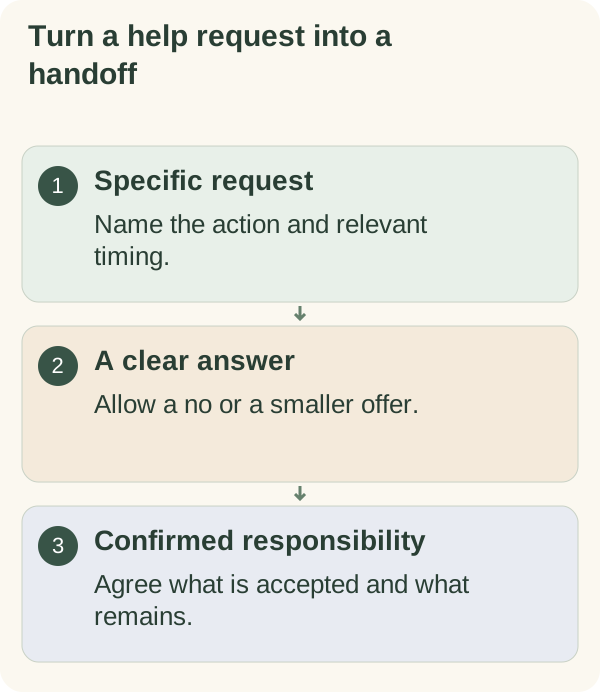
Most advice about asking for help is about confidence. This page is about the mechanics: which task to hand over, what to put in the message, and what to do with an answer that is "maybe", "no" or, sometimes, two people saying yes.
Find the task that hands over well
Look at what is filling the day and ask which parts someone else could do without needing you to explain everything. Errands, collections and one-off household jobs travel well. Tasks that need your login, your signature or your professional judgement do not.
| Usually easy to hand over | Possible, with the proper process | Keep with you, or use the official route |
|---|---|---|
| Collecting a parcel or shopping order | A school pickup (the school's own collection arrangements apply) | Anything that needs your password or PIN |
| Taking the bins out, walking the dog | Collecting something on your behalf where ID or a signed note is required | Banking, payments and signing documents |
| Cooking or bringing one meal | Covering part of your work through your manager or team | Confidential work or personal records |
| Phoning a shop to check opening hours | Waiting in for a delivery at your home | Decisions only you can make |
The middle column is where most mix-ups happen. Before handing one of those over, check the organisation's rules for who may collect, sign or act for you. Do not share passwords, financial access or sensitive documents just to make a request easier.
Prepare a clear help request
- Task:
state the specific action you would like help with.
- Timing:
explain when it is needed and why that timing matters.
- Details:
include the information necessary to decide.
- Choice:
give the person room to decline or offer a smaller part.
- Confirmation:
agree who is doing what before relying on the handoff.
Word-for-word requests you can adapt
Change the names and details, then make the words sound like you. Each script covers task, timing, details and an easy no.
PARTNER OR HOUSEMATE
"Today's got away from me. Could you take over dinner tonight?
Anything easy is fine. If you can't, tell me now and I'll
order something in."

FRIEND
"Small favour, and say no if it doesn't fit: could you grab
my prescription bag from the pharmacy on your way past before
6? I'll check what they need from you and send it over."

NEIGHBOUR
"Hi, it's [name] from number 12. I'm stuck out until late.
Would you be able to put our bin out tonight? Completely fine
if not, I'll find another way."

COLLEAGUE
"I've got a clash this afternoon. Could you take the 3pm
supplier call? The notes are in the shared folder under
[project]. If you can't, I'll ask [manager] to move it."

CONFIRMING A YES
"Thank you. So you're collecting the parcel before 5, and the
slip is in the photo I just sent. I'll let you know if
anything changes."

REPLYING TO A NO
"No problem at all, thanks for telling me straight away."
For the pharmacy line, check the pharmacy's own rules on who can collect for you before you ask. The friend should not need anything more private than what the pharmacy asks for.
Ask without implying they have time to spare
"I'm swamped, can you cover this?" can land as "you look less busy than me". Ask about the task, not about their free time, and let them judge their own day. "Could you do X by Y?" leaves the decision with them. Avoid explaining at length why your day is harder than theirs. A short reason is enough, and none is fine.
Timing helps too. If you can see in the morning that the afternoon will not fit, ask then. A request at 4:45 for something needed at 5 gives the other person almost no real choice.
Example: Sam's crowded Wednesday
A fictional example, written to show the steps in practice. Sam had a work deadline at 4, a boiler engineer due "between 8 and 12", a parcel waiting at the depot and nothing planned for dinner.
Sam looked at which task travelled best. The engineer visit needed someone at home, so it stayed with Sam. The parcel could go to someone else. Sam messaged a sister: "Could you collect a parcel from the depot on Mill Road before it closes at 6? It's under my name; they told me a photo of the card plus your ID is fine. No worries if today is bad."
The sister said she couldn't. Sam replied with thanks, then tried the neighbour with the same message. The neighbour said yes, and Sam sent a confirmation with the photo. Dinner was simply moved to Move: soup from the cupboard.
What Sam changed after trying it: the first draft had gone to two people at once, and both nearly said yes, which meant one of them would have made a wasted trip. Sam now asks one person at a time and gives each a clear time to answer by.
When the answer is maybe, late or doubled
Most guides stop at "ask clearly". These are the answers that actually cause trouble.
- If the reply is "I'll try" or "should be fine", treat it as not yet confirmed. Ask: "Shall I count on you, or keep looking?"
- If two people say yes, thank the second one straight away and release them: "Someone's just picked it up, so you're off the hook. Thank you for offering."
- If someone agrees and then cancels, go back to your decision for a no (below). Do not assume the task is now impossible; it is back on your list or moved.
- If you hear nothing by the time you set, send one short follow-up, then move to your fallback. Repeated chasing rarely helps either of you.
- If they offer part of the task, decide whether that part meets the need, and say clearly which part stays yours.
If the reason your day is too full is a health, care or safety emergency, contact the right service or emergency number first. A favour from a friend is not a replacement for that.
Have a decision for a no
Decide your fallback before you send the request. It might be asking another suitable person, using a proper service, moving a flexible task to another day or doing a smaller version yourself. If an essential responsibility still cannot be covered, look for appropriate support rather than pretending the handoff is complete.
When someone agrees, confirm the details and tell them promptly if anything changes. Handing a task over well is still one manageable step; Armored Kitten's small-steps approach counts it the same as doing the task yourself.
Record the handoff simply
Keep a one-line note: who agreed, what they are doing, and whether you need to hear back. "Neighbour: parcel, before 6, will text when done." Leave out private detail, and once you have agreed how you will hear back, avoid checking in repeatedly.
Afterwards, a short thank-you keeps the door open for next time. If you want help with the words, the encouragement message helper can get you started.
Use take a small connection step to draft the request. Then plan an overwhelming day using the help that has actually been confirmed.
The Smaller-day planning cards include an "Ask for practical help" card with lines for the task, the timing, the information needed and what was accepted.
Questions people often ask
What if I always feel like a burden when I ask? Keep the request small, specific and easy to refuse. A clear, small ask is usually easier for the other person than a vague "let me know if you can help".
Should I offer something in return? You can, but it is not required for a one-off favour. A thank-you and a willingness to help them another time is usually enough.
Is it all right to ask by text rather than calling? Yes, for most practical favours. A text lets the other person check their day before answering.
What if there is no one I can ask? Look at the task again. It may be possible to move it, shrink it or use a paid or public service. The guide to a smaller plan on a difficult day helps you sort what has to stay.