Treat the whole day as belonging to the appointment. Map it from the moment you start getting ready to the moment you are home and settled: preparation, travel there, arrival and waiting, the appointment itself, travel back and some time afterwards. Ask the provider anything that affects those blocks before the day. Only then fit other tasks around it, and choose small ones you can stop at any point.
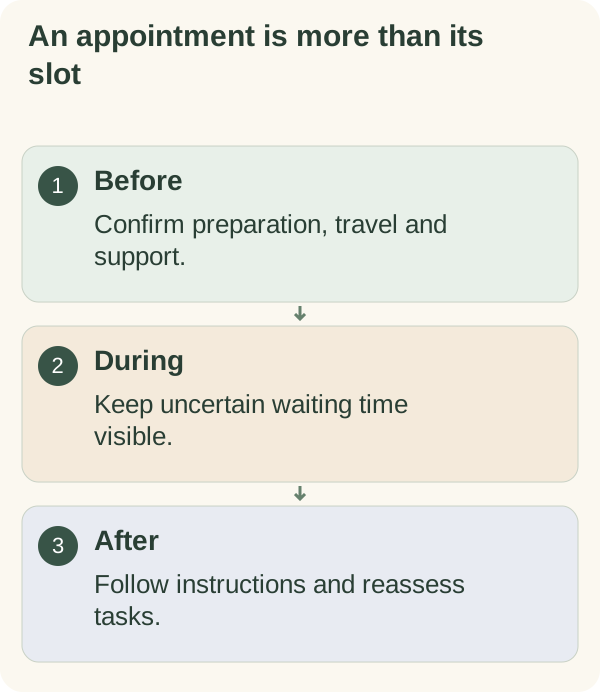
This page is about the day around a long appointment: a hospital or clinic visit with several stages, an assessment, a legal or official appointment in another town, or a day of tests. It does not tell you what a medical appointment needs. For preparation, recovery or whether you can travel alone afterwards, follow what the provider tells you and ask them when something is unclear.
Six questions to ask the provider
Most of the uncertainty in a long appointment day can be reduced with a phone call or a careful read of the letter. Ask these before the day.
- How long does it usually take? Ask for a range, including waiting between stages.
- When should I arrive, and where exactly? Large sites can have several entrances and departments.
- What do I need to bring? Documents, ID, letters, a list of current medicines, forms.
- Is there any preparation? For example, instructions about eating, drinking or medicines beforehand. Follow these exactly and ask if unsure.
- Will I need someone with me, or to take me home? Some appointments affect whether you can drive or travel alone afterwards. The provider can tell you.
- Can I bring someone, and is there somewhere to wait? Useful if a companion is coming too.
Write the answers in one place with the date and who told you. Reception staff change, and it helps to have the note.
Map the appointment day
- Confirm:
check the appointment details and required preparation.
- Travel:
arrange the outward and return journeys.
- Support:
confirm any companion, care or handover arrangement.
- Afterwards:
leave appropriate space for the needs you know about.
- Other tasks:
choose only work that can realistically and appropriately fit.
An appointment-day map you can copy
Fill in each row. The right-hand column is for what happens if that block runs long, so you have decided in advance rather than in a waiting room.
| Block | Time | Details | If it runs long |
|---|---|---|---|
| Getting ready | ____ | Documents packed, preparation done | Leave without the optional extras |
| Travel there | ____ | Route, parking or stop, buffer | Phone the department if you will be late |
| Arrival and waiting | ____ | Check-in desk, waiting bag | Message anyone expecting you |
| Appointment | ____ to unknown | Questions to ask written down | Hand over your later commitments |
| Travel home | ____ | Who is driving, or which transport | Agreed backup lift or route |
| Afterwards | ____ | Instructions received, rest of evening light | Optional tasks move to another day |
The blank finish time in the Appointment row is deliberate. If the provider cannot give you one, do not invent one.
Plan for a finish time you do not know
If the end of the appointment is uncertain, do not hang the next commitment on an exact time you cannot guarantee. Ask the provider what information is available, and tell anyone affected by your availability what you know.
A message that works: "I'm at an appointment that could run until mid-afternoon. I'll message when I'm out. Can we move our call to tomorrow, or keep it as a maybe for 5?"
An illustrative plan might say: "Appointment and travel are the main commitment. Ask someone to handle the agreed collection. Review optional admin after returning rather than promising it in advance." That keeps every later decision tied to what actually happens.
Pack for the waiting
Long appointments often involve a lot of waiting. A small bag saves the day from feeling wasted, and from tempting you into work that needs more focus than a waiting room allows.
- The appointment letter and anything the provider asked you to bring, in one folder.
- Phone charger and headphones.
- Something to read or listen to that you can drop mid-page.
- Water, and a snack if the provider's instructions allow it.
- A short list of small tasks that can stop at any moment: a reply to one message, a shopping list, booking a reminder.
Avoid planning anything that needs a long run of concentration. You will be called at an unpredictable moment, and half-finished complicated work is harder to return to than a short reply.
Example: Maya's day at the hospital clinic
Illustrative example only; this is not a real person's story. Maya had an appointment at a hospital clinic two towns away, with tests spread across the day. The letter said "allow most of the day".
She rang the clinic and learned three things: arrive at 9, expect to be there until early or mid-afternoon, and someone else should take her home. She asked her partner to drive her back and confirmed the time range with him. Her manager agreed she would be offline all day. A neighbour agreed to take in a parcel due that afternoon.
Her original plan had included "answer work emails in the waiting room" and "cook a proper dinner". She replaced the first with a short list of personal messages and a podcast, and the second with something from the freezer. The appointment finished at 3:30, later than she had guessed, and nothing else depended on the time.
What changed for next time: Maya now leaves the "if it runs long" column filled in before any long appointment, so on the day she only has to follow it. Planning the whole day around one big commitment, and letting the rest go, is how Armored Kitten's small-steps approach works on days like this.
When you are the one going with someone
If you are accompanying a parent, partner or friend, the day is still theirs, but the logistics may land on you.
- If they have the letter, ask to see it or to hear the instructions, so you know the times and what to bring.
- If you are their lift home, keep the whole afternoon clear. Your own later commitments should be moveable or handed over.
- If you need to step out, agree with them how you will be reached, and check with the department whether they can contact you.
- If you are unsure what they need afterwards, ask the provider while you are there, with the patient's agreement.
Move responsibilities deliberately
If you will be unavailable for work, care or household tasks, arrange it in advance. Confirm that another person has agreed to each handoff; crossing a task off your list does not move it to them. The practical help guide has wording for those requests.
Keep personal documents and appointment information somewhere suitable. A general day plan can point to the instructions without copying sensitive details into a shared note.
For the days before, the guide to preparing for an appointment without a last-minute rush covers documents and reminders in more detail.
Review after the appointment
Follow any instructions you received, and add necessary follow-ups to your list. Then look at the remaining tasks one at a time. There is no need to squeeze everything you deferred into the last hours of the same day.
Use make room for a difficult day to leave optional work. The daily planner can help compare the confirmed appointment arrangements with other commitments.
For help and handovers, the Smaller-day planning cards include a practical-help card you can fill in next to the provider's own instructions.
Questions people often ask
How much time should I allow for a long appointment? Use the range the provider gives you, then add travel and some buffer at both ends. If they cannot give a range, keep the whole day clear.
Should I try to work while I wait? Only on small tasks you can drop at any moment. Anything needing deep focus is better moved.
What if the appointment is cancelled or moved on the day? Ask when the new date is, then treat the freed time as open rather than filling it with everything you postponed.
Can I drive myself home? Ask the provider. It depends on the appointment and on you.