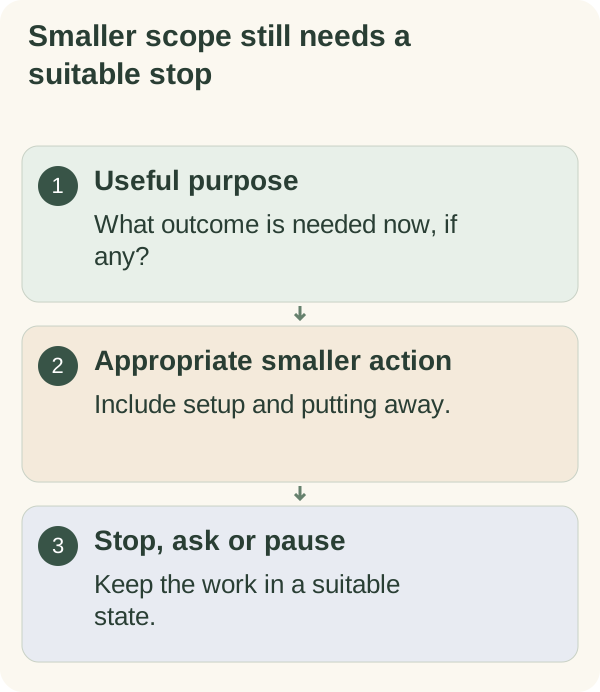
When you have less energy than you planned for, ask what the task is actually for today, then step down to the smallest version that still does that job. Count the setup and the cleanup as part of the task, because a "small" version that leaves a mess is not small. Pick a stopping point that leaves things safe and tidy. If even the smallest useful version is too much, pausing with a short note is a sensible choice, not a failed one.
This page is about ordinary tasks on a day when your energy is lower than you expected. It does not explain why that happens or suggest a treatment. If low energy keeps coming back, arrives suddenly or comes with other symptoms, talk to a doctor.
Separate the outcome from its size
Every task has a purpose and a size, and on a low-energy day you can often keep the purpose while cutting the size. Preparing one necessary document may serve today's need even if organising the entire folder does not fit.
Ask: what would make today's version of this task useful? The answer is usually much smaller than the task as written. "Sort out the kitchen" might really be "have a clean pan for dinner". "Do the accounts" might really be "send the one invoice that is due".
Some tasks have safety or professional requirements that cannot be removed to make them smaller. For health, care or hazardous work, follow the instructions that apply and get suitable help.
Resize an ordinary task
- Purpose:
name the useful outcome you need, if any, today.
- Core:
identify a smaller appropriate action that contributes to it.
- Boundary:
choose a stopping point that leaves things in a suitable state.
- Support:
consider whether someone can help with a specific part.
- Pause:
decide what to record if you leave the task for now.
A shrink ladder for everyday tasks
Each task below steps down from the full plan to a pause. Use the rows as examples and make your own ladder for the task in front of you.
| Task | Full version | Smaller | Smallest useful | Pause note |
|---|---|---|---|---|
| Kitchen | Deep clean, cupboards and floor | Surfaces and dishes | Clean the pan you need tonight | "Cupboards next; cloths under the sink" |
| Laundry | Wash, dry, fold, put away | Wash and hang | Wash one load of what you need tomorrow | "Basket by the door is clean, unfolded" |
| Inbox to zero | Reply to anything from today | Send the one reply someone is waiting on | "Flagged three; rest can wait" | |
| Report | Finish the draft | Write one section | Write the headings and three bullet points | "Section 2 next; figures in tab B" |
| Garage | Clear and reorganise | One shelf | Bag one box for the charity shop | "Left side done; bags by the car" |
The smallest useful version should still serve the purpose you named. If it does not, it is not useful, it is just smaller. Some lists also show "stretch the time instead": doing the full task over more days. That works for some tasks, but only if you are honest about the new finish date and tell anyone affected.
Count setup and cleanup
Imagine changing "sort all the bookshelves" to "find the book needed for tomorrow". The smaller action serves a current purpose. Pulling every book onto the floor and leaving the room blocked would create another problem rather than a useful stopping point.
Before choosing a version, add up three parts: getting things out, doing the task, and putting things back. Painting one wall still needs dust sheets, a tin opened and brushes cleaned. If setup and cleanup take more than the task itself, the smaller version may not be worth starting today.
Example: Sam's Saturday garage
An illustrative example (the person is made up): Sam had kept Saturday free to clear the garage. On Saturday morning Sam felt flat and slow, with nowhere near the energy the plan needed.
Sam's first idea was to do "half the garage". Thinking it through, half the garage meant pulling everything out to decide what stayed, which would leave the drive blocked until it was all sorted. That was not a safe or tidy stopping point.
Sam stepped down the ladder instead. Smaller: one shelf. Smallest useful: bag up the one box already marked for the charity shop and put it in the car, because the shop's donation day was Monday. That took twenty minutes including finding the bags.
Sam wrote a pause note on the garage door: "Charity box done. Left shelves next. Bags in the drawer by the door." What changed for next time: Sam now writes the ladder on Friday evening for any big Saturday task, so a low-energy morning only means choosing a rung, not redesigning the plan. Choosing the rung that fits the day is the core of Armored Kitten's small-steps approach.
Tasks that cannot safely stop halfway
Most advice about low-energy days assumes any task can be made smaller. Some cannot, because a half-done version is worse than not starting.
- If the task involves heat, electricity, ladders, sharp tools or chemicals, do not start a reduced version that you may abandon midway. Either do it with someone, or move it to a day you can finish safely.
- If stopping halfway would leave the house unusable, such as a bathroom with the floor up or a car with a wheel off, keep the task for a day with enough energy or help.
- If the task involves driving a long way, do not shrink your rest stops to save energy for the drive. Change the plan, share the driving, or go another day.
- If the task is part of someone's care, follow the care instructions; this ladder is not for deciding which care tasks to reduce.
For these tasks, the useful small action is often preparation: buy the part, book the help, read the instructions. That is real progress and can be stopped at any point.
When the smallest useful version is still too much
Sometimes even the bottom rung is too much. Then you have three choices: ask someone to do a specific part, move the task to another day, or pause it without a date. If choosing a first move is the hard part, start a task walks through finding one.
Leave a return note without promising a return time
Note where the work stopped and the next useful action if you expect to come back. "Materials remain in their usual storage; choose the next section before starting" is enough, and it does not hand tomorrow a new obligation.
If someone relies on the result, tell them through the usual channel. A private note does not update their expectations or arrange a replacement.
Review what remains, rather than carrying everything forward
At the next planning moment, decide whether the task still matters. Keep necessary work visible, remove optional work that has gone out of date and ask for support where it would help. A reduced plan today does not need to become tomorrow's backlog.
Use make room for a difficult day to compare those options. If choosing the first move is the remaining problem, try start a task.
On the Smaller-day planning cards, the "Could one action become smaller?" line is a quick way to write your chosen rung next to a pause.
Questions people often ask
Does doing a smaller version still count? Yes, if it does the job you named for today. That is the point of choosing the purpose first.
What if I end up with more energy halfway through? You can step back up the ladder. Decide the next rung before you start it, so you do not drift into a task you cannot finish.
How do I stop shrinking turning into avoiding? If the same task stays on the bottom rung for weeks, look at why: it may need help, a different time of day, or a decision to drop it.
Should I push through instead? Sometimes a deadline means you need to. If low energy is frequent or unexplained, talk to a doctor rather than relying on willpower.