Work backwards from the time you need to leave the house, not from the appointment time. A week before, confirm the details and what to bring with the provider. The night before, pack a bag and write down the three questions you most need answered. On the day, leave at a time that already includes travel, finding the building and checking in. Most last-minute rushes come from one missing piece: a document, the route, or a question you only remember on the way home.
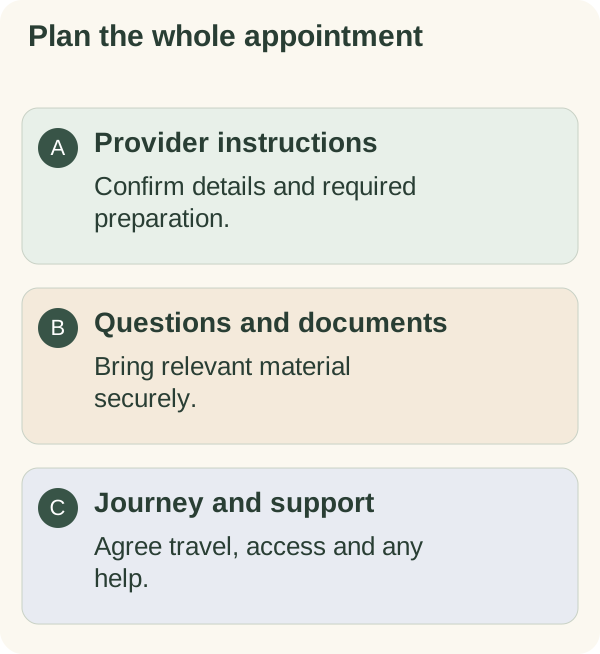
Turning an appointment into a few small, dated checks is Plan your days applied to one fixed point in your week, so the day itself has fewer surprises.
This works for most kinds of appointment: a clinic, a bank, a government office, a school meeting, a repair visit at home. It covers the organising only. What the appointment involves, and any preparation it needs, comes from the provider or the professional you are seeing.
Work back from the moment you leave
| When | Check | Notes |
|---|---|---|
| When booking | Write down date, time, full address, contact number and what to bring | Ask about access needs, interpreters or bringing someone |
| About a week before | Confirm details and any instructions; arrange time off, childcare or a lift | Find the documents now, not the night before |
| Two days before | Check the route, travel time, parking or stop, and which entrance | Look up whether the building has more than one site |
| The night before | Pack the bag, write the questions, charge your phone | Put the bag by the door |
| On the day | Leave at your calculated time | Take the confirmation with you |
| Within an hour after | Write notes, next steps and any date to chase | Before the details fade |
Work out your leave time
Most people plan from the appointment time and add travel. The rush comes from the steps in between. Add them all:
Appointment time:                         ________
minus  arrive-early time the provider asks for:   ____ min
minus  finding the building and the room:          ____ min
minus  parking or walking from the stop:           ____ min
minus  travel time at that time of day:            ____ min
minus  buffer for delays:                          ____ min
= LEAVE THE HOUSE AT:                     ________
An illustrative example: a 10:30 appointment, ten minutes early as requested, five minutes to find the room, five minutes from the car park, thirty-five minutes of driving and fifteen minutes of buffer gives a leave time of 9:20. Write the leave time in your calendar, not the appointment time, so your reminder goes off when it is actually useful.
The night-before bag
Pack it the evening before and leave it by the door:
NIGHT-BEFORE BAG
[ ] Appointment letter or confirmation (paper or on phone)
[ ] Anything the provider asked you to bring: ______________
[ ] ID, if asked for
[ ] Glasses, hearing aids or other things you rely on
[ ] Notebook and pen, or notes app ready
[ ] Question card
[ ] Phone charged, plus charger for a long wait
[ ] Something to do while waiting
[ ] Directions and the provider's phone number
Keep the original documents in the bag rather than copying private details into a calendar or a shared planner. A note saying "letter in the front pocket" is enough.
A three-question card
Long lists of questions often go unasked once you are in the room. Write the three that matter most, in the order you want them answered:
QUESTION CARD                     Appointment: ______________
1. The thing I most need to understand today: ______________
2. What happens next, and when? ______________
3. Who do I contact if ______________ ?

Useful lines if I need them:
"Could you say that again more slowly?"
"Could I have that in writing?"
"Is it alright if I take notes?"
Prepare in four short checks
- Week before:
confirm details and what to bring with the provider.
- Two days before:
check the route, the entrance and how long it really takes.
- Night before:
pack the bag, write the question card, set the leave-time alarm.
- Straight after:
write notes and the next state before you start the journey home.
Example: Maya goes with her father
Illustrative example only; this is not a real person's story. Maya was going with her father to an outpatient appointment at a large hospital. Last time they had been late: they could not find parking, he had forgotten his glasses, and on the way home neither of them could remember what had been said about the next step.
This time, a week before, she rang the number on the letter to confirm the time and asked where the drop-off point was, because her father walks slowly. Two days before, she checked the car park and which entrance was closest to the clinic. The night before, she packed the bag with him, and he wrote his own three questions; Maya added one only after asking whether he wanted it. They left at the calculated time and arrived with ten minutes to spare.
What she changed for next time came from what still went wrong: the explanation in the room was quick, and her notes were patchy. Now she asks at the start whether it is alright to take notes, and she asks at the end for the next steps in writing. They write a summary together in the car park before driving home.
If you are going with someone, or on their behalf
Appointment checklists are almost always written for the person being seen. If you are the one going along:
- If you are accompanying someone: check they want you there, and agree beforehand what your role is: driver, note-taker, or someone to help ask questions.
- If you want to speak on their behalf: many organisations need the person's permission before they will discuss things with you. Ask the provider how that works in advance.
- If the person has access or communication needs: ask the provider early about what they can arrange; do not assume it will be available on the day.
- If you are running late: call the provider as soon as you know, say when you expect to arrive and ask whether they can still see you.
- If the appointment is by phone or video: test the link or confirm the number the day before, and plan a quiet place with your notes in front of you.
- If you feel anxious about the appointment itself: bringing someone you trust and writing your questions down both help. Concerns about the appointment's content are for the professional you are seeing.
For appointments that take up most of a day, see planning around an appointment that takes most of the day.
Afterwards: write the next state within the hour
Before you are home, write down what happened and what comes next. Be precise about the state of each follow-up: "next appointment booked for the 14th" is different from "they said they would send a date". If an instruction matters, such as something to do before the next visit, confirm it with the provider rather than relying on memory.
Start a task helps if the first preparation check is the one you keep putting off. The daily planner lets you plan the whole appointment day, including travel and anything you need to fit around it. The "Open a life-admin item" card in the Small home reset kit suits the provider check and the state to record afterwards.
Questions people often ask
How early should I arrive? As early as the provider asks. If they do not say, add time for finding the building and the room, especially on a first visit.
What should I bring to an appointment? Whatever the provider asks for, plus the confirmation, anything you rely on such as glasses, and a way to take notes. Ask them if you are unsure.
What if I forget my questions in the room? Hand the question card over or read from it. That is normal and most professionals welcome it.
How do I make sure follow-up actually happens? Ask "what happens next, and when?" before you leave, write the answer down, and put a date in your calendar to chase if you have not heard.