Reset a single surface
- Step 1Choose the place you need
- Step 2Put away the easy items
- Step 3Box decisions and stop
Start with the one space you need to use next, not the worst room. Clear it in two passes: first take anything that already has a home back to where it belongs, then put everything that needs a decision into a single box to deal with later. Stop as soon as that space works again. The rest of the home waits its turn, in an order you choose by what you need, not by how bad it looks.
This is how Plan your days treats any job that feels too big to begin: find the smallest piece that changes tomorrow, finish that piece, and let the next one wait.
Why starting with the worst room backfires
The worst room is the slowest place to see progress. You can work for an hour and it still looks bad, which is exactly when people give up. Every item you pick up there also seems to belong somewhere else, so you carry things into other rooms and start tidying those too. By the end, three rooms are half done and none of them can be used.
Starting with the space you need next works the other way round. It is usually small, the improvement is visible quickly, and you feel the benefit the same day when you eat at the table or find your keys.
Pick the first space by what you need next
| If what you need next is to... | Start with... |
|---|---|
| Eat at home without clearing up first | The table, or one length of counter |
| Sleep properly | The bed and the floor around it |
| Leave the house on time | The area by the door: keys, shoes, bag, coat |
| Work or study | The desk, or one end of the table |
| Find a letter or form | Wherever paper collects, using the document starting guide |
| Have someone visit | The route from the front door to where they will sit, plus the bathroom |
If two rows apply, pick the one you will use first tomorrow. Write it as a sentence with a time in it: "I need the table cleared for dinner tonight." That sentence becomes your end point.
Two passes: move first, decide later
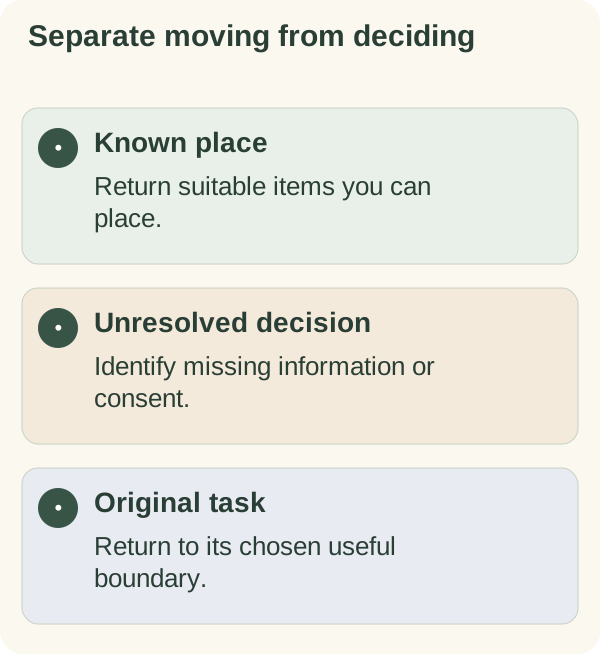
Tidying stalls when moving things and deciding about things get mixed up. Moving is quick. Deciding is slow and tiring: keep it or not, where should it live, whose is it, is this letter important? Separate the two and the first space clears much faster.
Pass one: things with a home. Pick up everything that has an obvious place and take it there in batches. Carry a basket. When you reach another room, drop the items just inside the door and come straight back. Do not start tidying that room. The basket is a delivery round, not an invitation.
Pass two: the decision box. Anything you would have to stop and think about goes into one box: paperwork, things that belong to someone else, items you are unsure about keeping, things with no home yet. Put obvious rubbish and recycling in a bag as you go. Write today's date on the box.
Clear one space in two passes
- Name the space and its use.
"The table, so we can eat there tonight."
- Get three containers.
A basket for things with a home, a box for decisions, a bag for rubbish.
- Do pass one.
Deliver items to their rooms and come straight back.
- Do pass two.
Everything that needs a decision goes in the box, unsorted.
- Check the end point.
Can you use the space for its purpose now? Then stop.
- Date the box.
Write when you will open it, for a short round only.
A starting card to copy
ONE SPACE CARD
Space: ____________________
I need it for: ______________  by: ______________
End point I will be able to see: ____________________

Basket = has a home    Box = needs a decision    Bag = rubbish/recycling

Decision box opens on: __________  (one short round, not the whole box)
Things that belong to someone else go to: ____________________
Next space, only if I still want to: ____________________
Example: Sam's flat after a hard month
A fictional example, written to show the steps in practice. Sam had a month of late shifts followed by a cold, and every room had drifted: clothes over chairs, post on the kitchen counter, mugs in the bedroom. Sam's plan was to block out a whole Saturday for it, and that Saturday had already been postponed twice.
Instead, Sam picked the area by the front door, because leaving on time for early shifts was the daily pain. Pass one took mugs to the kitchen, shoes to the rack and a pile of clothes to the bedroom doorway, without going in. Pass two filled a box with post, a borrowed charger and a bag of things to return to a friend. The end point was "keys, bag and shoes findable in under a minute". It took about twenty minutes.
The decision box filled faster than expected, so Sam made one change: paper went into its own envelope. That turned out to matter, because one letter had a reply date on it and became the first job the following evening. The next day Sam cleared the table. The bedroom waited until the weekend, and by then it felt smaller, because two delivery rounds had already moved things out of the rest of the flat.
Opening the decision box
Open it on the date you wrote, for one short round. Take items out one at a time and give each a quick answer:
- Keep, and it lives here: put it away.
- Keep, but it lives elsewhere: into the basket for the next delivery round.
- Belongs to someone else: set it aside for them; do not decide for them.
- Let it go: donate, recycle or bin.
- Still don't know: back in the box. That is allowed.
Check paper for dates before anything else. Do not throw away documents because a decluttering rule says so; whether you need to keep something depends on what it is and where you live, so check official guidance or ask the organisation that sent it.
If the mess has built up for months, or it is not only yours
Generic tidying advice assumes one person, one set of belongings and a few busy weeks. Real homes are often messier than that.
- If most of the mess belongs to people you live with: do not sort it for them. Gather their things into a bag or box at their door and agree a time for them to deal with it.
- If the state of the home has come with low mood, exhaustion or a long stretch of not coping: keep each attempt very small and talk to your doctor or someone you trust about how you are feeling, not only about the house. The NHS guide to tackling a to-do list describes breaking an avoided task into smaller parts, which is the same idea as one space at a time.
- If letting things go is so hard that rooms can no longer be used for their purpose: that is worth raising with a GP or another health professional. Support exists, and it is not something a checklist should try to solve.
- If you find damp or mould, signs of pests, broken glass, exposed wiring or furniture too heavy to move safely: stop and get suitable help, such as your landlord, a qualified trade or someone to lift with you.
Keeping the first space working
Once the first space works, protect it with a tiny daily put-back: two minutes each evening returning anything that has landed there. Only then pick the next space, using the same table and the same two passes. A home tidied one useful space at a time stays usable throughout, which is the point.
The daily planner has room to write the space, what you need it for and your opening action. Choose a first small step offers an illustrated version of the same idea. The companion can help you organise what you describe, but it cannot see the room, judge what is safe or decide anything about your belongings or anyone else's.
The Small home reset kit has fields for the area and a sensible stopping point. Keep anything that needs another person's agreement on a separate note so the decision box stays yours.
Questions people often ask
Should I declutter first or tidy first? Tidy the space you need first. Decluttering is a set of decisions, and those go in the box for later, when you can give them proper attention.
What if I get distracted in another room? Use the drop-and-return rule: put the items just inside the door and walk back to your space. If you notice a job there, write it down rather than starting it.
How long should a tidying session be? As long as it takes to reach your end point. If that feels too long to start, choose a smaller end point, such as half the table.
The decision box never gets opened. What now? Give it a date and open it for one short round. Items you still cannot decide on can stay in the box. Progress is the items that came out, not an empty box.