Plan laundry around when you need things, not around a fixed laundry day. Work back from the next time you need work clothes, sports kit or clean bedding, and start a load only when drying and putting away also have a time and a place. Then look at where your loads usually get stuck. Most laundry piles are stuck at one stage, and fixing that one stage does more than any new schedule.
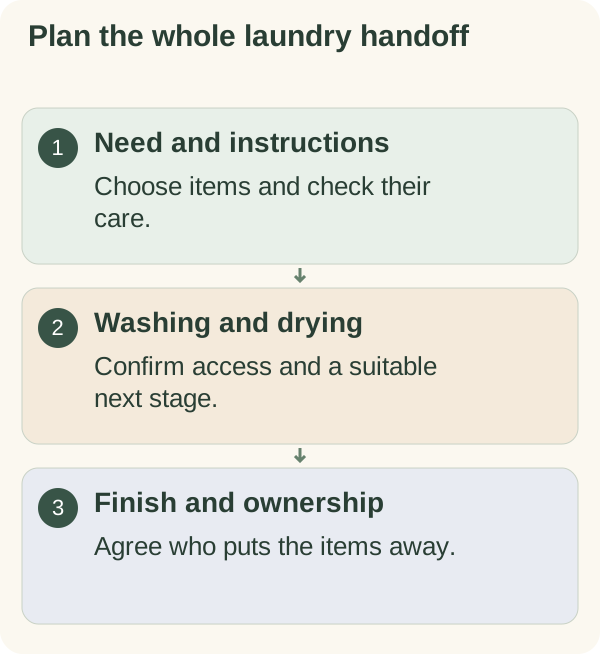
Breaking laundry into stages is a small example of how Plan your days works in practice: every stage is a manageable step, and the plan bends when the week does.
Laundry is five jobs wearing one name
"Do the laundry" hides five separate jobs, each needing its own time and space:
- Gather: get the items to the machine, sorted the way the care labels need.
- Wash: the machine runs, which needs access and someone around at the end.
- Dry: on a rack, a line or in a dryer, which needs space and hours.
- Fold: a few minutes, but it needs a clear surface.
- Put away: back into drawers and wardrobes, often in several rooms.
A fixed laundry day assumes you have time for all five on the same day. A flexible routine accepts that they can be spread out, as long as each stage has a slot before you start the first one.
Work back from the "needed by" date
Instead of washing everything on one day, ask what you actually need clean and when:
| Items | Needed by | Latest wash if air drying | Latest wash with a dryer |
|---|---|---|---|
| Work clothes | Monday morning | Saturday | Sunday |
| Sports kit | Wednesday evening | Monday | Tuesday |
| School uniform | Monday morning | Saturday | Sunday |
| Bedding | Flexible | A dry day with time to air the room | Any free evening |
These are illustrative timings. How long things take to dry depends on the fabric, your home and the weather, so adjust the gaps to your own experience. Check care labels and your machine's instructions for how each item should be washed and dried.
Anything without a "needed by" date can wait until there is a convenient gap, so it stops competing with what is urgent.
Find the stage where your loads get stuck
| Stuck at | What you see | Try this |
|---|---|---|
| Gathering | Clothes on chairs and floors | One basket per bedroom, or one near the machine |
| Washing | A full basket and an idle machine | Pair starting a load with a fixed cue, such as clearing up after dinner |
| Moving to dry | Damp clothes left in the drum | Start a load only when you will be home when it finishes; use a delay timer if your machine has one and its instructions allow |
| Drying | The rack full for days | Smaller loads, and check rack space before washing |
| Putting away | A clean pile on a chair | Fold straight into piles by person or drawer, or give each person a basket to empty themselves |
Pick one row. A week of fixing just that stage usually shows whether it was the real problem.
Map one load before you start it
- Choose the items.
What is needed by when?
- Check the labels.
Sort by care instructions, not by habit.
- Plan the finish.
Will you be home when the machine stops?
- Book the drying.
Is there space on the rack, the line or in the dryer?
- Name who puts it away.
You, or someone who has agreed to it.
A flexible week with two cues instead of a day
A routine that survives a changing schedule often uses two cues a week rather than one fixed day. For example: "an evening when I'm in and have nothing on after dinner" and "a weekend morning". At each cue, wash what has the nearest "needed by" date. Bedding and towels move to whichever cue has more time.
A laundry tracker to copy
LAUNDRY THIS WEEK
Needed soon:   __________ by ______    __________ by ______
Cue 1 (day/time): __________   Load: ______________
Cue 2 (day/time): __________   Load: ______________
Drying plan: rack / line / dryer / launderette
Put away by: ______________   Who: ______________
Waiting for a quieter week: ______________
Backup if the machine or weather fails: ______________
Example: Sam and the shared basement machines
This is an illustrative example, not a real person's story. Sam's building has two shared machines in the basement, which are busy all weekend. The flat has no dryer and one clothes rack. Sam's plan had always been Sunday laundry, but most Sundays both machines were taken, the basket overflowed and work shirts ran out by Thursday.
Sam moved the main wash to Tuesday evening, when the basement was usually quiet, and washed smaller loads of work clothes only. The rack went up straight after, folding happened on Wednesday morning, and shirts were back in the wardrobe before they were needed.
What did not fit was bedding: it would not dry on the rack in winter without taking over the flat for days. Sam changed that one item. Bedding moved to a dry weekend when it could go outside, and in the wettest months to a launderette visit once a month. The rest of the routine stayed as it was.
When the machine is shared or broken, or the weather won't help
Laundry routines are usually written for someone with their own washer, a dryer and a garden. If that is not you:
- If you share machines: learn the building's rules and quiet times, and plan your cue around those rather than your own preferred day.
- If your machine breaks: wash only what has a "needed by" date, by hand or elsewhere, following the care labels, and report the fault to whoever handles repairs.
- If you are drying indoors and rooms get damp: use smaller loads and spread them out. If damp or mould appears, raise it with your landlord or check local housing guidance.
- If someone in the home has been ill: follow official health guidance and the care labels for washing their bedding and clothes, and ask a health professional if you are unsure what is needed.
- If you rely on a launderette: batch the non-urgent items for that trip and keep a small home wash only for what is needed soon.
Sharing the stages in a household
In a shared home, agree who owns each stage instead of assuming that whoever starts a load is responsible for finishing it. Starting a wash and leaving it for someone else to dry is a handoff, and handoffs only work if the other person has said yes. A short line is enough: "I'll put a load on at seven. Could you hang it up when it finishes at nine?" For agreeing jobs like this across the whole household, the household check-in guide gives a simple weekly format.
On a crowded day, plan an overwhelming day helps you decide whether laundry is necessary today or can move. The daily planner is useful for setting the next laundry stage against everything else you have on.
The "Map one laundry cycle" card in the Small home reset kit asks which items are needed, when washing can fit, what follows washing and who finishes each stage.
Questions people often ask
Is it better to do a little laundry every day or one big day a week? Neither is better in general. Choose by your space and time: small daily loads suit homes with little drying room, while one bigger session suits a week with one free day.
What should I wash first when everything is dirty? The items with the nearest "needed by" date. Everything else waits for the next cue.
How do I stop clean laundry piling up on a chair? Make putting away part of the same session as folding, or give each person a basket and make emptying it their job.
Should I wash bedding on a fixed schedule? Pick a rhythm that suits your home and drying options, and move it to whichever cue has the most time. Bedding is rarely urgent, which makes it the easiest item to move.