You can prepare for the week in about fifteen minutes, on whichever day you have the information, by answering five questions: what is fixed, what those fixed things need beforehand, what you are about to run out of, who is doing what, and what your first move is. Everything else stays undecided until closer to the time. If you miss the check altogether, a two-minute version on the first morning of your week covers most of it.
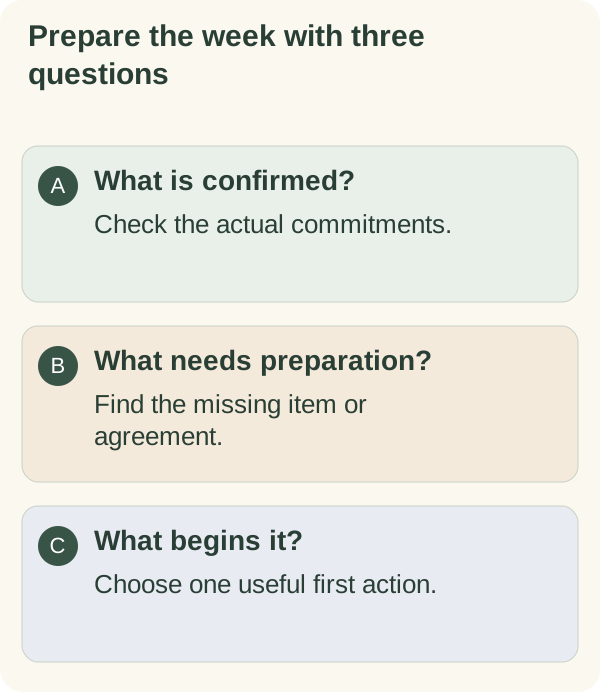
A short check instead of a planning marathon is the habit at the centre of Plan your days: enough planning to take the first step, and no more than the week can actually use.
Why the long Sunday session tends to fail
A long Sunday planning session has three problems. It takes time out of the one day many people use to rest. It plans every slot of a week that will change by Wednesday, so much of the work is wasted. And it often becomes a list of hopes, with every possible task scheduled, which makes the week look impossible before it starts.
The aim of weekly preparation is narrower: make sure nothing fixed catches you out, and know what to do first. That fits in fifteen minutes.
Pick your check moment
The right moment is when the week's information is available and you still have time to act on it.
| If your week looks like this | Check at this moment |
|---|---|
| Monday to Friday office hours | Friday afternoon before you log off, or briefly on Sunday evening |
| Shifts that change weekly | The day the rota is published |
| Children at school | When the school's weekly message arrives |
| One big shop a week | Just before you write the shopping list |
| Freelance or project work | When the next week's deadlines are confirmed |
Pick one and keep it for a month before judging it.
The five questions
Run the week check
- What is fixed?
Appointments, travel, deadlines, collections and anything agreed with other people.
- What do the fixed things need first?
A form, a document, a booking, a gift, clean kit.
- What will run out?
Food staples, medicines you already take, travel passes, printer ink, phone credit.
- Who is doing what?
Lifts, pickups, shared jobs, anything you are waiting on someone to confirm.
- What is my first move?
One action, written in plain words, for the first day of the week.
Mark anything not yet confirmed as a question rather than a plan: "Is Mum still coming on Thursday? Ask her." A tentative arrangement should look different from an agreed one.
A fifteen-minute script
WEEK CHECK                     Week starting: __________

0-3 min   FIXED: read the calendar and messages
          ______________________________________
3-6 min   NEEDS FIRST: what each fixed thing needs beforehand
          ______________________________________
6-9 min   RUNNING OUT: check cupboards and passes, add to list
          ______________________________________
9-12 min  HANDOFFS: who is doing what; questions to send
          ______________________________________
12-15 min FIRST MOVE (one action, verb first):
          ______________________________________

Left open on purpose: meals / exercise / social / optional jobs
When the time is up, stop. If something deserves a longer think, give it its own slot later in the week instead of stretching the check.
Leave some things undecided on purpose
Meals, exercise and social plans rarely survive being pinned to exact days. Keep a short menu instead: "three dinners I can make from what's in", "two times I could go for a walk", "one person to call this week". Then decide on the day. If shopping is a regular part of your week, making a grocery list part of your weekly routine shows how to keep that list running so the "running out" question takes a minute.
Old tasks need a quick look too. Before carrying something over from last week's list, ask whether it still matters. Copying stale items forward makes the coming week look fuller than it is.
Example: Alex and the Thursday rota
A fictional example, written to show the steps in practice. Alex works in a shop where the rota for the following week is published on Thursday. Alex used to spend Sunday afternoons planning the week in detail, and most weeks the plan fell apart because shifts had already been swapped.
Alex moved the check to Thursday evening, after the rota came out, and used the fifteen-minute script. The first check turned up two things the Sunday plan would have missed: a late shift on Tuesday clashed with a parcel collection, so Alex rearranged the delivery; and a dentist appointment on Friday needed a form filled in beforehand, which became the first move. Everything else was left as a menu.
After two weeks, Alex dropped the "running out" step into the shopping list app instead, because it was quicker to update the list as things ran low. The check shrank to about ten minutes, and Sunday went back to being a day off.
When the week is unpredictable, or you miss the check
Weekly-planning advice tends to assume a regular week and a reliable slot to plan it. Neither is guaranteed:
- If you are on call or your hours are not known in advance: plan only the fixed points, and keep a short "if I get a free evening" list to pick from.
- If the week collapses because you or someone you care for is ill: drop to the fixed points and the essentials. Plan an overwhelming day helps sort what must happen from what can move.
- If you are coming back from travel or holiday: do the check on the journey home, focusing on what has changed while you were away.
- If you missed the check completely: use the two-minute version below on the first morning of your week.
TWO-MINUTE CHECK
Today's fixed thing: ______________
Anything it needs first: ______________
First move: ______________
The weekly review tool is a fuller version for when you want to look back at the last week as well as ahead. The necessary-action and agreement fields in the Small home reset kit are handy for household jobs that come up during the check.
Questions people often ask
Do I need a planner or app for this? No. Use the calendar and notes you already rely on. Rebuilding everything inside a new tool adds work rather than saving it.
What if the check keeps taking longer than fifteen minutes? You are probably planning the whole week rather than checking it. Stop after the first move and give any bigger question its own slot.
Should I plan meals in the week check? Keep a short menu of options rather than fixed days, and make sure the ingredients for them are on the shopping list.
Is it worth doing in a quiet week? Yes, because quiet weeks are when a single fixed item, like a form due Friday, is easiest to forget.