A grocery list becomes a routine when it has three fixed moments: you add to it the moment you notice something is running low, you check it for five minutes before every shop, and you clear it straight after. Keep it in one place everyone can reach, keep a separate list of staples so you are not rewriting the same items each week, and write each entry so the person shopping can act on it without phoning home.
Most grocery-list advice stops at "write a list and stick to it". The list itself is rarely the problem. What goes wrong is the habit around it: items remembered on the bus, three people buying milk, a vague note the shopper cannot decode. This page is about those moments.
Keep one list where you notice things
The best place for the list is wherever you are when you see that something is running out. For many households that is a note on a shared phone list; for others a sheet on the fridge works better. You do not need a new app if the current method works. You do need a single list. Two lists, one on paper and one on a phone, guarantee that one of them is out of date.
Agree one simple capture rule: whoever uses the last of something, or opens the last pack, adds it to the list there and then. That rule does more than any shopping-day effort, because the list fills up during the week instead of relying on memory at the end of it.
If several people add items, agree what an entry means. A short label at the start of the line saves the shopper from guessing:
- Need: we have run out or will before the next shop.
- If seen: useful but not urgent; skip it if it is hard to find.
- For (meal): needed for a planned meal, such as "for Thursday's soup".
Keep a staples list so you stop rewriting it
Staples are the items you buy most weeks or keep in all the time. Write them once, on a separate list, grouped roughly by where they sit in the shop: fresh produce, chilled, bread and bakery, cupboard, frozen, and household items. Before each shop you run down the staples and copy across only what is missing.
Your staples will look different from anyone else's. Keep the list short. If an item has not been bought in a month, take it off.
The five-minute check before you shop
Pick a cue that comes just before the shop, with enough time to fix gaps: the evening before a regular trip, or before you open the online order. A fixed weekday is optional; what matters is that the check happens before the purchase.
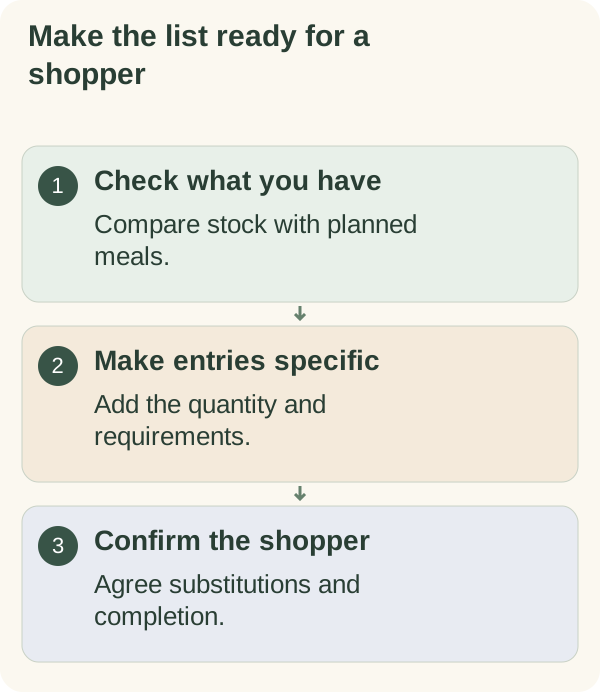
Run the pre-shop check
- Staples:
run down the staples list and copy across anything you are out of or low on.
- Meals:
look at the meals planned for the coming days and add what they need.
- Cupboards:
open the fridge and cupboards to remove anything already in stock.
- Details:
make each entry specific enough to buy, with a quantity or size where it matters.
- Limits:
check the amount you plan to spend and how much you can carry or store.
- Shopper:
confirm who is shopping and who can answer a question about substitutions.
Planning meals first makes the second step much faster. The free meal planner turns the meals you choose into a grocery list you can copy or print, which you can then check against the cupboards.
Write entries the shopper can act on
A list written for yourself can be shorthand. A list someone else will use needs a little more. Compare these:
| Vague entry | Entry the shopper can act on |
|---|---|
| Milk | Milk, 2 large, usual kind (Need) |
| Bread | Sliced bread, 1 loaf; any brand is fine |
| Cheese? | Cheese for Tuesday's pasta (For Tuesday); check fridge first |
| Stuff for lunches | Wraps and fillings for 3 lunches; ask if unsure |
| Gluten-free pasta | Gluten-free pasta, 1 pack. Must say gluten-free on the pack; no substitute |
| Snacks | Snacks (If seen); skip if the shop is busy |
The last two rows show the most important distinction on any shared list: which items are flexible and which are requirements. For allergies and medical diets, write "no substitute" and make sure the shopper knows to check the label, since a similar product is not automatically suitable. The person with the requirement, or their doctor or dietitian, decides what is safe; the list only passes that on.
Example: Daniel and Maya's shared list
An illustrative example (the person is made up): Daniel and Maya share a flat and take turns doing the weekly shop. For months they each kept a list in their own phone. On Daniel's weeks the shop came back without the things Maya had noticed running out, and twice they both bought washing-up liquid.
They switched to one shared phone list and agreed the capture rule: whoever finishes something adds it. They also wrote a staples list of about twenty items, grouped by aisle, and pinned it to the top of the shared list.
The first week, Daniel's shop still missed two things, because Maya had added them as "bits for the curry". After that they agreed to write the actual items with "For curry" in front. The habit that made the biggest difference was the last one: whoever shops ticks off what was bought, and sends a short "shop done" message so nobody buys the same thing on the way home.
A list layout you can copy
Use this as a template in a notes app or on paper. Keep the staples section at the top and copy items down as needed.
STAPLES (check each shop, copy down what's missing)
Fresh: __________________________
Chilled: ________________________
Bakery: _________________________
Cupboard: _______________________
Frozen: _________________________
Household: ______________________

THIS SHOP
Shopper: ________   Shop day: ________
Questions to: ________

NEED
- item, amount, note
FOR (meal)
- item, amount, which meal
IF SEEN
- item

NO SUBSTITUTE (requirements, check label)
- item, what the label must say

AFTER THE SHOP
Bought: tick off   Not found: move to next shop or drop
"Shop done" sent: yes / no
When the shop does not go to plan
Lists usually fail at the point of purchase, which most articles skip. Some situations to decide in advance:
- If an item is unavailable, the shopper follows the label: buy an alternative for flexible items, leave "no substitute" items, and mark the meal it was for so someone can change it.
- If you order online and the order has a cut-off, set the pre-shop check for the evening before the cut-off, not the morning of it. Missing items can wait for the next order or a short top-up.
- If the shopper has no signal in the shop, questions cannot be answered live. Write the decision into the list in advance: "if none, skip" or "if none, buy X instead".
- If you shop for someone else, such as an older relative, keep their list separate from yours and agree with them what can be swapped. Keep any health details to the minimum the shopper needs.
- If an item keeps getting copied forward week after week, ask whether it is still needed. A list full of old items hides the current ones.
Close the list after every shop
Within an hour of getting home, tick off what was bought, move what could not be found, and delete anything no longer needed. On a shared list, tell the others it is done. This takes a minute and is the step that makes next week's list trustworthy.
Use build a small routine to choose the cue for your pre-shop check. If the list keeps falling to one person, small ways to reconnect can help open a calmer conversation, and the household check-in guide covers dividing the job itself. The food-decision card in the routine worksheet can prompt the stock and meal check; keep purchase details on the list the shopper will use.
A grocery list is a small example of the approach on the habits and goals path: one manageable step, repeated each week, that makes looking after yourself and the people you live with a little easier.
Questions people often ask
Should the list be on paper or on a phone? Whichever everyone will actually use. A shared phone list helps when different people shop; paper on the fridge works when one person shops and everyone else is at home. Choose one, not both.
How do I stop forgetting items until I'm in the shop? Add things the moment you use the last of them, and do the five-minute check before you leave, not in the car park.
Do I need a meal plan to make a good list? It helps, because it explains why each item is there. Without one, the staples list and a cupboard check still cover most of a week.
What is the point of the "If seen" label? It stops the shopper treating every line as essential, which makes a busy shop faster and leaves the important items easy to spot.