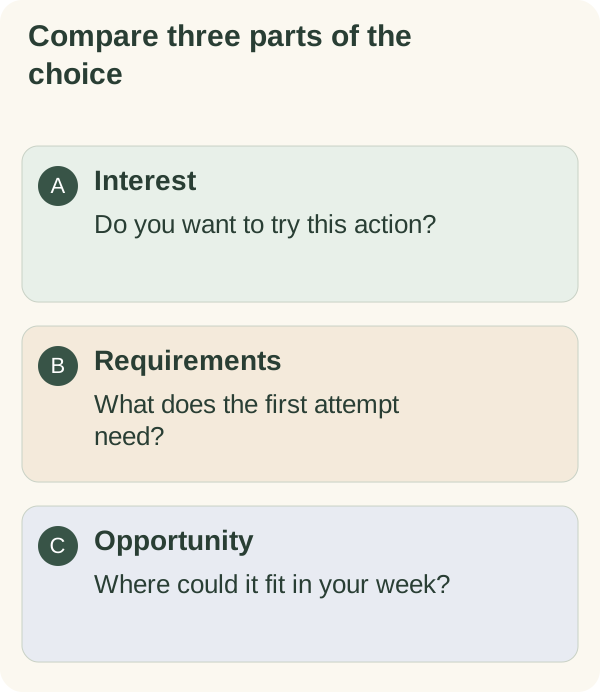
Write down three or four habits you are considering, each as a specific action, and compare them on four questions: do you actually want to do it, what would the first attempt need, where would it fit in the week you have now, and would it make anything else easier. Start with the one you want that needs the least setup. If your favourite idea depends on something you do not have yet, getting that missing piece is your first step, and it counts.
Starting with one habit is a planning suggestion, not a rule about how many changes a person can make. If a doctor, dietitian or other qualified professional has already given you advice, follow it; this page is about choosing between optional habits, not deciding what your health needs.
Turn wishes into actions you could start this week
Most people know the area they want to work on, but not the action. "Be healthier" cannot be started; "fill a water jug when I make my first coffee" can. Before comparing anything, rewrite each idea as something you could do this week, with a recognisable beginning.
| Broad wish | A specific first action |
|---|---|
| Move more | Walk the long way to the station on workdays |
| Eat better | Write a grocery list before the weekly shop |
| Cook at home more | Plan three dinners before shopping |
| Sleep better | Put the phone on charge in the kitchen at a set time |
| Be less stressed | Write tomorrow's first task before finishing work |
| Get fitter | Book and attend one gym induction |
The right column is not a recommendation. It is a model for the kind of sentence you are aiming for: one action, one moment, nothing to interpret. For the sleep, food or fitness side of any of these, follow guidance that fits your own health.
Compare your ideas side by side
Put your three or four specific ideas in a grid and answer the same four questions for each. Plain words work better than scores; "yes", "partly" and "no" are enough.
- Do I want to do this? Not "should I", but would you be glad to do it on an ordinary day.
- What would the first attempt need? Equipment, a place, a booking, information or another person's agreement.
- Where could it fit in the week I have now? A real moment in the current week, not a better future week.
- Would it make anything else easier? Some habits support others: a grocery list makes cooking at home easier, and a packed bag makes a gym visit easier.
The NIDDK guide to changing habits discusses planning around practical obstacles. Use that principle to examine your options, without treating a worksheet as personal medical or nutrition advice.
Rules for picking the first one
Once the grid is filled in, these rules usually settle it:
- If one idea is "yes" on all four, start there, even if it looks modest.
- If two ideas tie, pick the one that would make another easier. Doing it first gives the second a better start later.
- If your favourite idea needs something you do not have, make getting that thing the first step. Booking an induction or buying a water bottle is a fine first week.
- If an idea depends on another person, ask them before you start, or pick a different idea for now.
- If none of the ideas is a "yes" on the first question, do not pick the least bad one. Leave the decision for a week and notice what you find yourself wishing you did.
Choose your first habit
- List:
write three or four ideas you are genuinely considering.
- Specify:
rewrite each as one action with a clear beginning.
- Compare:
answer the four questions for each, in plain words.
- Pick:
apply the rules above and choose one.
- Prepare:
sort out anything the first attempt needs.
- Set the first try:
choose the day and moment for the first attempt.
Example: Sam chooses between four ideas
The example below is illustrative; the person in it is not real. After a tiring few months, Sam wanted to "sort out my health" and had four ideas: join a gym, cook at home more, go to bed earlier and walk at lunchtime.
Sam rewrote them as actions: book a gym induction; plan three dinners before the weekly shop; phone on charge in the kitchen by 10.30 p.m.; walk round the block after lunch on office days. Then Sam filled in the grid.
The gym needed choosing a gym and a booking, and Sam was not sure about wanting it. The early night depended on a housemate who watched television late in the shared room. The lunchtime walk was a clear yes and fitted three office days. Cooking was a "partly" on wanting it, but planning dinners would also make the weekly shop easier.
Sam started with the walk. After two weeks it felt routine, and Sam added the dinner planning, which shared nothing with the walk but built on the same small-step approach. The gym idea went onto a "later" list with one preparation step written next to it: visit two gyms at the busy hour first.
A choosing grid you can copy
Fill in one row per idea. Keep the grid; the ideas you do not pick now are your list for later.
IDEA (one specific action)        WANT IT?   FIRST TRY NEEDS        FITS WHERE?        MAKES EASIER
1. ________________________      y / p / n  ___________________   ______________     ____________
2. ________________________      y / p / n  ___________________   ______________     ____________
3. ________________________      y / p / n  ___________________   ______________     ____________
4. ________________________      y / p / n  ___________________   ______________     ____________

My first habit: ______________________
What I need first: ___________________
First try on: ________  at: ________
Later list: __________________________
When you want to change everything at once
The usual advice is "start with one", which is hard to hear when you feel several things need to change now. Some situations need a different answer.
- If a doctor has told you to make changes, their advice comes first and is not optional in the way these habits are. Use this page only for choosing between any extra habits you want on top.
- If several habits are closely linked, such as planning meals, writing the list and shopping, treat them as one routine with steps and start with the first step.
- If you have already started several habits, keep the one that is going best, pause the others with a date to reconsider, and write them on the later list so they are not lost.
- If the habit you want depends on someone else, such as a shared walk or shared cooking, choose it only once they have agreed; until then, start with one you can do alone.
- If you feel you have to change everything because something is wrong with your health or mood, speak to a doctor or qualified professional first. A habit worksheet is not the right tool for that.
Decide what you will look at after the first try
Before you start, decide what would tell you the habit fits: the moment was available, anything you needed was ready, and you were glad you did it. Keep a simple record of what you know happened, and leave unrecorded days as unknown rather than filling them in to make a tidy chart. After a week, the guide to reviewing a new habit after the first week walks through what to look at.
You can use the browser habit tracker to explore your own schedule. It remains separate from the Telegram companion's records. If you are unsure whether your idea is a habit, a goal or a one-off task, goals vs tasks vs habits helps you tell them apart.
Choose a small routine when you have an action in mind. Keep, shrink, move or pause it as circumstances change. A planning conversation is not an automatic instruction to save a habit or schedule follow-ups. The first card in the Small healthy routine worksheet can hold the action, the moment it fits and the alternative you choose.
Picking a single starting habit is the first move on the habits and goals path, where looking after yourself is built one manageable step at a time rather than in one big overhaul.
Questions people often ask
Why only one habit at a time? Because each new habit needs attention while it settles, and attention is limited on a busy week. One that sticks is more useful than four that fade.
How do I know when to add a second habit? When the first happens without much thought on most of its planned days, and you notice you have room. There is no fixed number of weeks.
What if the habit I picked turns out to be wrong? Swap it for the next idea on your grid. You have learned something about your week, which makes the next choice easier.
Should my first habit be about food, exercise or sleep? Whichever you want and can start soonest. For what to eat, how much to exercise or how much to sleep, follow guidance from a qualified professional who knows your health.