At the end of the first week, spend ten minutes comparing what you planned with what you know happened. Sort each planned day into done, missed or not recorded, look for the obstacle that showed up most often, and make one change at most: keep the habit as it is, make it smaller, move it, or pause it. One week is enough to spot a timing or preparation problem. It is not enough to decide the habit is wrong for you, or that it is settled for good.
Most advice on reviewing a new habit comes down to "count how many days you did it". A count tells you how the week went, but not what to change. The useful part of a first-week review is working out why the misses happened, because that is the part you can fix.
Write down exactly what you planned
Start by writing the habit as you originally set it, in one line: the action, the time or cue, and the days. For example, "walk around the block after lunch on workdays" or "fill the water jug when I make my first coffee". If the plan was vaguer than that, the review has found its first problem: you cannot tell whether a vague plan worked.
If the habit has changed during the week, write both versions. Habits often drift in the first few days, and noticing the drift is useful.
Sort the days into three piles
Go through each planned day and put it in one pile:
- Done: you know it happened, even if it was a smaller version.
- Missed: you know it did not happen.
- Not recorded: you do not know, because nothing was written down.
Keep "not recorded" separate. Filling blanks from memory tends to turn them into misses, and that makes the week look worse than it was. The guide on what a missing habit entry means explains why the difference matters. If you used the free habit tracker, it already keeps done, missed and not recorded apart, and rest days separate from all three.
Read the pattern, not the score
Four out of five can hide a problem, and two out of five can hide a habit that is nearly working. Look at which days fell into which pile and what those days had in common. This table matches common first-week patterns with one change to try:
| What you notice | What it often means | One change to try |
|---|---|---|
| Missed on the same weekday each time | That day has a clash you did not plan for | Move that day's slot, or take that day out of the plan |
| Missed whenever it needed preparing | The setup is the real habit | Do the preparation the evening before |
| Done, but it always felt like a chore | The version is too big, or the time is wrong | Shrink it, or try a different slot for one week |
| Lots of "not recorded" | Recording is the problem, not the habit | Record at the same moment you do it, or use a simpler mark |
| Never started once | The first step is unclear or too big | Write the very first physical action and make that the habit |
| Done every day, easily | The plan fits | Keep it unchanged for another week before adding anything |
| The habit no longer seems worth it | Your reason has changed | Pause it or stop tracking it; both are valid decisions |
Pick the row that fits best and make that single change. Changing the time, the size and the day all at once means next week cannot tell you which change helped.
Run the ten-minute review
- Plan:
write the habit exactly as you set it, including the cue and days.
- Piles:
sort each planned day into done, missed or not recorded.
- Pattern:
note what the missed days had in common.
- Choice:
decide to keep, shrink, move or pause.
- One change:
write the single adjustment for next week, or "no change".
- Next review:
pick the day you will look again.
Example: Maya's lunchtime walk
Here is a made-up example to show how it can work. Maya planned a short walk after lunch on each of her five workdays. At the end of the first week her first reaction was "only three out of five, I'm already failing".
When she sorted the days, the picture changed. Monday, Wednesday and Thursday were done. Tuesday was missed because her team meeting ran into lunch. Friday was not recorded: she thought she had walked but had not marked it and could not be sure.
Tuesday's meeting happens every week, so she moved Tuesday's walk to the end of the day and kept the rest. For Friday's blank, she changed how she recorded it, marking the walk as soon as she got back to her desk rather than in the evening. She did not add anything else.
The second week had one miss, on a day it rained heavily, and no blanks. Her review that week found nothing to change, so she kept the plan as it was.
A first-week review card you can copy
Use this on paper, in a note or alongside your tracker.
HABIT AS PLANNED
Action: ______________________
Cue or time: _________________
Days: ________________________

THE WEEK
Mon: done / missed / not recorded   note: ________
Tue: done / missed / not recorded   note: ________
Wed: done / missed / not recorded   note: ________
Thu: done / missed / not recorded   note: ________
Fri: done / missed / not recorded   note: ________
Sat: done / missed / not recorded / rest
Sun: done / missed / not recorded / rest

What the missed days had in common: ______________
Decision: keep / shrink / move / pause
The one change: ______________ (or "no change")
Next review on: ________
When the first week was not a normal week
Reviews assume a typical week. Many first weeks are not.
- If you were ill, take those days out of the review entirely. Restart from the next ordinary day, and if the habit involves activity, check with a doctor before resuming if you are unsure.
- If something unexpected took over the week, such as a family emergency or a deadline, call it a trial that did not happen yet and run the first week again. There is nothing to learn about the habit from a week it never had a chance in.
- If you did it perfectly but hated it, treat that as information. Keep the slot and change the action, or stop. A habit you dread is unlikely to last, however good the score.
- If you started three habits at once, review each one separately, then keep the one that went best and pause the others for now.
- If doing the habit raised a health worry, such as pain, dizziness or anything that concerns you, stop and ask a doctor or suitably qualified professional before continuing. A tracker cannot tell you whether something is safe for you.
What a week can and cannot tell you
One week can show you a clash in your timetable, a missing preparation step or a recording problem. It cannot show that the habit is having a health effect, and a completion count says nothing about whether the amount or type of activity is right for you. For those questions, use guidance from a doctor or qualified professional. Keep the review to what it is good at: whether the arrangement fits your week.
If the review points to a pause rather than a change, how to decide whether to pause a habit or make it smaller can help you choose between the two.
Leave the next version simple
The best outcome of a first review is often "no change". If something does need changing, change the cue, the preparation or the size, and leave everything else alone. Do not add a second habit just because you sat down to review the first.
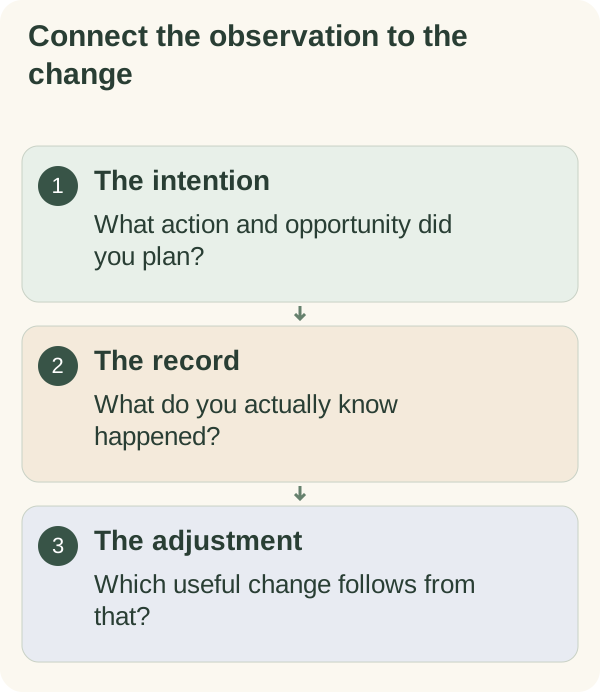
Use the weekly review template to record the observation alongside the rest of your week. Then build a small routine from the next realistic opportunity, keeping any health decisions within the guidance that applies to you. If the week left several days blank and you need a fresh start, restart after missed days without trying to make them up. The practical-fit review card in the routine worksheet gives you a place to connect one observation to the next decision.
Reviewing kindly after a single week is the heart of the habits and goals path: you look at what happened, choose one manageable next step and carry on, rather than starting over.
Questions people often ask
Is one week too soon to review a habit? It is too soon to judge the habit, but a good time to fix the arrangement. Timing clashes and preparation gaps usually show up in the first few days.
What counts as a good first week? One where you learned something about the fit. Even a week of misses is useful if it shows you the slot was wrong.
Should I add a second habit if the first week went well? Not yet. Keep the first one unchanged for another week or two. If it still feels easy, then consider a second.
What should I do with days I did not record? Leave them as not recorded and fix the recording, not the habit. Guessing them as missed makes the review less accurate.