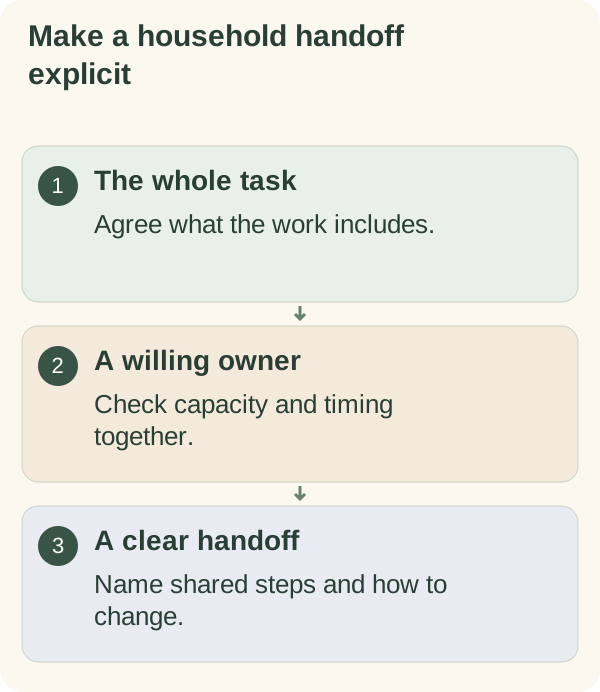
A household check-in works when it is short, regular and about arrangements rather than blame. Meet for about fifteen minutes at the same time each week and cover three things: what is coming up, which routine tasks need an owner, and what is not working. Describe each task in full before anyone agrees to it, ask people rather than assigning them, and agree in advance how someone says "I can't do this one this week" so the task comes back to the group instead of falling to whoever notices first.
Many guides to sharing chores start with a rota or a chart. A chart records a decision; it does not make one. The check-in is where the decision happens, and it works for partners, housemates and families with older children alike.
Keep the check-in short and the same each week
Pick a time when everyone is usually home and not rushing: after a weekend meal, or a weekday evening that tends to be quiet. Keep it to about fifteen minutes. If it regularly runs longer, you are solving bigger problems in it, and those deserve their own conversation.
Run a fifteen-minute check-in
- Look ahead.
Each person names anything unusual in the coming week: late shifts, trips, visitors, deadlines.
- Check the routine tasks.
Go through the recurring jobs and confirm who has each one this week.
- Ask what is not working.
One round: is any task slipping, unclear or too much for someone?
- Agree changes.
Swap, split or pause tasks to fit the week ahead.
- Write it down.
Update the shared list so it shows this week's arrangement.
Use the same order every time. A predictable shape makes the check-in feel routine rather than like a meeting someone has called because something is wrong.
Name the whole task before anyone takes it
Much of the friction over housework comes from tasks that are bigger than their names. "Doing dinner" can mean deciding what to eat, checking the cupboards, shopping, cooking and washing up. If one person agrees to "dinner" thinking it means cooking, and the other thinks it means all of it, both will feel let down.
| Task name | The parts it usually includes |
|---|---|
| Dinner | Deciding the meal, checking what is in, shopping, cooking, washing up, putting leftovers away |
| Weekly shop | Checking stock, writing the list, placing the order or going, unpacking, telling others it is done |
| Laundry | Collecting, sorting, washing, drying, folding, putting away |
| Bins and recycling | Emptying indoor bins, sorting, taking out on the right night, bringing the bins back in |
| Bills and admin | Noticing the letter or email, checking it, paying or filing, telling others if it affects them |
Agree whether a task is taken whole or split. Splitting is fine, as long as the handoff is clear: "I'll write the list on Thursday evening, you'll do the shop on Friday."
Ask, do not assign
The quickest way to make a shared list resented is to fill it in for other people. Ask instead, and let people say what they can take this week, given everything else they have on. Capacity changes from week to week. Being at home more does not mean being available for more housework, and caring responsibilities, health and work all count.
If nobody volunteers for a task, it is still a decision to make together: rotate it, split it, do it less often, or pay for help if that is an option your household chooses. Leaving it unassigned means it will fall to whoever minds most.
Write down what was agreed
After the check-in, update a shared list everyone can see. Write what was agreed in words both people recognise: "Daniel checks supplies and writes the list Thursday; Sam places the order Friday." Note any spending limit or approval needed before someone relies on it.
Keep the record about tasks, not people. It should show current responsibilities, not become a scorecard, and it should not record anyone's private circumstances. "Sam: lighter week" is enough; the reason does not need to be on the fridge.
Example: Daniel and Sam, housemates
The example below is illustrative; the person in it is not real. Daniel and Sam had shared a flat for a year. Daniel did most of the cooking and Sam most of the cleaning, but neither had ever said so out loud, and the shopping had drifted entirely to Daniel. He had started leaving pointed notes.
Sam suggested a short Sunday check-in after their usual lunch. In the first one they listed the routine tasks and wrote out the parts of each. Shopping turned out to be four separate jobs, and Daniel was doing all of them. They split it: Daniel writes the list because he knows what the meals need, and Sam places the order and unpacks it.
In the third week Sam had a run of late shifts and said so in the "look ahead" step. They agreed that Daniel would do the order that week, and that Sam would take the bins for two weeks in return. The notes on the fridge stopped. What made the difference, they both said afterwards, was that "I can't this week" now had a place to be said before the task was missed, not after.
A check-in agenda and scripts you can copy
Keep the agenda on the shared list. The scripts are there for the moments that feel awkward to say.
HOUSEHOLD CHECK-IN (about 15 minutes, same time weekly)

1. Coming up this week (each person):
   ___________________________________
2. Routine tasks, owner this week:
   Dinner: ____  Shop: ____  Laundry: ____  Bins: ____
   Other: _________________
3. What isn't working? (one round)
   ___________________________________
4. Changes agreed:
   ___________________________________
5. List updated: yes / no
TO ASK FOR A CHECK-IN
"Could we spend fifteen minutes on Sunday going through
who's doing what this week? I'd find it easier than
sorting it out as we go."

TO SAY YOU CAN'T DO A TASK
"I can't do the shop this week because of my shifts.
Could someone swap with me? I can take the bins instead."

TO RAISE SOMETHING THAT ISN'T WORKING
"The washing-up keeps ending up with me. Can we look at
whether that task needs splitting differently?"
When the split feels unfair
Check-ins handle routine swaps well. Some situations need more than a swap, and they are rarely covered in chore-chart advice.
- If one person does work nobody sees, such as noticing what has run out or remembering birthdays, add it to the task list by name. Invisible jobs only get shared once they are written down.
- If working hours are very unequal, aim for a split both people think is fair, which may not be an equal number of tasks. Talk about time and effort as well as the count.
- If a teenager or older child is joining in, give them a whole task they can own, with the parts written out, rather than random helping on request.
- If someone is unwell or going through a hard time, reduce the tasks rather than redistributing everything onto one other person. Some jobs can be done less often for a while.
- If someone never comes to the check-in, keep it short and ask them how it could suit them better before deciding without them.
- If the disagreement is about more than chores, stop the check-in and agree a separate time to talk. A task list cannot settle a bigger problem in a relationship or household.
Give blocked tasks a route back
A task that someone cannot do should come back to the group, not stay silently assigned. Agree the route: a message on the shared list, a word at the next check-in, or a direct ask. When the same task keeps slipping, look at its scope, owner or timing at the next check-in. Another reminder cannot settle a disagreement about who is responsible.
To suggest a first check-in to someone you live with, take a small connection step helps you prepare a short, low-pressure invitation. The weekly review tool can structure a brief check without assigning or messaging anyone automatically. If your planning conversations already happen but run long, making a household planning conversation shorter has ways to tighten them. Use the action and review cards in the routine worksheet after the conversation, so the note reflects the arrangement you actually agreed.
Sharing the routine work of a home is one of the ways you look after the people around you as well as yourself, and a short weekly check-in turns that into one manageable step. Other routines in the same spirit are on the habits and goals path.
Questions people often ask
How often should we have a check-in? Weekly works for most households, because routine tasks run on a weekly rhythm. If nothing changes for a month, you can move to every other week.
What if one person does not want a check-in? Ask what would make it easier for them: shorter, at a different time, or done by message. Start with a single question rather than a full agenda.
Should we rotate tasks or keep fixed owners? Either works. Fixed owners suit tasks someone is good at or does not mind; rotation suits tasks nobody wants. Many households mix the two.
Does this work for couples as well as housemates? Yes. The steps are the same, though couples may find more of the conversation is about time and fairness than about the tasks themselves.