If your hours keep changing, tie the habit to something that happens whatever the timetable does, such as getting home or making the first drink of the day, instead of to a clock time. Give it two sizes, a full version for ordinary days and a minimum version for crowded ones. Then, each time your new schedule arrives (the rota, the week's calendar, the travel plan), spend a few minutes placing the habit in it and deciding which days get which version.
Most habit advice assumes a stable week: same wake time, same commute, same evenings. "Do it at the same time every day" is good advice for someone with that week and impossible for someone on rotating shifts, on call, freelancing or caring for a relative. The fix is not more willpower. It is a different kind of cue.
Swap the clock time for an anchor
An anchor is an event that happens on almost every kind of day, even though its time moves. Getting home happens after an early shift and after a late one. Making the first drink of the day happens whether you wake at five or at eleven. Attach the habit to the anchor, and it moves with your day automatically.
| Kind of changing schedule | Anchors that usually survive it | A habit attached to it |
|---|---|---|
| Rotating shifts | Getting home from any shift; the first meal after waking | "After I take my shoes off after a shift, I lay out tomorrow's things" |
| On call | Finishing the first drink of the day; the end of a call-out | "After my first coffee on days I'm not called in, I go for a short walk" |
| Freelance or client-driven work | Opening the laptop; sending the last email of the day | "Before I open email, I write tomorrow's shopping needs" |
| Caring for someone | The first care visit or school drop-off; their bedtime | "After the drop-off, I take the long way back" |
| Frequent travel | Arriving somewhere; unpacking | See the guide to keeping a routine when you travel for work |
Choose an anchor that is short, clear and happens at a moment when you have a few minutes. "When I get home" works better than "in the evening", because you can tell exactly when it has happened.
The NIDDK guide to changing habits describes making a plan, identifying what gets in the way and adjusting when circumstances change. That supports reviewing a routine's practical barriers. It does not establish that one schedule is right for everyone.
Give the habit two sizes
On a changing schedule, some days have room and some do not. Decide in advance what the habit looks like on each kind of day, so a crowded day changes its size rather than cancelling it.
- Full version: what you do on an ordinary day with some room. For example, a walk around the park.
- Minimum version: the smallest version that still counts. For example, a walk to the end of the road and back.
Write both down. The minimum version should be small enough that you could do it on your worst day of the month. It keeps the anchor in place on days when nothing else fits, which makes the full version easier to return to.
Some days the right answer is neither. Planned rest days and days off from the habit belong in the arrangement from the start.
Place the habit when your schedule arrives
The usual advice is to plan on Sunday evening. If your rota comes out on a Wednesday, or your client schedule changes on Monday morning, Sunday is the wrong time. Plan when the information arrives.
Place the habit in a new schedule
- Look at what is fixed.
Mark shifts, calls, visits and travel you know about.
- Find the anchors.
Note where the anchor event will happen on each day.
- Size each day.
Mark each day full, minimum or rest, based on what surrounds it.
- Leave unknowns unknown.
Do not plan days you have no information about yet.
- Set the review point.
Choose when you will check whether the arrangement fits.
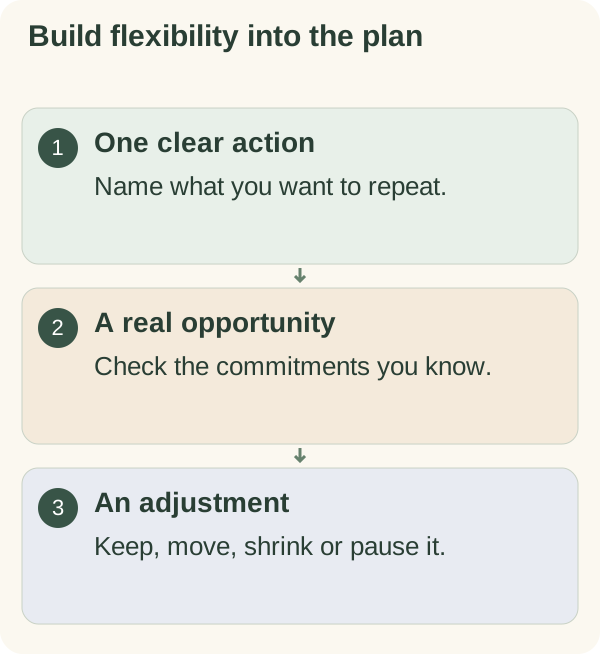
Five minutes when the rota lands is usually enough. If the schedule changes again, repeat the steps for the days that moved, not the whole week.
Example: Daniel on rotating shifts
A fictional example, written to show the steps in practice. Daniel works a rota that moves between early, late and night shifts, published two weeks at a time. He wanted to walk more and had tried a fixed 7 a.m. walk, which lasted until his first week of lates.
He changed the anchor to "after I get home from any shift and change my shoes". His full version was a walk around the local park; his minimum was a walk to the corner shop and back. When each rota came out he marked the days: after early shifts, full; after lates, minimum; after nights, rest, because he went straight to sleep.
The first fortnight showed one gap: on days off there was no "getting home from a shift". Daniel added a second anchor for those days, "after breakfast on a day off", and kept the full version. By the third rota he was placing the walk in a couple of minutes, and the walks happened on far more days than the fixed 7 a.m. plan ever managed. For anything about how much or how hard to exercise around night shifts, he left that to advice from his doctor.
An if-then cue sheet you can copy
Fill this in once, then use it each time your schedule changes.
HABIT: ______________________

ANCHORS
On work days, after: ____________________
On days off, after: _____________________

SIZES
Full version: ___________________________
Minimum version: ________________________
Rest days are: __________________________

IF-THEN RULES
If the day is long or late:  minimum
If the day is ordinary:      full
If I'm ill or exhausted:     rest, no catching up
If the anchor doesn't happen: ______________

PLACE IT WHEN: my schedule arrives on ________
REVIEW ON: ________
When you do not know your schedule until the day itself
Some people only find out their hours that morning: zero-hours contracts, on-call roles, caring for someone whose needs change suddenly. Planning days ahead does not work, and most advice does not cover it.
- If you get your hours on the day, move the placing step to that moment. When you hear your hours, decide in a few seconds: full, minimum or rest.
- If even the anchor is unpredictable, use "the first quiet moment" as the anchor and keep only the minimum version as the plan. Anything more is a bonus.
- If a daily habit is unrealistic, choose a number of times a week instead, and let the days fall where they can. Record which days it happened rather than tracking a streak.
- If caring duties interrupt without warning, pick a habit that can be stopped halfway without losing anything, such as reading or a walk near home.
- If your schedule changes are affecting your sleep or health, talk to a doctor or occupational health service. A habit plan works around a schedule; it cannot fix the effects of one.
Keep the plan and the result apart
A scheduled habit shows an intention; your record shows what happened. If there is no record, keep that uncertainty visible instead of assuming the habit was done or missed. Changing schedules make blanks more likely, and filling them with guesses makes the habit look less reliable than it is.
At each review, ask which part caused difficulty. Did the anchor not happen? Was the full version too big for that kind of day? Did the habit stop being useful? Choose one adjustment, or pause the habit.
Use the free habit tracker to explore a schedule on your own; it keeps rest days separate from days you have not recorded. For the bot's actual management controls, read Track a small habit in Telegram. If walking is the habit you want, a walking plan for people with changing schedules has more detail on that.
Build one small routine when you have chosen your next action. The conversation starter is something to review and paste yourself. It does not silently create a habit, save a health record or enroll you in reminders. The action and availability cards in the Small healthy routine worksheet let you compare the habit with the week you know about.
A habit that bends with your schedule is still a habit, and keeping one going through a changing week is exactly the kind of small, manageable step the habits and goals path sets out.
Questions people often ask
Is it really a habit if it happens at different times? Yes. What makes it a habit is the link to a cue you meet regularly, not the clock time. An anchor event gives you that link even when the hour changes.
What if I miss the anchor completely? Treat the day as a minimum-or-rest day and move on. You do not need to make it up later in the week.
How do I choose between a full and a minimum version on the day? Decide when the schedule arrives, not on the day, so there is nothing to argue with yourself about when you are tired.
Should I build more than one habit around my shifts? Start with one. Once it is placing itself easily in each new rota, a second habit can share the same anchor.